






Wix is best for businesses that want strong design flexibility, content, services, bookings, and eCommerce in one website. Shopify is better for merchants focused primarily on selling products, managing inventory, expanding across sales channels, and scaling store operations.
Wix and Shopify can both help me build an online store, accept payments, and sell products online.
But after looking at how both platforms have evolved, I would no longer compare them simply as a website builder versus an eCommerce platform.
Wix has developed much stronger eCommerce, SEO, and AI capabilities, while Shopify continues to focus heavily on commerce, inventory, payments, and multichannel selling.
My quick take: I would choose Wix when design, content, and services are just as important as selling online. I would choose Shopify when eCommerce is the main business, and I expect my store operations to become more complex.
But that’s an easy take; let’s go through my complete breakdown to know better.
My experience comparing Wix and Shopify for merchants

One thing I've learned while working with ecommerce businesses is that Wix and Shopify usually make sense for very different reasons.
When I look at a smaller business that needs a website first and ecommerce second, I can understand why Wix is attractive. The setup feels straightforward, and there's a lot of freedom around design.
But when I'm inside a Shopify admin reviewing products, orders, apps, and store operations, I can also see why merchants choose Shopify once selling becomes the center of the business.
So when someone asks me, "Wix or Shopify?", the answer is a little more complicated than a simple "this or that".
What is Wix?
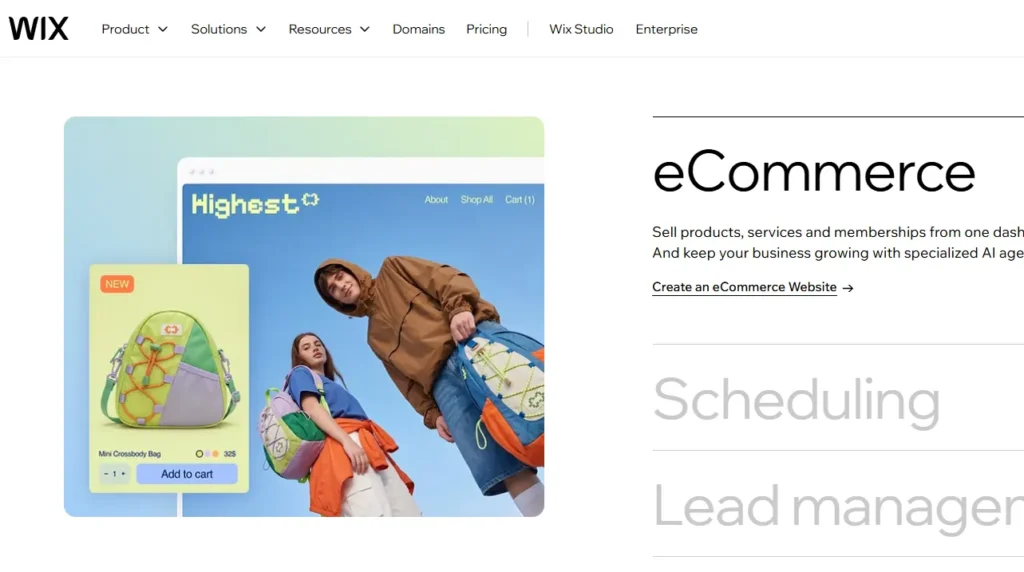
Wix is a hosted website builder that lets merchants create and manage a website without needing to code.
I can use its visual editor, templates, and AI website-building tools to create everything from a business website or portfolio to a complete online store.
For eCommerce, Wix now supports product management, payments, inventory, marketing, SEO, and online selling. Its Core plan is the first plan that lets me accept payments and includes basic eCommerce functionality.
Wix currently lists Core at $29/month when billed annually. Check out all Wix’s plans to find the right one for your business.
What is Shopify?

Shopify is a commerce platform built around selling products online, in person, and across different sales channels. I can use it to manage products, inventory, customers, orders, payments, shipping, and marketing from one system.
I would not describe Shopify as a platform only for big store owners. While it does have big brands like Gymshark and Allbirds, Shopify Basic is designed for solo entrepreneurs, while Grow, Advanced and Shopify Plus support increasingly complex businesses.
Wix vs Shopify comparison for ecommerce in 2026
| Feature | Wix | Shopify |
|---|---|---|
| Best for | Businesses combining content, services, and eCommerce | Businesses where eCommerce is the main operation |
| eCommerce starting price | Core: $29/month billed annually | Basic: $29/month billed annually or $39/month |
| Design | More visual drag-and-drop freedom | Commerce-focused theme system |
| eCommerce tools | Strong tools for small and growing stores | More commerce-focused tools for complex selling |
| Inventory | Suitable for standard eCommerce requirements | Better suited to increasingly complex inventory operations |
| Payments | Wix Payments plus supported third-party providers | Shopify Payments plus supported third-party providers |
| AI | Strong website creation, content, image, and marketing tools | Sidekick focuses heavily on commerce and admin tasks |
| SEO | Advanced SEO settings, URL controls, and structured data | Strong automatic technical SEO plus editable on-page settings |
| Apps | Wix App Market | Large commerce-focused Shopify App Store |
| Scalability | Can support growing and larger websites | Strong fit when commerce complexity increases |
Wix vs Shopify: Pricing and transaction fees in 2026
The current annual-billing prices for Wix (2026)
- Light: $17/month
- Core: $29/month
- Business: $39/month
- Business Elite: $159/month
You need Core or above to accept payments and use Wix's eCommerce functionality.
The current annual-billing prices for Shopify (2026)
- Basic: $29/month annually or $39 monthly
- Grow: $79/month annually or $105 monthly
- Advanced: $299/month annually or $399 monthly
- Plus: Starting at $2,300/month
So Wix Core and Shopify Basic currently have the same $29/month annual entry price.
For US online card payments, Shopify Payments currently starts at 2.9% + 30¢ on Basic, 2.7% + 30¢ on Grow, and 2.5% + 30¢ on Advanced.
If you use a third-party payment provider, Shopify lists additional transaction fees of 2%, 1%, and 0.6%, respectively.
Wix Payments currently charges 2.9% + $0.30 for standard US credit and debit card transactions excluding American Express. Other payment methods and situations can have different fees.
That is why I would compare subscription price + payment fees + apps rather than deciding which platform is cheaper from the monthly plan alone.
Wix vs Shopify for SEO: Which is better?
Wix now lets merchants manage:
- Title tags and meta descriptions
- URL slugs
- Product and blog URL structures
- Canonical tags
- Structured data
- Robots meta tags
- Bulk SEO settings
Shopify automatically handles several technical SEO elements, including canonical tags, sitemap.xml, robots.txt, and SSL.
You can also edit page titles, descriptions, URLs, and image alt text.
So my verdict is a tie with different strengths. Wix gives me strong visible SEO controls, while Shopify gives me solid technical defaults designed around an eCommerce site.
Wix vs Shopify AI features in 2026
AI now deserves its own place for both these platforms.
Wix uses AI heavily during website and store creation. I used it to generate a site, create product descriptions, edit product images, generate marketing emails, and improve SEO metadata.
Shopify's Sidekick takes a more commerce-focused approach. I asked it to analyze store data, manage orders, edit products, generate content, build apps, and work with third-party apps. Shopify also lets me review changes before they are applied.
My take: I would lean toward Wix when I want AI to help with website creation and presentation. I would lean toward Shopify when I want AI involved in everyday commerce operations.
Wix vs Shopify for dropshipping: Which is better?
Both Wix and Shopify support dropshipping, so I would not rule out either platform.
Wix lets me connect dropshipping services such as Modalyst, Spocket, Printful, and Printify, add supplier products to my store, and let the supplier handle fulfillment.
It also supports print-on-demand and ready-to-sell dropshipping products directly through its eCommerce ecosystem.
Shopify gives me more ways to build a dropshipping operation. I can use dedicated dropshipping apps, work directly with suppliers, or use Shopify Collective to source products from other Shopify brands with synchronized pricing and inventory. Shopify also has a dedicated dropshipping category in its App Store.
Because of that wider supplier and app ecosystem, I would choose Shopify for a business focused primarily on dropshipping or planning to scale its product sourcing.
Wix vs Shopify for small business: Which one should you choose?
Small businesses usually choose between Wix and Shopify based on their current goals.
- Wix works well for businesses that need a professional website with basic ecommerce features
- Shopify is better suited for businesses where selling products is the primary focus.
If you run a service-based business, or sell a limited number of products, Wix can be a practical choice. Its drag-and-drop editor makes it easier to create a branded website without much technical experience.
Shopify is a stronger option for small businesses that want to build a dedicated online store. It offers better inventory management, more ecommerce-focused features, a larger app ecosystem, and tools that help businesses scale.
| Feature | Wix | Shopify |
|---|---|---|
| Best for | Service businesses, creators, and small stores with fewer products | Product-based businesses focused on ecommerce growth |
| Ease of use | Simple website builder with flexible design controls | Easy ecommerce setup with tools built around selling |
| Inventory management | Suitable for smaller catalogs | Advanced inventory and order management |
| Payment options | Supports online payments with built-in tools | Extensive payment options and ecommerce features |
| Apps and integrations | Good selection for basic business needs | Larger ecosystem for marketing, sales, and automation |
| Scaling | Better for smaller ecommerce operations | Better for growing stores and higher sales volume |
For most small businesses that are testing ecommerce, Wix can be enough to get started. However, if you expect your store to grow, manage more products, run marketing campaigns, or need advanced ecommerce functionality, Shopify provides a stronger foundation.
Choose Wix if:
- You primarily need a website with some ecommerce functionality.
- You sell a small number of products or services.
- Design flexibility is more important than advanced selling tools.
Choose Shopify if:
- Selling products online is your main business goal.
- You need better inventory, order, and customer management.
- You plan to scale your store over time.
Ready to move your store from Wix to Shopify?
If Shopify is the right fit for your ecommerce goals, working with an experienced Shopify migration agency like Identixweb can help you move your products, customer data, and store settings safely without affecting your business operations.
From migration planning to post-launch optimization, we handle the technical process so you can focus on growing your store.
Wix or Shopify: Who's the winner?
After comparing the two platforms, this is how I would make the decision.
I would choose Wix if:
- My website needs strong design freedom.
- Content, services, bookings, or portfolios are as important as products.
- My eCommerce operation is relatively straightforward.
- I want a visual website builder with built-in business tools.
- I want AI to help heavily with website creation and marketing.
I would choose Shopify if:
- Selling products is the main purpose of my website.
- I expect inventory and order management to become more complex.
- I want to sell through multiple commerce channels.
- I expect to rely heavily on commerce-specific apps.
- I want a platform designed to grow with more sophisticated retail operations.
Here are a few more comparison blogs if you are choosing an e-commerce platform in 2026.
FAQs
1. Is Shopify better than Wix?
For an ecommerce-focused business, I would choose Shopify because it is built specifically around products, inventory, orders, payments, apps, and multichannel selling. Wix is a stronger choice when the website also needs substantial content, services, bookings, or more flexible page design alongside ecommerce.
2. Wix or Shopify, which is better for small businesses?
I would choose Wix for a small business, especially when services, content, or website design are equally important. I would choose Shopify for a small business built primarily around selling products, particularly if it expects its inventory, sales channels, or store operations to become more complex.
3. Can I transfer my Wix website to Shopify?
Yes, but it is called a migration rather than a website transfer. Shopify supports moving Wix products and customers through CSV imports or its Store Migration app for eligible stores. The storefront design and some content usually need to be rebuilt or transferred separately.
4. Can I connect Wix to Shopify?
Yes. Shopify currently lets merchants create a Buy Button or product collection in Shopify and embed it on a Wix website, so you can manage products through Shopify while keeping your Wix site.
About the author
Bhavesha Ghatode
Explore Content with Bhavesha, a passionate and dedicated technical content writer with a keen understanding of e-commerce trends. She is committed to sharing valuable insights, practical assets, and the latest trends that can help businesses thrive in a competitive environment.