




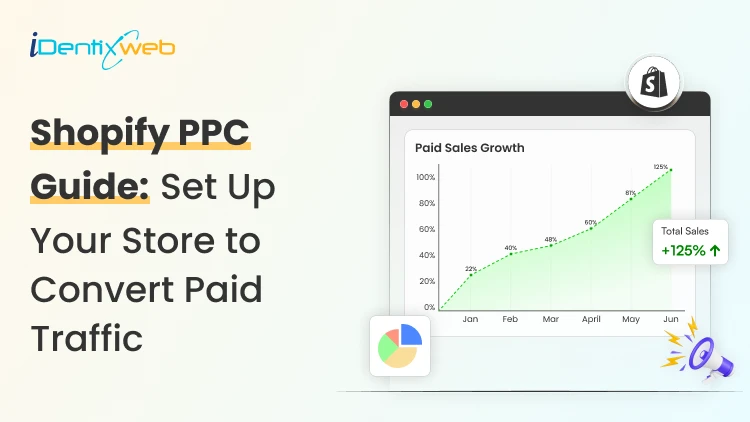

Shopify PPC refers to pay-per-click advertising campaigns run by Shopify store owners across platforms like Google, Meta, Microsoft Ads, Pinterest, and TikTok. Advertisers pay only when a user clicks their ad. Shopify's native integrations with these platforms automate catalog syncing, conversion tracking, and dynamic ad creation, giving Shopify merchants a technical foundation that many other ecommerce platforms do not offer out of the box.
Paid ads can be the fastest way to grow a Shopify store. They can also be the fastest way to burn through a budget with nothing to show for it.
The difference between the two almost always comes down to how the campaign is built, managed, and connected to the rest of the store's conversion stack.
PPC for Shopify works. But it rewards merchants who treat it as a system, not a shortcut. Here is how to build that system properly.
What is Shopify PPC & why it works differently
Shopify PPC (pay-per-click advertising) means running paid ads across platforms like Google, Meta, Microsoft, and TikTok, paying only when someone clicks.
If a thousand people see your ad but none click, you pay nothing.
What makes PPC for Shopify websites distinct is Shopify's native integration with the major ad platforms. Your product catalog syncs automatically to Google Merchant Center and Meta. The Meta Pixel and Google conversion tag install without manual coding. Any product change you make in your Shopify admin (price, stock, title) propagates to your ad feeds in real time.
The result is that Shopify merchants have access to richer, real-time product data in their ad accounts than most competitors running on other platforms.
Is your Shopify store ready for PPC? Check this first
Before spending anything on ads, run through this readiness check:
- Conversion rate: The typical ecommerce store converts between 2% and 3% of sessions. If yours is significantly below 1%, paid traffic will not fix that. It will expose it, at scale.
- Product page quality: Every product your ads link to needs clear, high-resolution images, benefit-focused copy, visible social proof, and an obvious path to purchase. If someone clicking from an ad has to work to understand what they are buying, they will leave.
- Mobile experience: A large share of paid ad traffic lands on mobile. Test your product pages and checkout on actual mobile devices.
- Average order value relative to CPC: Work backwards from your margin. If your AOV is £60 with a 35% gross margin, your maximum allowable CPA is £21. At a 2% store conversion rate, that means your maximum CPC cannot exceed £0.42. If CPCs in your category run £1.50 and above, paid search will not be profitable without first raising your AOV or conversion rate.
How does PPC advertising work on Shopify?
Every time an ad slot becomes available on a search results page, a social media feed, or a product listing, the platform runs an auction in real time. Your ad wins or loses that auction based on three inputs.
Your bid
The maximum amount you are willing to pay per click or action. On Google, you set this via bidding strategies. On Meta, it is a daily or lifetime budget with optional bid caps.
Ad quality
Google assigns a Quality Score to every ad based on expected click-through rate, relevance to the user's search, and the landing page experience. A higher Quality Score means a lower effective cost per click for the same position. Meta uses ad relevance diagnostics that function similarly: higher-relevance ads cost less to reach the same audience.
Competition
The more advertisers bidding on the same keyword or audience, the higher the price. High commercial intent queries like "buy [product] online" carry significantly higher CPCs than broader or informational searches.
Here are the core metrics to track across any PPC campaign for Shopify websites:
| Metric | What It Measures |
| CPC (Cost Per Click) | What you pay each time someone clicks your ad |
| CTR (Click-Through Rate) | Percentage of ad impressions that result in a click |
| CVR (Conversion Rate) | Percentage of clicks that turn into orders |
| CPA (Cost Per Acquisition) | What you pay per completed purchase |
| ROAS (Return On Ad Spend) | Revenue generated for every £1 spent on ads |
| Impression Share | Percentage of eligible auctions where your ad appeared |
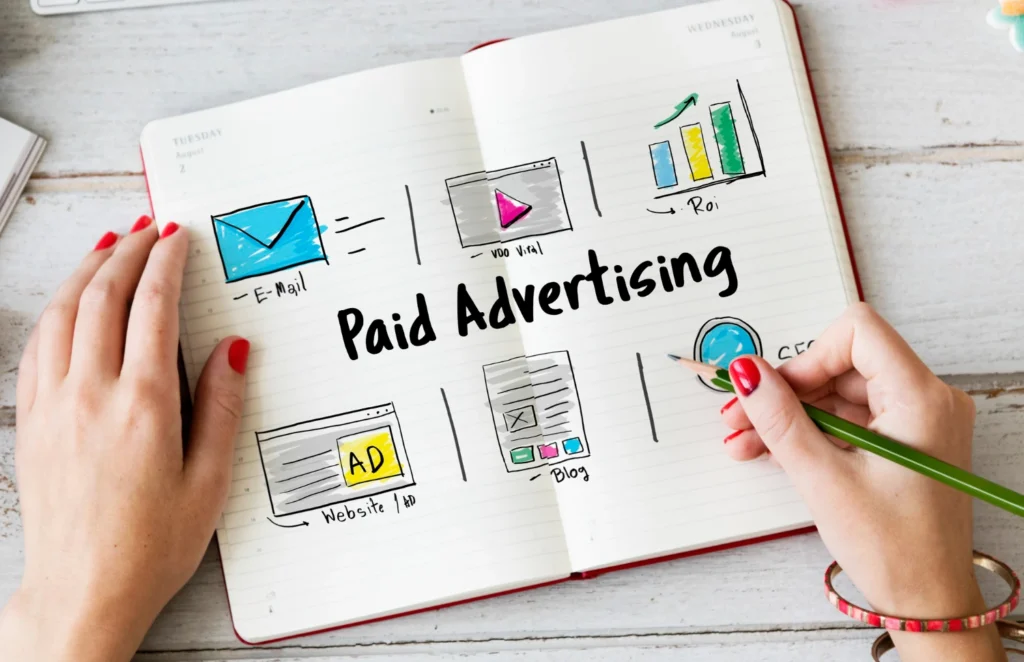
Where to run ads? Top platforms for Shopify PPC management
Choosing where to start should be based on where your ideal customer already spends time and what they are ready to do when they get there.
Google Ads
Google is the highest-intent PPC platform for most Shopify stores. When someone searches "waterproof hiking boots UK," they are actively looking to buy.
Your ad appearing at that moment positions you in the purchase path with minimal persuasion required.
Google Ads for Shopify encompasses four distinct formats:
- Search Ads target specific keywords. You write the headlines and descriptions; Google shows your ad when someone searches a matching query.
- Google Shopping Ads pull directly from your Shopify product catalog via Google Merchant Center. They display product images, prices, and your store name inside search results.
- Performance Max campaigns are Google's AI-driven format that distributes ads across Search, Shopping, Display, Gmail, Maps, and YouTube from one campaign. They require quality first-party data to optimize effectively: your product feed, customer lists, and Shopify conversion data.
- YouTube Ads work best for retargeting existing site visitors and building brand awareness for visually compelling products. They become valuable once you have enough conversion data to build lookalike audiences.
Meta Ads (Facebook and Instagram)
Meta's ad platform reaches users based on who they are and how they behave, rather than what they are searching for.
Users who have shown interest in sustainable home goods, recently browsed competing products, and fall in a specific demographic can all be layered into a single audience definition.
Facebook advertising mistakes, such as broad targeting with no segmentation or static creative that does not stop the scroll, account for the majority of wasted spend on Meta. Getting the basics right is more impactful than finding clever hacks.
One significant advantage exclusive to Shopify merchants is Shopify Audiences. The tool generates custom high-intent audience lists using aggregated purchase data from across the Shopify network, identifying users who have demonstrated real buying behavior for products similar to yours.
Microsoft Advertising (Bing Ads)
Bing reaches a smaller audience than Google, but often at 20 to 30% lower CPCs with meaningfully less auction competition.
The demographic skews slightly older and higher-income, which suits specific product categories well, particularly home goods, professional services, and premium items.
A key practical advantage: you can import your Google campaigns directly into Microsoft Ads, making launch fast and low-effort once your Google campaigns are structured properly.
TikTok Ads
TikTok has matured into a legitimate ecommerce channel, particularly for products targeting younger demographics.
It syncs with Shopify, enabling in-app product discovery and purchase. Creative requirements differ from other platforms: native-feeling, unpolished content performs better than polished advertising.
Production costs can be lower, creatives can feel more authentic, and audiences are genuinely open to discovering new brands mid-scroll.
How to set up your first Shopify PPC campaign
Step 1: Define a measurable goal
Every campaign needs one primary objective: drive purchases, capture leads, or build awareness. Your goal determines which bidding strategy you use, which ad format serves it, and what metric you measure success against.
Step 2: Sync your Shopify catalog
Install the Google & YouTube and Facebook & Instagram channel apps in your Shopify admin. These pull your product data into the respective ad platforms, enable dynamic creative, and configure conversion tracking without manual pixel implementation. Clean data here means clean attribution data from day one.
Step 3: Research keywords
- High-intent buying terms: Searches like "[product] buy," "[product] price UK," "[product] free delivery." Users searching these phrases are close to purchasing.
- Long-tail keywords: Specific phrases like "men's waterproof trail running shoes size 10." Lower search volume, far less competition, and users who know exactly what they want typically convert at higher rates.
- Negative keywords: Just as important as your target keywords. A store selling premium dog food should exclude "homemade dog food" and "free dog food samples" from the start.
Step 4: Write ads that pre-qualify the click
Effective ad copy does two jobs simultaneously:
- It attracts buyers who are genuinely interested
- It signals to everyone else that this ad is not for them.
Use headlines to communicate your key differentiator, whether that is next-day delivery, a current promotion, or a specific product feature. Ad extensions (sitelinks, price extensions, promotion extensions) add contextual detail without adding to your click cost.
Step 5: Match every ad to the right landing page
If someone clicks an ad for "navy linen chinos" and lands on a homepage, they do not have to search for the product.
Every ad should land on the most relevant destination: a specific product page, a tightly curated collection page, or a dedicated Shopify landing page built around the campaign's offer.
Match the headline, images, and offer between your ad and landing page exactly.
Step 6: Set a budget you can measure from
Use your AOV, gross margin, and target CPA to reverse-engineer a viable CPC:
- AOV: £80 | Gross margin: 40% | Maximum allowable spend per order: £32
- At a 2% store conversion rate: 50 clicks per sale
- Maximum viable CPC: £32 ÷ 50 = £0.64
If competitive CPCs in your keyword set run at £1.50, the math does not work without fixing either the conversion rate or the AOV first.
Planning your Shopify marketing budget around these numbers before launch prevents learning-phase losses from depleting your test budget before you have meaningful data.
Turn Paid Clicks Into Bigger Orders
With iCart, you can add cart upsells, product recommendations, free gifts, and progress bars to increase AOV without increasing ad spend.
Before you spend more on Shopify PPC, make sure every visitor has a reason to buy more.
Shopify PPC campaign optimization strategies
These Shopify PPC campaign optimization strategies apply across platforms, and when applied consistently, the compounding effect on ROAS is significant.
Audit your search terms weekly
Your keyword list tells the platform what to bid on. Your search terms report shows what it is actually matching to.
Review search terms weekly and add irrelevant, low-converting, or off-brand queries to your negative keyword list. On Google Shopping, where you do not set keywords directly, the search terms report is the primary lever for improving targeting precision.
Run A/B tests
Run two to three variants at all times per ad group and test one element at a time: headline A versus headline B, static image versus short video, benefit-led description versus feature-led description. Let each test reach statistical significance before deciding.
Make retargeting your highest-priority campaign type
Retargeting reaches people who already visited your store, viewed specific products, or added to cart without completing purchase.
Warm audiences convert at significantly higher rates than cold traffic because the intent is already established. The ad's job is to bring them back, not to create interest from scratch.
Shopify's catalog sync enables dynamic retargeting where ads automatically show each user the exact products they viewed, at the price they saw.
Segment campaigns by product margin
Not all products justify the same ad spend. High-margin products can sustain higher CPCs and more aggressive bidding.
Lower-margin products need lower CPAs or should not be in paid campaigns at all. Running separate campaigns for high-margin product lines gives you the budget control to spend where it pays.
How to measure PPC performance for Shopify stores
- ROAS (Return on Ad Spend): Revenue generated per £1 spent. A 3x ROAS is a common benchmark, but the right target depends on your gross margin. Calculate your breakeven ROAS before launch
- CPA (Cost Per Acquisition): What you pay per completed order. Track CPA at the campaign and ad group level. A high-ROAS product campaign, averaged with a low-performer, makes the account look mediocre.
- CVR (Conversion Rate): If your CVR drops below historical norms without a change in targeting, the problem is usually on-site: a checkout bug, a product page issue, or a new landing page that is not converting as well as the previous one.
- Impression Share: If impression share on your highest-performing campaigns is low (under 60%), you are leaving qualified clicks on the table.
Managing Shopify PPC campaigns over time
- Weekly: Review the search terms report and add negatives. Check spend pacing relative to daily budget limits. Flag any campaign where ROAS or CVR has dropped more than 15% week-over-week.
- Monthly: Evaluate creative performance and pause underperforming variants. Review audience overlap between campaigns. Adjust bids for seasonal demand patterns. Compare current month metrics against the prior 90-day average, not just the previous month.
- Quarterly: Audit the full campaign structure. Remove products that have dropped below viable CPA thresholds. Reassess platform allocation: should the budget shift from Meta to Google, or is there a case for testing Pinterest or TikTok for a specific product line?
FAQs
1. What is Shopify PPC?
PPC for Shopify refers to pay-per-click advertising campaigns run by Shopify store owners across platforms like Google, Meta, Microsoft Ads, Pinterest, and TikTok. Shopify's native integrations with these platforms automate catalog syncing, conversion tracking, and dynamic ad creation, giving Shopify merchants a foundation that many other ecommerce platforms do not offer.
2. How much does PPC cost for Shopify stores?
You set your own budget, and the platform charges per click. CPCs vary widely by platform and keyword competitiveness. Most new Shopify stores start with a monthly test budget of $400 to $1300 to generate enough conversion data for meaningful optimization.
3. Which PPC platform is best for Shopify?
Google Shopping is the highest-converting platform for product-based Shopify stores because it intercepts buyers with active purchase intent. Meta (Facebook and Instagram) is stronger for lifestyle and visually driven products.
4. What is a good ROAS for paid campaigns for Shopify stores?
A 3x ROAS is a common starting benchmark. A store with 40% margins breaks even at 2.5x ROAS; anything above is profit. A store with 20% margins needs 5x just to break even. Set your target ROAS above breakeven.
5. How long does PPC take to start working?
Most PPC platforms need two to four weeks to exit the learning phase and begin optimizing effectively. Google's smart bidding strategies require approximately 30 to 50 conversions per campaign before the algorithm has enough data to optimize bids.
6. Should I run paid campaigns or focus on SEO?
PPC delivers immediate traffic while SEO builds organic visibility over months. Growing Shopify stores benefit from both running in parallel: PPC for product launches, seasonal pushes, and high-intent acquisition; SEO for long-term category visibility and lower cost-per-visit over time.
7. What is Shopify Audiences, and how does it improve PPC?
Shopify Audiences is a tool exclusive to Shopify merchants that generates custom audience lists using aggregated purchase intent data from across the Shopify commerce network. It identifies users who have demonstrated real buying behavior for products similar to yours, rather than relying on demographic proxies.
8. What metrics should I track for Shopify PPC management?
Track ROAS, CPA, CVR, CTR, and impression share at the campaign and ad group level. Set up UTM parameters on all ad URLs to ensure Shopify Analytics attributes revenue to the correct source. Review the search terms report weekly. Also track AOV alongside your ad metrics: Increasing AOV often improves PPC economics faster than reducing CPC alone.
About the author
Vineet Nair
Vineet is an experienced content strategist with expertise in the ecommerce domain and a keen interest in Shopify. He aims to help Shopify merchants thrive in this competitive environment with technical solutions and thoughtfully structured content.