



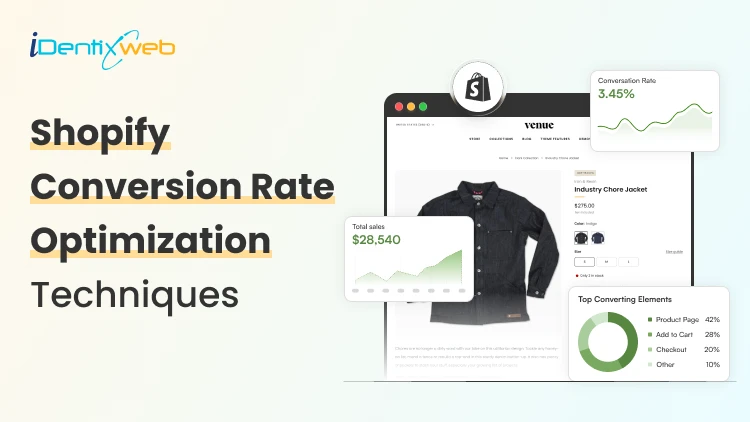
You're getting traffic to your Shopify store, but the sales just aren't matching up, right? If that sounds familiar, you're definitely not alone. This is exactly where Shopify conversion rate optimization steps in to change the game for your business. Most store owners pour money into ads and SEO, only to watch visitors leave without buying a single thing. The truth is, getting traffic is only half the battle, turning that traffic into paying customers is what actually grows your revenue.
In this blog, we'll walk through the best ways to improve your Shopify conversion rate, share real examples, and give you tools that actually work in 2026.
Let's get started.
What Is a Good Conversion Rate on Shopify?
Before diving into techniques, let's answer a question every merchant asks: what is a good conversion rate on Shopify?
Here's a quick breakdown based on industry data:
| Conversion Rate Range | Performance Level |
| Below 0.5% | Needs serious work |
| 0.5% - 1.5% | Average, room to grow |
| 1.5% - 3.5% | Good, above average |
| 3.5% and above | Excellent, top 20% |
"The average ecommerce conversion rate is between 2.5% and 3%. Even if you're doing everything right, you can still expect to win the sale around 2-3% of the time." - Shopify
So if your store is hovering around 1%, don't panic. There's a clear path forward, and the techniques below will help you get there.
Why Shopify Conversion Rate Optimization Matters
Think about it this way: if 1,000 people visit your store and only 10 buy, that's a 1% conversion rate. Now, if you double that to 2%, you've doubled your revenue without spending a single extra rupee on ads. That's the magic of Shopify conversion rate optimization.

Here's what good CRO does for your store:
- Reduces customer acquisition cost (CAC)
- Increases average order value (AOV)
- Improves return on ad spend (ROAS)
- Builds long-term customer loyalty
- Makes your marketing budget go further
10 Best Shopify Conversion Rate Optimization Techniques
Now let's get into the actual techniques. These are the strategies top Shopify stores use every single day to increase Shopify conversion rate and grow revenue.
1. Speed Up Your Store (Page Load Time Matters)
Did you know that a one-second delay in page load time can drop conversions by 7%? That's huge. Shoppers today expect pages to load in under 3 seconds, anything slower and they're gone.
Quick fixes to speed things up:
- Compress images using tools like TinyPNG or Shopify's built-in image optimizer
- Remove unused apps and code
- Use a fast, lightweight Shopify theme like Dawn or Sense
- Enable lazy loading for images and videos
Run your store through Google PageSpeed Insights to see exactly where you stand. Struggling with a slow store? Our Shopify website management team can audit your site, fix speed issues, and optimize everything from images to code.
2. Make Your Product Pages Convert Like Crazy
Your product page is where the buying decision happens. If it's weak, your conversions will be too.
Must-haves for a high-converting product page:
- Clear, high-quality product images (at least 5-7 angles)
- Short product video showing it in use
- Bullet-point benefits (not just features)
- Customer reviews with photos
- Trust badges near the buy button
- Clear shipping and return policies
A Baymard Institute study shows that 50% of users find product images more important than descriptions. So invest in great visuals.
3. Add Social Proof Everywhere
People trust people. When shoppers see others buying and loving your products, they feel safer hitting that "Add to Cart" button.
Types of social proof that work:
- Customer reviews and star ratings
- User-generated content (UGC) from Instagram
- "X people bought this in the last 24 hours" notifications
- Trust seals from secure payment providers
- Press mentions or media logos
4. Simplify Your Checkout Process
A complicated checkout is the number one reason people abandon their carts. The Baymard Institute reports that the average cart abandonment rate is 70.19%, and a long, confusing checkout is a top culprit.
How to fix your checkout:
- Offer guest checkout (don't force account creation)
- Show progress bars
- Display total cost upfront (no surprise shipping fees)
- Allow multiple payment options (UPI, cards, wallets, BNPL)
- Auto-fill address fields when possible
5. Use a Sticky Cart Drawer
A sticky cart drawer keeps the cart visible no matter where the shopper scrolls. It's like a gentle reminder that they're shopping, and it makes adding more items effortless.
Stores using sticky cart drawers see an average AOV increase of 15-20%. Why? Because customers can add more products without leaving their current page. Our iCart Cart Drawer Cart Upsell app does exactly this, plus it adds smart upsells, free shipping bars, and discount tiers right inside the drawer. Merchants using iCart have reported up to a 30% lift in average order value.
6. Show Delivery Dates Clearly
One of the biggest reasons shoppers hesitate is uncertainty about when their order will arrive. Showing a clear delivery date right on the product page builds trust and pushes them to buy faster.
Show estimated delivery dates, pickup options, and shipping windows. It's a simple way to reduce purchase hesitation and build buyer confidence.
7. Optimize for Mobile First
Over 73% of ecommerce sales now happen on mobile, according to Statista. If your Shopify store isn't mobile-friendly, you're losing out big time.
Mobile optimization checklist:
- Buttons should be thumb-friendly (at least 44px tall)
- Text should be readable without zooming
- Forms should auto-detect input types
- Images should load fast on slow connections
- Checkout should work smoothly on any device
10. Use Urgency and Scarcity (Honestly)
Urgency works because it taps into FOMO (fear of missing out). But please, only use it when it's real. Fake countdowns hurt your brand long-term.
Genuine urgency tactics:
- Show real low-stock alerts ("Only 3 left in stock")
- Display flash sale countdowns
- Highlight shipping cutoff times ("Order in the next 2 hours for same-day dispatch")
- Show real-time purchase notifications
Common Mistakes That Hurt Your Shopify Conversion Rate
Even with great products, these mistakes can sink your conversions:
- Ignoring mobile users
- Hiding shipping costs until checkout
- Using stock photos for product images
- Skipping customer reviews
- Forcing account creation before purchase
- Cluttered, distracting homepage
- Weak or missing CTAs
- No clear return policy
- Slow page speed
- Generic, copied product descriptions
If any of these sound familiar, fix them today. You'll see results faster than you'd expect.
Final Thoughts
Shopify conversion rate optimization isn't a one-time task, it's an ongoing process. The merchants who win are the ones who keep testing, learning, and improving every month.
Start with the techniques that match your biggest pain points. Maybe it's a slow store, a clunky checkout, or weak product pages. Pick one, fix it, measure the impact, and move on to the next. Small changes compound into big wins over time.
FAQs
1. What is a good conversion rate on Shopify?
A good conversion rate on Shopify is anything above 3.5%. The average sits around 1.4%, so if you're hitting 2-3%, you're already doing better than most stores. Top-performing stores reach 4.8% or higher with strong CRO.
2. How long does it take to see CRO results?
You'll usually see early results within 2-4 weeks of making changes. Bigger wins come over 2-3 months as you keep testing and refining. CRO is a long-term game, not a one-time fix.
3. Do Shopify apps really help with conversion?
Yes, the right apps can make a huge difference. Apps like iCart Cart Drawer Cart Upsell, Stellar Delivery Date & Pickup, and Sellmore Post Purchase Upsell directly target high-impact areas like cart, checkout, and post-purchase, where most conversions are won or lost.
4. What's the biggest factor that affects Shopify conversion rate?
Trust and clarity. If shoppers don't trust your store or can't quickly understand what you're selling and why it's worth buying, they'll leave. Focus on clear messaging, social proof, and a frictionless experience.

About the author
Sajini Annie John
Meet Sajini, a seasoned technical content writer with a passion for e-commerce and expertise in Shopify. She is committed to helping online businesses to thrive through the power of well-crafted content.