

Blog
Gather knowledge about the latest insights, updates, tips, and tricks in the Ecommerce industry.

5 Min • 20 March 2026
How Anua Unlocked 5X AOV Growth with iCart’s Smart Cart Features
delivery customization Challenges Solutions drive results Scale business delivery customization Challenges Solutions drive results Scale business delivery customization Challenges Solutions drive results Scale business delivery customization Challenges Solutions drive results Scale business Anua is a globally recognized Korean skincare brand known for its minimalist philosophy and focus on gentle yet effective formulations. Built on the idea of simplifying skincare routines, Anua develops products that deliver visible results while avoiding harsh or irritating components, making them suitable for sensitive skin types. Initially using a traditional full cart experience, Anua transitioned to iCart’s side cart solution in August 2025, to create a more seamless and engaging shopping journey. This shift allowed customers to easily explore complementary skincare products without disrupting their browsing flow, making it more intuitive to discover items that fit into a complete routine. By surfacing relevant recommendations directly within the cart, the brand enhanced product visibility across its range. Challenges Before implementing iCart’s side cart solution, Anua faced limitations with their existing full cart experience, which created friction in the customer journey. The traditional cart setup redirected users away from product pages, interrupting their browsing flow and reducing opportunities to explore additional products. As a skincare brand built around routines rather than single-item purchases, this made it difficult to effectively showcase complementary products and encourage customers to build complete regimens. Additionally, the lack of in-cart personalization and strategic upsell opportunities meant that customers were often unaware of related products that could enhance their skincare results. This limited the brand’s ability to increase average order value (AOV) and fully leverage its diverse product range. Anua needed a more dynamic and intuitive cart experience that could seamlessly introduce relevant recommendations while maintaining a smooth and engaging shopping journey. ❌ Cart Value Barriers Low average order value (AOV) due to single-item focus Most customers completed purchases with one primary product instead of building multi-step routines. Cart abandonment near shipping thresholds Customers were not clearly informed or motivated to reach free shipping or discount thresholds. Missed savings opportunities Customers were unaware of potential value in purchasing bundled routines or multiple complementary products. ❌ Absence of Progress-Based Incentives No free shipping or discount progress bar Customers were not motivated to increase their cart value due to lack of visible incentives. Missing tiered rewards system There were no structured milestones (e.g., “Spend more to unlock offers”), reducing upsell opportunities. ❌ Ineffective Cart UI/UX (Pre-Side Cart) Full-page cart disrupted shopping flowCustomers had to leave their browsing journey, increasing friction and drop-offs. No quick add/remove functionality Users couldn’t easily modify their cart or add suggested products without navigating away. Solution To overcome these challenges, Anua implemented iCart’s side cart solution to transform their traditional cart into a high-converting, interactive experience. By replacing the full-page cart with a seamless side cart, the brand ensured that customers could continue browsing while viewing their cart, significantly reducing friction in the shopping journey. Additionally, features like product recommendations & progress bars for free shipping and discounts motivated customers to increase their cart value. By combining personalization, incentive-driven messaging, and a user-friendly interface, Anua successfully turned their cart into a powerful revenue-driving touchpoint rather than just a checkout step. To maximize their cart effectiveness, they implemented two powerful features: ✅ Progress Bar with Multi-Reward Incentives Implemented a tiered progress bar to encourage higher cart value Customers are guided with a clear message like “Add $3.10 to unlock secret offer,” motivating them to continue adding products. Generated over $5M+ in revenue through incentive-driven cart progression Used product-based rewards to align with customer intent Instead of generic discounts, Anua incentivized purchases with relevant skincare items like Dark Spot Pads and mini serums. Built visual motivation for routine expansion As customers add products, they can clearly track progress toward unlocking multiple rewards, encouraging them to build a complete skincare routine. ✅ Product Recommendations Implemented “Frequently Bought Together” recommendations Customers adding a single product (e.g., toner) are shown complementary items like serums, moisturizers, or pads to complete their routine. Generated over 275K revenue through in-cart recommendations Encouraged full skincare regimen building Instead of isolated purchases, the cart suggests step-by-step product combinations aligned with common skincare routines. Increased product discovery at the final stage By surfacing relevant items directly in the cart, Anua ensured customers explore more of their catalog without leaving the checkout flow. Results Achieved in Last 180 Days 22932 Total Store Orders 45101 Total iCart Orders 5X iCart Generated AOV 65.70% Upsell Affected Conversion Rate These improvements reflect a clear shift in customer behavior on Anua’s store. Cart abandonment reduced as shoppers discovered complementary skincare products and felt encouraged to build complete routines. Engagement also increased, with customers interacting more with in-cart recommendations and exploring relevant product pairings. Results & Impact And...Results is Our Main Clarification By implementing iCart’s cart drawer, product recommendations, and progress bar, Anua transformed its cart into a high-performing conversion touchpoint. Shopping Experience Enhancement The improved cart experience encouraged customers to discover complementary products and understand the value of sustainable beauty routines. For instance, the clear presentation of subscription savings alongside one-time purchase options helped customers make more informed decisions about their long-term hair care needs. As Anua continues to optimize its cart experience, the brand is closely monitoring: Routine-based purchasing behavior - tracking how customers move from single items to multi-step regimens Engagement with in-cart recommendations - measuring interaction with suggested products Cart value progression - analyzing how incentives influence higher spending [related_cases_slider] Ready to Write Your Success Story? Try icart App Join successful businesses like Anua and Master your delivery scheduling Delight customers with precise timing Grow your special occasion orders Expand your delivery reach
Read Blog
12 Min • 18 September 2026
Squarespace to Shopify Migration: A Step-by-Step Guide From Someone Who Has Done This Before
Migrating from Squarespace to Shopify requires auditing your existing store, exporting and formatting data, importing products and customers, rebuilding the storefront, replacing apps. You also need to set up payments and shipping, map old URLs, create SEO redirects, test checkout and customer flows, and monitoring traffic, sales, and technical issues after launch. A Squarespace store can take you far, but many businesses eventually reach a point where they need more ecommerce flexibility, advanced features, and room to scale. That is when Shopify becomes a natural next step. But migrating from Squarespace to Shopify is not just about copying products from one store to another. A successful migration involves data mapping, storefront rebuilding, URL redirects, customer and order data, app replacements, SEO checks, and thorough testing before launch. The important part is getting the order right. Some decisions need to be made before you export your data, while others can create problems if they are left until after the new Shopify store goes live. This guide walks through the Squarespace to Shopify migration process step by step, including what to prepare, what needs to be transferred or rebuilt, what to check before launch, and what to monitor after your Shopify store is live. Common methods to migrate from Squarespace to Shopify There is no single migration method that works for every Squarespace store. The right approach depends on your catalog size, the type of data you need to move, your existing integrations, and how much of the new Shopify store needs to be rebuilt. CSV export and import CSV export and import is the method I recommend for most small and mid-size stores. You can export your products, customers, and orders from Squarespace, reformat the files to match Shopify's templates, then import them through your Shopify admin. Third-party migration apps Third-party migration apps like Migration Pro can automate this process. I always tell people to double-check compatibility first. Shopify's own free Store Migration app currently also supports platforms like WooCommerce, Wix, Etsy, Square, and Squarespace. Hiring an agency For larger catalogs, complex stores, or businesses that cannot risk downtime, hiring a Shopify migration agency can make the transition smoother. An experienced team handles data migration, SEO redirects, app setup, testing, and launch support while ensuring your store moves without losing important customer and business data. If you want experts to handle the entire process, Identixweb’s Shopify migration services help businesses move from platforms like Squarespace, WooCommerce, Wix, and other custom platforms with minimal disruption. A Squarespace migration is more than a data transfer A migration isn't always about fixing a poorly performing store. A business may already be generating sales and still reach a point where its existing platform makes growth or day-to-day management harder. For example, just recently I had a conversation with a store with a growing catalog. They needed more control over its ecommerce functionality, checkout experience, integrations, or customer journey. In that situation, simply reproducing the existing website on Shopify misses part of the purpose of the migration. The migration should begin by identifying the parts of the existing store that need to be preserved, the functionality that needs to be recreated, and the areas that can be improved during the rebuild. That means reviewing the store structure, mapping important URLs, identifying integrations and customer workflows, and deciding what should be migrated as-is versus redesigned for Shopify. This is why it is useful to approach a Squarespace to Shopify migration as a controlled store rebuild, not just a platform switch. How to migrate from Squarespace to Shopify step by step Step 1: Audit your Squarespace store before migrating Before exporting anything, create a complete inventory of your existing Squarespace store. Make a list of your products, collections, pages, blog posts, images, customer data, and important URLs. This helps you separate three things: What needs to be migrated What needs to be rebuilt What can be removed or improved It is also the right time to remove outdated products or content that you no longer want to carry forward. Step 2: Create your Shopify store and prepare the setup Create your Shopify account and configure the basic settings before importing any data. Set up your store preferences, payment methods, shipping settings, taxes, and customer account options. This is also a good time to select a Shopify theme and plan how your new storefront will be structured. Your Squarespace design will not transfer automatically, so having a clear layout plan makes the rebuilding process much easier. Step 3: Export your Squarespace store data Squarespace allows you to export important store data that can be moved to Shopify. Depending on your store setup, this may include: Product information Customer details Order records Website content Blog posts Export these files carefully and keep a backup of your original Squarespace data before making any changes. Step 4: Format your data for Shopify Shopify uses a different structure than Squarespace, so exported data needs some cleanup before importing. Product fields need to be mapped correctly, including converting Squarespace product URLs into Shopify Handles, restructuring categories into Shopify product types or collections, and converting product weights into Shopify’s required gram format. Take time to review product titles, descriptions, variants, images, and inventory details before importing. Step 5: Import your products into Shopify Once your product data is ready, upload the CSV file through Shopify Admin under Products > Import. Avoid publishing products immediately. Import them as drafts first so you can review everything before customers see them. Check product images, pricing, variants, inventory, and descriptions carefully. Check: Product images Pricing Variants Inventory Product descriptions Product types and collections URLs and handles If you are migrating a large catalog, it is also useful to review a sample of imported products across different product types rather than checking only a few similar products. This can help uncover mapping problems that may affect only certain products or variants. Step 6: Migrate customers, orders, and reviews Product migration is the easiest part. Customer accounts, order history, and reviews require additional attention. Customer information can be imported into Shopify from Customers > Import. Note: Passwords cannot be transferred because platforms store them differently. Customers may need to activate their accounts again after migration. Squarespace reviews cannot be directly exported, so you will need a Shopify review app to rebuild your social proof. Historical orders also require third-party migration tools because Shopify does not support direct order imports through a standard CSV file. Step 7: Rebuild your Shopify storefront and pages Your Squarespace theme will not move to Shopify, which means your storefront design needs to be recreated. Rebuild important pages such as your homepage, product pages, collection pages, about page, and contact pages. Choose a Shopify theme that matches your brand style and customize it based on your customer journey. This is a good opportunity to improve your navigation, page speed, and conversion elements instead of creating an exact copy of your old store. Step 8: Install essential Shopify apps and configure features One of Shopify’s biggest advantages is its app ecosystem. After rebuilding your store, install the tools your business needs to improve customer experience and sales. Depending on your requirements, this may include: Product reviews Email marketing Search and filtering Upsells and cross-sells Loyalty programs Analytics tools The right apps can help replace missing Squarespace functionality and add features that support your store’s growth. Step 9: Set up SEO redirects and check search visibility SEO is one of the most important parts of any migration. Squarespace and Shopify use different URL structures, so old links need to be redirected properly. Create a redirect map that connects your existing Squarespace URLs with their new Shopify URLs. Transfer important metadata, review indexed pages, and check that your high-traffic pages have a matching destination on Shopify. Step 10: Test everything before launching Before switching your domain, test your entire Shopify store as a customer would. Check: Product pages Search functionality Cart and checkout flow Payment methods Shipping rates Mobile experience Customer account access Redirects Place test orders and fix any issues before making your Shopify store live. A careful launch checklist can prevent problems that affect customers after migration. Coming from a different platform instead of Squarespace? The migration process changes depending on the platform you're moving from. If you're migrating to Shopify from another ecommerce platform, explore these related guides: Wix to Shopify migration WooCommerce to Shopify migration BigCommerce to Shopify migration Post-migration tips: Issues to solve after moving from Squarespace to Shopify Launching the Shopify store is not the end of the migration. The first few weeks are important for identifying issues that only become visible once real customers and search engines interact with the new site. Fix broken links and missing redirects One of the most common issues after migration is broken URLs. Since Squarespace and Shopify use different URL structures, some old pages may return 404 errors if redirects are not set up properly. Check your most visited pages, product URLs, and blog links. Create redirects for missing pages and regularly monitor Google Search Console for crawl errors. Don't only check whether a redirect exists. Make sure it points to the most relevant equivalent page rather than sending every old URL to the homepage. Check product data and images Even after a successful product import, some details may not transfer perfectly. Review your product catalog for missing images, incorrect variants, pricing errors, inventory mismatches, or formatting issues. For larger catalogs, use a sample-based review across different product types and then investigate any patterns you find. This is often more efficient than manually checking every field on every product. Review checkout and payment settings A change in platform can affect your checkout configuration. Test the complete buying journey, including adding products to cart, applying discount codes, selecting shipping options, making payments, and receiving order confirmation emails. Check your payment gateways, tax settings, and shipping rates to avoid issues for real customers. Rebuild missing features from Squarespace Some features available on your Squarespace store will not exist by default in Shopify. Identify any missing functionality and replace it with Shopify apps or custom solutions. This could include product reviews, advanced search, subscriptions, loyalty programs, bundles, or upselling features. The goal isn't to recreate every feature automatically. It is to make sure the new Shopify store supports the customer and business workflows that actually matter. Optimize your Shopify store after migration A migration is also an opportunity to improve your store instead of simply recreating your old website. Review your product pages, navigation, mobile experience, and conversion elements. Use Shopify’s ecosystem to add features that improve customer experience, such as cart upsells, personalized recommendations, and better product discovery. Monitor traffic and sales performance Keep tracking your store performance after launch. Compare your Shopify data with your previous Squarespace metrics to identify changes in traffic, conversion rate, and customer behavior. A temporary fluctuation is normal after migration, but consistent drops usually indicate issues with SEO, tracking, user experience, or technical setup. If performance drops, check SEO redirects, indexing, tracking, site speed, product availability, checkout functionality, and the customer experience before assuming the platform itself is responsible. Planning your Squarespace to Shopify migration? A successful Squarespace to Shopify migration is less about moving everything as quickly as possible and more about controlling what changes along the way. Start with a store audit. Map your data before importing it, rebuild the storefront around your current requirements, plan your redirects before launch, and test the customer journey before switching your domain. For straightforward stores, much of the process can be handled in-house. Larger catalogs, custom functionality, complex integrations, or stores with significant organic traffic may benefit from specialist migration support. Identixweb helps businesses plan and execute Shopify migrations, including data migration, storefront rebuilding, SEO redirects, integrations, testing, and post-launch support. FAQs 1. Why do store owners migrate from Squarespace to Shopify? Store owners move from Squarespace to Shopify when their ecommerce requirements become more complex. Common reasons include access to a broader app ecosystem, more flexibility for ecommerce functionality, greater control over the customer journey, international selling capabilities, and more options for extending the store as the business grows. 2. How do I migrate from Squarespace to Shopify? Start by auditing your Squarespace store and backing up your data. Export the information that needs to be transferred, prepare it for Shopify's data structure, import your products and customer information, rebuild your storefront, configure required functionality, and create redirects for important URLs. Before switching your domain, test the store, checkout, payment methods, redirects, and customer-facing functionality. 3. Will I lose my SEO rankings when I migrate Squarespace to Shopify? A platform migration does not automatically mean you will lose your rankings, but changes to URLs, content, internal links, indexing, and site structure can affect organic visibility. Create redirects for important old URLs, preserve valuable content and metadata, check your new site's indexing, and monitor Google Search Console and organic traffic after launch. 4. Can I migrate my Squarespace reviews to Shopify? No. Squarespace does not support exporting reviews. You will need to rebuild that section using an app like Judge.me, Loox, or Yotpo. 5. How much does it cost to migrate from Squarespace to Shopify? The cost depends on how much data needs to be transferred, the size of the catalog, the complexity of the storefront, custom functionality, integrations, SEO requirements, and whether the migration is handled in-house or by a professional team. A straightforward DIY migration may involve little more than your time and Shopify's own costs, while a complex migration can require development, design, data migration, SEO, and testing work. 6. What are the different methods to migrate from Squarespace to Shopify? You can migrate from Squarespace to Shopify manually using CSV exports and imports, use a third-party migration app, or hire a Shopify migration agency to handle the process end-to-end. The right method depends on your catalog size, store complexity, custom functionality, and how much of the migration you want to manage yourself.
8 Min • 31 July 2026
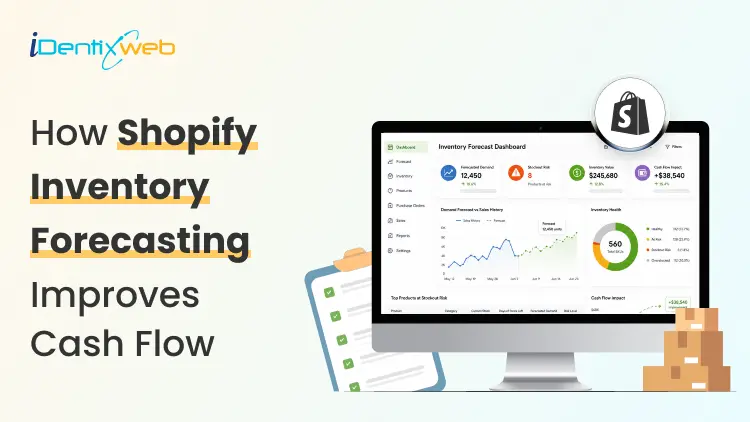
Complete Guide to Shopify Inventory Forecasting to Manage Cash Flow (+ Tools)
Shopify inventory forecasting is the process of estimating how much stock each product will need and when it should be reordered using sales history, supplier lead times, promotions, and current inventory levels. Accurate forecasting helps merchants avoid stockouts, reduce excess inventory, and keep more cash available for business expenses. Tools such as Sidekick, Prediko, Inventory Planner, and Assisty can automate inventory forecasting. If your ROI feels lower even when sales are good, your stock is usually the reason. Cash you've spent on inventory is cash you can't spend on ads, payroll, or the next order. Shopify inventory forecasting is working out how much stock you need and when to order it, so less of your money sits on a shelf. One thing worth knowing before anything else: Stocky, the free forecasting and purchase order app that came with Shopify POS Pro, stops working on August 31, 2026. If you order stock through Stocky, you've got a few weeks to sort out a replacement. What is Shopify inventory forecasting? Shopify inventory forecasting means predicting how many units of each product you'll sell over a future period. You use your sales history, supplier lead times, and whatever promotions you have planned. What you're after isn't the forecast itself. It's a list of purchase orders with dates and amounts against them. A forecast that never turns into an order hasn't done anything for you. Forecasting is really a cash question This is my philosophy: Stock is the biggest cheque you write and the slowest one to come back. You pay a deposit today, pay the balance six weeks later, pay duty when it lands, and only then do the units start selling. Every forecasting choice you make is a choice about how long your money is stuck. Two numbers tell you whether that's under control. Your cash conversion cycle The cash conversion cycle counts the days between paying your supplier and getting paid by your customer. CCC = Days Inventory Outstanding + Days Sales Outstanding − Days Payables Outstanding Days Inventory Outstanding is (Average inventory ÷ COGS) × 365. If you hold $120,000 of stock on average against $480,000 of annual COGS, that's 91 days. Days Sales Outstanding is quick for a normal Shopify store, since Shopify Payments in the US settles in about 2 to 5 business days. It climbs once you add wholesale on Net 30 or marketplaces with their own payout cycles. Days Payables Outstanding is how long your supplier lets you wait. On Net 30, that's 30. So: 91 + 3 − 30 = 64 days. Your money is tied up for a bit over two months on every dollar you put into stock. Most DTC brands land somewhere between 60 and 120 days, and under 60 is doing well. Pull these reports before you do anything else Go to Analytics > Reports and filter by Inventory. I look at four main reports here for forecasting. ABC product analysis grades every variant by how much revenue it brings in. A-grade products are the ones making up 80% of your revenue, B-grade the next 15%, C-grade the last 5%. It's worth knowing that the window is fixed for the last 28 days and you can't change it. If you sell seasonal products, run it at a few different points in the year instead of trusting one snapshot. Products by days of inventory remaining gives you days of stock left per variant, worked out from your average daily sales over the last 28 days. This is the best way to spot what's going to run out before your next delivery lands. Products by sell-through rate shows what share of available stock you sold in a period. There's about a two-day processing delay on it, so the newest data you can see is never today's. Month-end inventory value multiplies cost per item by ending quantity, which gives you your inventory cash position over time, and it's the number you need for the DIO calculation above. For a full walk-through of every report and what the columns mean, see my guide on how to pull a Shopify inventory report in 2026. How to do a Shopify inventory forecast? Clean up your sales history first Sales history and demand history aren't the same thing. Take out days when a product was out of stock, because zero sales that day tells you about your supply, not your demand. Check your product codes while you're in there. If one product exists under three different SKUs because of an old migration, you're splitting one demand pattern into three weak ones, and every forecast after that will be wrong. My guide on setting up SKUs in Shopify covers a naming system that survives growth. Split the catalogue with ABC Don't treat every product the same. Pull the ABC report and give each grade a different level of attention. A-grade products get looked at weekly and get tight reorder points. B-grade products get a monthly check. C-grade products get simple rules and a look every quarter. Create cash calendar Here’s something I do. Take each purchase order you're planning and put its payments on a calendar with real dates against them. An overseas order has four separate payments going out: the supplier deposit, often 30% up front, the balance when it ships, the freight, and then duty and customs when it lands. Lay twelve weeks out in a spreadsheet, one row per payment, and put your expected Shopify payouts in as money coming in. If any week goes red, you move an order, split it, or go back to your supplier about terms. Doing that once a month heads off nearly every cash crunch I see. Pre-orders flip the timing in your favour, since you're collecting money before you place the supplier order. You also get a real demand signal instead of a guess, which is worth almost as much. My walkthrough on setting up pre-orders on Shopify covers the setup and the apps. AI inventory forecasting on Shopify AI inventory forecasting on Shopify uses machine learning to find patterns across your sales history and outside signals that a spreadsheet formula would miss. It handles hundreds of products at once, retrains itself as new sales come in, and picks a different model per product without you telling it to. A model can spot that a product spikes three weeks after a particular campaign, or that two of your products eat into each other, without you knowing to look for it. Where I see it failing is bad data. Feed it sales history full of stockout periods, untracked variants and missing cost figures, and you'll get numbers that are wrong. Clean the inputs first. Sidekick sits in your admin. It can answer stock questions, flags what needs reordering and drafts the PO. It won't replace a proper demand planning tool if your forecasting is genuinely complicated. Inventory forecasting tools worth looking at in 2026 Prediko is a Shopify-native tool with SKU-level twelve-month forecasts, a buying table that tells you what to restock, a purchase order calendar and raw materials tracking. Pricing scales with your GMV from around $49 a month. Good fit for growing DTC brands. Inventory Planner This is a free-to-install app by Sage with usage-based pricing after that. It is strong on multi-location planning and automated replenishment. Cogsy This app is built around scenario modelling rather than one forecast. You can see where your stock lands under different growth assumptions. Assisty Assisty has AI forecasting and automated PO generation. Often the pick for people who want something that works without a long setup project. My guide to building a Shopify tech stack covers how the inventory category fits in your app stack. Where to start with forecasting in 2026 Shopify inventory forecasting gets much less complicated once you stop treating it as a math problem. Pull your ABC report and your days-of-stock report. Work out your cash conversion cycle. Redo safety stock on your ten biggest products. Most stores free up a decent chunk of money from that alone. FAQs 1. How to fix inventory not tracked in Shopify? Open Shopify Admin > Products, select the product or variant, and enable Track quantity in the Inventory section. Assign the correct stocking location, enter the available quantity, and save. For multiple products, use Products > Inventory or the bulk editor to enable tracking. 2. How do I add inventory to my Shopify store? Go to Products > Inventory, choose the relevant location, and enter the stock amount using Set to or Adjust by. You can also update quantities from an individual product or variant page, or import inventory in bulk using a CSV file. 3. Which is the best Shopify forecasting app? Prediko is currently a strong all-round option for growing Shopify brands, offering AI sales forecasting, purchase orders, inventory transfers, bundle planning, reports, and integrations with warehouses and 3PLs. Assisty is another great option with forecast demand with AI to predict future sales. 4. How much does Shopify forecasting cost? Shopify’s native demand-forecasting assistance through Sidekick costs nothing because Sidekick is included with Shopify plans. However, features and usage limits can vary. Dedicated forecasting apps cost extra; for example, Prediko currently starts at $49 per month, while simpler tools such as Assisty start at $19 per month. 5. Is Shopify good for inventory management? Yes. Shopify is suitable for most small and growing retailers. This is because it supports inventory tracking, location-based stock levels, adjustments, transfers, purchase orders, suppliers, sell-through reporting, and inventory-remaining insights.
9 Min • 26 October 2026
Shopify Conversion Rate Optimization: The BFCM 2026 Fixes That Matter Most
Black Friday is November 27. Cyber Monday is November 30. You have five weeks. Your ads, emails, and texts will send shoppers to your store, whatever you do. What decides your BFCM revenue is what those shoppers find when they land. That is the job of Shopify conversion rate optimization (CRO). Last year, Shopify merchants sold $14.6 billion over BFCM with an average cart of $114.70. At that volume. Why BFCM Traffic Converts Differently? BFCM shoppers don’t behave like your regular visitors. They arrive with a deal in mind, usually on a phone, and they leave quickly if anything feels off. Here’s what’s different about BFCM traffic: Most visitors land on a sale or product page from an ad or email, not on your homepage. Smartphones drove 56.4% of online holiday transactions in 2025, according to Adobe. Gift buyers want to know the gift will arrive in time and can be returned. Cross-border shoppers placed 16% of Shopify’s BFCM orders last year. Shop Pay was used on 32% of Shopify BFCM orders, so shoppers expect one-tap checkout. Step 1: Find the Biggest Leak in Your Shopify Conversion Funnel The first step in CRO for Shopify is finding out where shoppers leave your store. Before changing anything, check your conversion funnel in Shopify Analytics. Go to Analytics > Report > Conversion rate breakdown It follows visitors from session to add to cart, to checkout, to completed purchase. Compare your BFCM week from last year with the last 30 days, then split the numbers by device, traffic source, and landing page. Based on our experience, here are the reasons and their fixes. Where shoppers drop offWhat it usually meansStart withLow add-to-cart rate, worst on mobileShoppers can’t see the deal, price, or delivery date fast enoughProduct page fixesGood add-to-cart, few reach checkoutSurprise costs, or a cart that stallsCart fixesReach checkout but don’t buyPayment, form, or trust problemsCheckout fixesOne traffic source far below the restThe ad promises something the page doesn’t showLanding page match For example, let's take a store with 20,000 sessions. Of those, 1,400 add to cart, 560 reach checkout, and 380 buy, for a 1.9% conversion rate. Here the biggest problem sits between cart and checkout, since only 40% of carts make it through. Lift that to 50%, and you’d get 475 orders instead of 380. At last year’s average BFCM cart of $114.70, that’s roughly $10,900 more from the same traffic. Step 2: The Fixes, Stage by Stage Start with the stage your data points to. Every fix below can be done by mid-November without a redesign. 1. Make the landing page match the ad If someone clicks “30% off all serums,” the page they land on should say exactly that with the sale price showing. Send product ads to product pages and offer ads to a sale collection. See our Black Friday landing page examples for more ideas. 2. Show the deal and the delivery date on the product page Shopify applies automatic discounts in the cart and at checkout. Depending on your theme, your product page might still show the full price. Check it on a real phone. If the discount isn’t visible, add a sale badge or a compare-at price with the savings right next to it. Gift buyers also need a delivery date. Shoppers abandon checkout because delivery is too slow. Show an estimated arrival date and your holiday order cutoff on the product page. Above is a store using a delivery date calendar on their cart page. 3. Remove the cost surprise Unexpected costs are the top reason people walk away from checkout. Show your shipping costs or free shipping threshold in the cart. Set the threshold a little above your current average order value. If you sell abroad, show local currencies and duties through Shopify Markets. 4. Turn the cart into a place to decide A full-page cart pulls shoppers off your sale page. A slide-out cart drawer keeps them where they are. Show the discount they’ve unlocked, how much they’re saving, and how close they are to the next reward. Suggest one relevant product. Keep express checkout buttons inside the drawer. 5. Make checkout a one-tap job Turn on Shop Pay, Apple Pay, Google Pay, and PayPal, and show them on product pages and in the cart. Also, don’t force people to create an account. 6. Test every discount code on a phone Make sure to test every discount code you’re promoting on your phone. A code that fails at checkout costs you the sale. Check expiry dates, time zones, minimums, and discount combination settings. Our guide to Shopify discount combinations explains how they interact. 7. Check your page speed Run your key product pages and cart through Google PageSpeed Insights, especially on mobile. Compress large images, remove unused apps, and check for scripts slowing down your store. Test everything on a real phone. For more fixes, see our guide on what to check after installing Shopify apps. If the store already feels slow, see what to check after installing Shopify apps. Case study: How Anua turned its cart into an upsell engine In August 2025, Anua, the Korean skincare brand, moved its Shopify store off a full-page cart and onto iCart, our cart drawer app. BFCM was three months away, and their cart had three problems. The cart page sent shoppers away from the product they were looking at. Most people bought one product instead of a full routine, so order values stayed low. Nobody could see how close they were to free shipping or a reward either. A slide-out cart drawer replaced the cart page, and they upsell offers in the cart drawer itself. Anua’s cart drawer using iCart What we like most is the timing. The new cart went live in August, so it had months of real shoppers behind it by the time November traffic arrived. Results: $857,686.65 in store revenue during BFCM week Average order value: $116.81 Share of orders with an upsell added: 7342 Your 5-week BFCM Conversion Plan Here’s the plan we’d follow with five weeks left. DatesWhat to doOct 26 to Oct 30Check tracking and run your funnel auditNov 2 to Nov 13Make your fixes. Theme edits and new apps stop on Nov 13Nov 16 to Nov 20Test on real phones and place test ordersNov 20 to Nov 30No new ideas. Only fix what’s brokenNov 27 to Nov 30Watch your numbers live Shopify’s Rollouts feature helps here. It’s available on Basic and up. You can schedule your BFCM theme to go live on November 27 and switch back on its own after Cyber Monday. If your Shopify store has limited traffic, prioritize bigger improvements over small A/B tests. At a 2% conversion rate, detecting a 10% relative lift (from 2% to 2.2%) requires approximately 80,700 sessions per version. Most stores won’t get there in five weeks, and a hidden shipping cost doesn’t need a test anyway. Hold off on a new theme, a new payment provider, URL changes, or a batch of new apps until December. If your store already feels slow, here’s our guide on what to check after installing Shopify apps. What to Watch During BFCM Weekend Check a few numbers every few hours so you can fix problems the same day. Last year, Shopify sales peaked at 12:01 PM EST on Black Friday, so be around then. Watch revenue per session, not just conversion rate. A sudden increase in ad traffic can pull your BFCM conversion rate down even while revenue climbs. What you seeLikely causeQuick fixRevenue per session drops as sessions riseAd traffic landing on the wrong pageCheck top landing pages and pause the weakest ad setMobile add-to-cart rate fallsA product page is broken, slow, or sold outOpen your top five products on a phoneCheckout conversion dropsA payment method or code is failingPlace a test order Start With the Biggest Drop-off, Not the List Good Shopify conversion rate optimization before BFCM is mostly about orders. Check your Shopify Analytics and find the stage where you lose the most shoppers. Fix it, test it on a phone, and implement all your ideas by November 20. After Cyber Monday, compare your BFCM funnel with a normal month and keep what worked. Look beyond total sales. Check whether more shoppers completed checkout, whether your cart offers increased average order value, and which product pages performed better. These numbers will tell you what actually helped and what needs more work. BFCM lasts four days, but the improvements you make to your Shopify store should keep helping you convert shoppers long after the sale ends. FAQs 1. How early should I start conversion rate optimization before Black Friday? Six to eight weeks ahead is ideal. With five weeks left, audit now, finish changes by mid-November, and implement all the strategies in your store a week before Black Friday. 2. What is a good Shopify conversion rate during Black Friday? Anything between 3- 5% is good. Compare against your own BFCM week from last year, not an industry average. Revenue per session also tells you more than conversion rate during a sale weekend. 3. Why does my conversion rate drop on Black Friday when sales go up? Ads and deals on sites bring in lots of first-time visitors who are comparing prices. Sessions grow faster than orders, so the rate dips. Check conversion by traffic source to find the channel pulling it down and optimize it. 4. How do I check that my Shopify conversion tracking still works? Go to Shopify Admin > Settings > Customer events and use the Pixel Helper to test your tracking. Place a test order and check that the checkout completion event fires. Then verify the purchase event in GA4's Realtime report and Meta Events Manager's Test Events, if both platforms are connected.
![How to Mark a Product Sold Out on Shopify in 3 Steps? [2026]](https://www.identixweb.com/wp-content/uploads/2025/09/19-09-Fri-Blog-How-to-Mark-a-Product-Sold-Out-on-Shopify-in-3-Easy-Steps_.webp "How to Mark a Product Sold Out on Shopify in 3 Steps? [2026]")
Vineet Nair
5 Min • 19 September 2025
931 Views

Bhavesha Ghatode
6 Min • 18 September 2025
812 Views

Bhavesha Ghatode
7 Min • 12 September 2025
778 Views

Bhavesha Ghatode
5 Min • 12 September 2025
895 Views
![Best Black Friday Landing Page Examples + Template That Convert [2026]](https://www.identixweb.com/wp-content/uploads/2025/09/Black-Friday-Landing-Page-Examples.webp "Best Black Friday Landing Page Examples + Template That Convert [2026]")
Vineet Nair
11 Min • 12 September 2025
824 Views
Bhavesha Ghatode
5 Min • 12 September 2025
820 Views
Bhavesha Ghatode
7 Min • 11 September 2025
834 Views

Bhavesha Ghatode
6 Min • 10 September 2025
876 Views

Bhavesha Ghatode
7 Min • 8 September 2025
834 Views

Bhavesha Ghatode
7 Min • 5 September 2025
781 Views

Bhavesha Ghatode
6 Min • 5 September 2025
720 Views

Bhavesha Ghatode
6 Min • 5 September 2025
966 Views