



Shopify merchants sold $115.6 billion worth of goods in the second quarter of 2026 [Source: Yahoo Finance].
Sales on the platform grew more than 30% for the fifth quarter in a row. The money is there for the taking, but the question is how much of it reaches you.
I've spent years on calls with people starting Shopify stores. Most of them ask me how to use Shopify to make money without wasting months or savings.
Here’s a complete breakdown of how to use Shopify to make money. We update this every year with new trends and technologies, so save this if you are thinking of growing your brand.
Can You Really Make Money on Shopify in 2026?
Yes. Shopify is a proven e-commerce platform with many big brands on it, like Gymshark and Steve Madden, to name a few.
But it won't bring you customers on its own. This is not like Amazon, where you get a ready-made set of customers who pop in.
Here’s the simple difference. Selling on Amazon is like renting a stall in a busy mall. Shoppers are already walking past and searching for products. You pay for that crowd with a fee on every sale, and your listing sits right next to your competitors.
Amazon also owns the customer, so you can’t easily sell to those buyers again.
Shopify is like opening your own shop on a quiet street. The brand, the prices, and the customer list are all yours. But nobody walks in until you bring them in with ads, social media, search, or email.
Our Shopify vs Amazon comparison covers the fees and trade-offs in detail.
How to Use Shopify to Make Money Online: 6 Proven Models
We see six main ways people earn with Shopify right now. Pick one based on your budget, skills, and how soon you need income.
| Model | Startup cost | Margin | Best for |
| Your own products | Medium to high | High | Makers |
| Print on demand | Low | Low to medium | Designers |
| Dropshipping | Low to medium | 20% to 50% before ads | Marketers |
| Digital products | Very low | Very high | Experts and creators |
| Services and Partner work | Very low | High | Freelancers |
| Apps and themes | Medium | High once built | Developers |
1. Sell your own products

Your own brand gives you the most control over price and quality. It also needs the most cash, because you buy stock upfront. Start with a small batch and reorder only what sells.
2. Print on demand

A partner prints and ships each order after the customer pays. You never hold stock.
Margins are thinner, so your designs and your niche have to do the selling.
3. Dropshipping
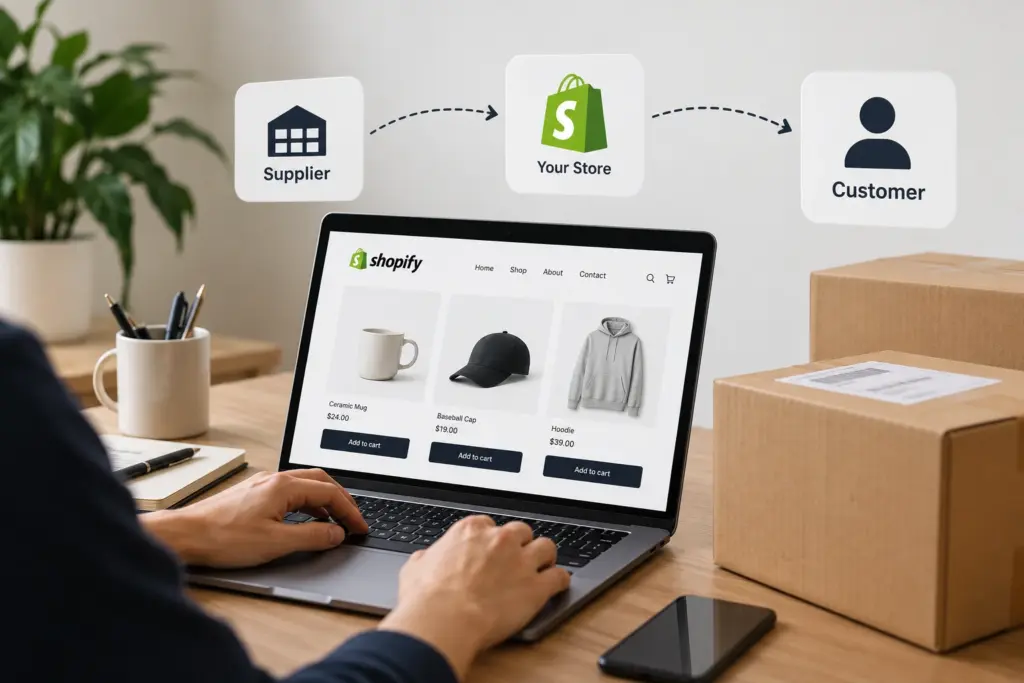
Suppliers ship straight to your customer. It's cheap to start but hard to stand out. We will explain more later in the article.
4. Digital products

Templates, guides, presets, and courses cost almost nothing to deliver. Shopify even has a free Digital Downloads app that handles delivery for you.
5. Services and Shopify Partner work

You don't have to sell products at all. Partners who build and launch a store earn 20% of its monthly plan fee plus 0.1% of eligible sales.
Payouts run for four years. Read more details regarding this on the Shopify Help Center.
6. Apps and themes

Smaller app developers keep 100% of their first $1 million in App Store revenue and 85% after that. Theme sellers keep 85%.
You can go through more details in the Shopify Help Center regarding this.
Is It Hard to Make Money on Shopify?
Starting is easy. Shopify offers a 3-day free trial plus 1$ per month for the next 3 months if you opt for monthly billing. Making a profit is hard, as with any business.
Most new owners badly underestimate what one customer costs.
Shopify's own merchant survey says the same. Customer acquisition was the top challenge in year one for 36% of merchants, as Shopify's dropshipping report notes.
Shoppers who add to cart often leave anyway. Baymard Institute puts average cart abandonment at 70.22%, and 40% of people who quit at checkout blame extra costs like shipping and tax.
So, yes, making money on Shopify takes work, especially when you're spending money to bring customers to your store.
That's where Identixweb's Shopify Store Setup Services can help. Our team helps you build a store that's easy to navigate, works smoothly on mobile, and makes shopping and checkout easier for your customers.
Why "make money fast" rarely works: A call we still think about
Last year we got on a call with a founder who had just quit his sales job. He wanted his Shopify store making $5,000 a month within 60 days. His total budget was $1,500.
His plan was a trending kitchen gadget he'd found on TikTok. He was also thinking about buying a store someone else had built. We told him what we tell everyone about prebuilt Shopify stores. They rarely come with the part that matters, which is traffic.
So we asked him three questions. Who buys this? What does one customer cost you? What do you keep per order? He couldn't answer any of them.

We did the math on the call. The gadget cost him $12. He planned to sell it for $34.99. Shipping was $5, and card fees on the Basic plan came to about $1.31. He'd keep $16.68 per order before ads. At around $23 per order from ads, he'd lose about $6.50 on every sale.
We did the math on the call.
| Cost Breakdown | Amount (USD) |
| Selling Price | $34.99 |
| Product Cost | −$12.00 |
| Shipping Cost | −$5.00 |
| Shopify Payment Processing Fees | −$1.31 |
| Profit Before Ads | $16.68 |
| Advertising Cost Per Order | −$23.00 |
| Net Loss Per Order | −$6.32 |
We changed three things. He cut the store down to one product line. He sold a two-pack bundle at $59, which left about $27 per order after product, shipping, and fees. And he spent his first month posting short videos instead of buying ads.
His first sale came in week three. His first month with real profit after ad spend came in month five. It was slower than he wanted. But he knew exactly why each order made or lost money, and that's what kept him going.
Can You Make Money With Shopify Dropshipping?
Yes, but in 2026, dropshipping looks very different from what it was a few years ago. Margins are thinner, shipping rules have changed, and generic products rarely win.
Shopify puts typical dropshipping margins at 20% to 50%, and your ad spend comes out of that.
Are you thinking about selling to US shoppers from overseas suppliers? Every cheap parcel now clears regular customs and can owe duties. Your costs go up, and delivery can slow down.
Here's what still works in my experience:
- Suppliers based in or close to your customers' country
- Private label or branded products, so you aren't selling the same listing as 500 other stores
- A narrow niche where you truly understand the buyer
- Honest shipping times shown right on the product page
My guide to dropshipping for beginners explains how to start a dropshipping business in 2026
New in 2026: Your Products Can Sell Inside AI Chats
Since March 2026, Shopify's Agentic Storefronts make merchants' products discoverable in ChatGPT by default.
Thousands of merchants already sell in Microsoft Copilot, and select brands have started selling in Google AI Mode and Gemini, per Shopify's announcement.
For a new store, that's an extra sales channel you manage right from your Shopify admin. The catch is that AI assistants read your product data.
Clear titles, detailed descriptions, real FAQs, and accurate policies all help.
Our guides on answer engine optimization for Shopify and the ChatGPT Shopify integration walk you through the setup.
A Simple Plan for Your First 90 Days
Here's the plan we give most new founders. The goal is to get real sales data before you spend real money.
Days 1 to 14: Set up simple
Shopify currently offers 3 days free, then $1 a month for your first 3 months. After that, the Basic plan costs $39 a month, or $29 a month billed yearly. Go through our guide on Shopify pricing plans to see what every plan includes.
Pick a free theme. Dawn and Horizon are both made by Shopify, cost nothing, and get regular updates. Sidekick, the AI assistant inside your Shopify admin, can draft product descriptions and images so you launch faster. Before you go live, place a test order. Check that checkout, shipping, taxes, and order emails all work.
Days 15 to 45: Get your first 10 orders
Don't pay for traffic yet. Sell through free channels first, like short videos, niche communities, and people you know who fit your buyer profile.
Talk to every early buyer. Ask why they bought and what nearly stopped them. Their answers will shape your product pages and, later, your ads.
If you'd rather not tie up cash in a big inventory, start with a single product store. Run through our conversion checklist for single product stores before you set up your single product store.
Days 46 to 90: Test ads with a clear limit
Before you run a single ad, work out your break-even cost per order. It's simply what you keep from one sale before ad spend. If you keep $27 per order, any ad that costs more than $27 per sale loses money.
Set a rule for yourself. When an ad spends double that amount without a sale, switch it off.
Start with a small daily budget. Change one thing at a time, like the image, the hook, or the offer.
Grow your order value without extra ad spend. Offer bundles, or set a free shipping threshold a little above your average order.
Collect emails from day one. Across 150,000 brands, automated emails made up just 2% of sends but drove 30% of email revenue, per Omnisend's 2026 Ecommerce Marketing Report.
Welcome and abandoned cart emails alone produced 76% of those automated orders, so set up those two first.
By day 90, you'll know your real cost per customer, your best product, and whether the store is worth scaling.
The Honest Way to Use Shopify to Make Money
If you want to know how to use Shopify to make money, start smaller than you think. Pick one model and do the math for your margins before you launch. Spend money only where your data says it works.
Shopify gives you the checkout, the hosting, and new channels like AI chat. Finding customers is still your job. Treat your first 90 days as a test, and let real orders tell you what to do next.
FAQs
1. How long does it take to make money on Shopify?
Most new stores take a few months to turn a steady profit. First sales can come within weeks if you already have an audience. Without one, plan for three to six months of testing.
2. Can you make money on Shopify with no money?
You can start with very little money. Shopify offers $1/month for the first three months in the US. After that, regular pricing applies, starting at starting at $39/month for Basic (29/month billed yearly). Use a free theme and sell print-on-demand or digital products without holding stock. You'll still need a budget for marketing and testing.
3. How much does the average Shopify store make?
There's no reliable public average. Stores range from weekend side projects to global brands, so any average would mislead you. Track your own net margin per order instead.
4. Is Shopify worth it for beginners in 2026?
Yes. If you're ready to market your store. Shopify handles checkout, payments, and hosting, and it now connects you to AI shopping channels. Your product and your traffic decide the rest.
5. Can you make money on Shopify without selling products?
Yes. You can offer services to merchants, join the Shopify Partner Program, or build apps and themes. Partners earn a recurring revenue share on stores they launch.
6. How much does it cost to start a Shopify store?
You can start a Shopify store for as little as $1/month during its three-month promotional period, after a 3-day free trial. A free theme keeps setup costs low, but you should budget for a domain, apps, transaction fees, and marketing. Your actual startup cost depends on what you sell and how you attract customers.

About the author
Vineet Nair
Vineet is an experienced content strategist with expertise in the ecommerce domain and a keen interest in Shopify. He aims to help Shopify merchants thrive in this competitive environment with technical solutions and thoughtfully structured content.