




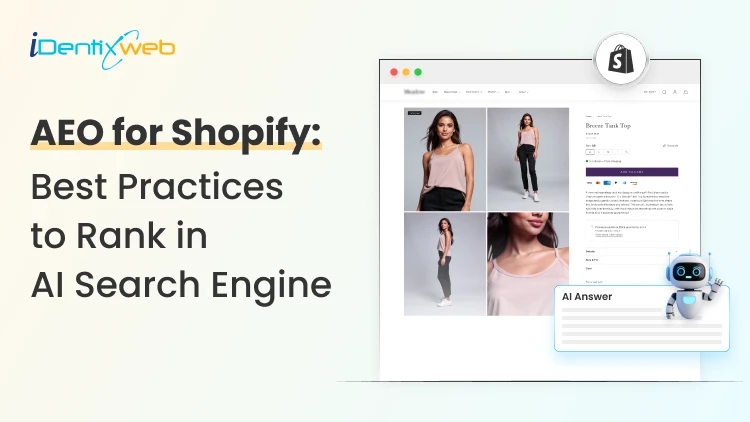
A few years ago, Shopify merchants only had to think about Google rankings, product page SEO, and blog traffic. Now, buyers go to ChatGPT and ask:
“What is the best product for oily skin?”
AI search engines do not show results the same way traditional Google search does. They read, compare, summarize, and recommend. For Shopify stores, that changes how content needs to be written.
AEO helps fix that.
Shopify’s answer engine optimization (AEO) best practices are about making your content easy for AI search engines, Google AI Overviews, ChatGPT, Gemini, Perplexity, and other answer engines to understand.
At Identixweb, we offer AI consulting services for merchants and have helped 300+ merchants worldwide. From that experience, I can say one thing clearly: Shopify stores that explain their products better have a stronger chance of being ranked in AI search engines.
What does AEO mean exactly?
AEO means Answer Engine Optimization. Answer engine optimization for Shopify stores is the process of improving your store content so answer engines can pick clear, useful answers from your website.
AEO helps your answer get selected when a buyer asks
“What is the best running shoe for flat feet?”
An AI answer engine may look at product pages, reviews, buying guides, FAQs, and trusted sources before giving a response.
If your Shopify store has clear product information, strong FAQs, real reviews, structured data, and helpful buying content, AI tools can understand your store better.
Why should Shopify merchants care about AEO?
Buyers are asking longer and more specific questions. They do not always search with short keywords anymore. They search with intent.
A new store may not have big brand authority yet. AEO gives that store a better starting point because it improves the quality of product content, FAQs, and buyer education.
For new Shopify stores, AEO is useful because it helps with:
- Better product understanding
- Stronger buyer trust
- Better long-tail keyword coverage
- Clearer collection pages
- More useful blog content
- Better chances of appearing in AI-generated answers
More AI Traffic Means More Chances to Upsell
Once AEO brings more ready-to-buy shoppers to your Shopify store, the next step is turning that traffic into higher-value orders.
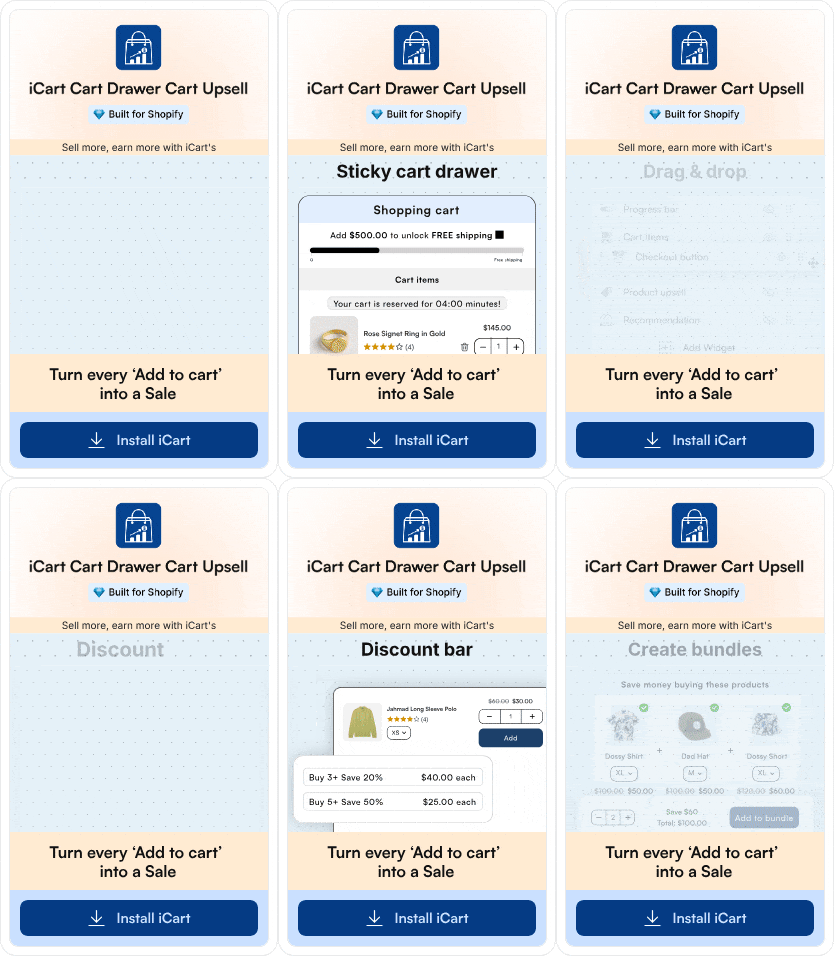
With iCart Cart Drawer Cart Upsell, merchants can show smart product recommendations, free gifts, progress bars, and cart upsells right inside the cart, helping increase AOV without disturbing the buying journey.
What is GEO?
GEO means Generative Engine Optimization. For Shopify stores, GEO means optimizing your brand and products so generative AI tools can discover, understand, mention, and recommend them.
How is GEO different from AEO?
While AEO focuses on answers, GEO focuses on AI-generated visibility.
For example, a buyer may ask:
“Which type of dress is best for summer?”
An AI tool may answer based on product pages, app listings, blogs, reviews, comparison pages, Reddit discussions, Shopify community answers, and trusted ecommerce publications.
GEO helps your brand become part of that answer. For merchants, GEO becomes more important when buyers use AI tools for research before reaching Google or your website.
Difference Between AEO vs GEO
| Point | AEO | GEO |
| Main goal | Help your content get selected as a direct answer | Help your brand get mentioned in AI-generated responses |
| Main focus | Clear answers and structured information | Brand visibility across AI search tools |
| Best for | FAQs, product answers, how-to queries, buying questions | Product recommendations, brand comparisons, and AI summaries |
| Shopify use case | Answer buyer doubts on product, collection, and blog pages. | Make your store discoverable in ChatGPT, Gemini, Perplexity, and Google AI Overviews |
| Content style | Short, direct, factual answers | Deep, trustworthy, well-connected content |
| Key signals | FAQs, schema, page structure, direct answers | Reviews, mentions, citations, authority, content depth |
Answer engine optimization (AEO) best practices for Shopify stores
1. Answer real buyer questions on important pages
Every key Shopify page should answer real buyer questions. That means your product page should not read like a short label. Ask yourself:
- What does a first-time buyer want to know?
- What can stop them from buying?
- What does customer support get asked again and again?
- What would an AI tool need to compare this product with another one?
For example, for a clothing store, answer questions about size, fit, fabric, washing, returns, and delivery. Keep answers short and direct so buyers can make a quick decision before purchasing.
2. Build product pages with complete information
Your product page should help buyers make a decision without opening five more tabs.
Google’s product structured data guidance also shows how useful product details can appear in richer ways across Search, including price, availability, ratings, shipping, and return information.
A simple product page structure can look like this:
| Product Section | What to Add |
| Best for | Mention the ideal customer or use case |
| Benefits | Explain what the product helps with |
| Specs | Add size, material, ingredients, or features |
| How to use | Give simple usage steps |
| Shipping | Mention delivery time and options |
| Returns | Add clear return policy details |
| FAQs | Answer purchase doubts |
3. Add helpful FAQs
FAQs are one of the easiest AEO improvements for Shopify stores. Do not add random FAQs only because they include keywords. Add questions your buyers actually ask.
Useful FAQ examples include:
- Is this product suitable for daily use?
- How long does shipping take?
- Can I return this product?
- What size should I choose?
- Is this compatible with my device?
- Can I use this with other products?
- What makes this product different?
Keep each answer within 2 to 3 sentences. AEO works better when the answer is easy to extract.
4. Use structured data for better search understanding
Structured data helps search engines understand your Shopify store. I usually check these schema types in Shopify stores as part of the best practices for AEO.
- Product schema
- Organization schema
- Breadcrumb schema
- FAQ schema
- Review schema
- Article schema for blogs
For ecommerce pages, Product schema matters a lot. It can help Google understand product name, price, availability, ratings, shipping, return policy, and product variants. Google also recommends adding ecommerce policy data, such as return policy, under Organization markup where relevant.
5. Create buying guides and comparison content
AI search engines often answer comparison-style questions. Shopify stores can use this as an advantage. Create content that helps buyers choose the right product. Buying guides work well because they match how buyers ask AI tools for help.
Here are some good content ideas that I always use:
- Product A vs Product B
- How to choose the right product
- Best products for a specific problem
- Gift guides
- Size guides
- Product bundle guides
- Category buying guides
6. Strengthen E-E-A-T across your Shopify store
Google’s helpful content guidance says its systems aim to reward content that helps people and shows experience, expertise, authoritativeness, and trustworthiness.
For Shopify stores, E-E-A-T should appear across the store. Trust signals are a key factor in E-E-A-T. A buyer has no reason to trust an unknown store unless the site gives them one.
AEO and E-E-A-T work together. AI search engines need signals that your content is useful and trustworthy. Buyers need the same thing before they place an order.
7. Make your content easy to read and extract
AI search engines prefer a clear structure. Buyers do too, so break your content into clear sections.
For example, in a product page, avoid a long description like:
“Our premium product is made with high-quality materials and designed for comfort, performance, and daily use.”
Write something more useful:
Best for: Daily wear, travel, and casual outings.
Material: 100% cotton.
Fit: Relaxed fit.
Care: Machine wash in cold water.
Shipping: Ships within 2 to 4 business days.
8. Optimize for long-tail conversational queries
AI search users ask full questions. Your content should answer those questions naturally.
Examples:
- Which moisturizer is best for dry skin in winter?
- How do I choose the right size for a linen shirt?
- What is the best gift for a coffee lover?
For Shopify's answer engine optimization AEO best practices, long-tail queries are important because they show buyer intent.
9. Build topical authority around your product category
AEO works better when your store covers a topic deeply. Build content clusters around your main product categories.
For example, a Shopify store selling protein supplements can create:
- What is whey protein?
- Whey protein vs plant protein
- Best protein powder for beginners
- How to choose protein powder
- Protein powder for muscle gain
- Protein powder for weight management
- Protein collection page
- Individual product pages
For a new store, topical authority helps Google and AI search engines understand what your brand is about.
10. Track AI search visibility
AEO needs tracking. You may not get perfect data from every AI tool, but you can still monitor progress. Do not use tools at first. Do manual prompt testing in ChatGPT, Perplexity, Claude, and Gemini.
For example, if you run a clothing store, pick 10 to 20 important buyer questions regarding your product and search in the AI tool. Once you see your store popping up in search engines, use a combination of GA4 and tools like SE Ranking or Semrush. For the AI side, pair those with AI visibility tracking tools to measure how often assistants mention and cite your brand over time.
11. Work with Shopify AEO specialists when needed
Answer engine optimization is not simple. You need technical knowledge to rank faster on AI search engines. A Shopify AEO specialist can help with:
- Product content audit
- Collection page optimization
- FAQ planning
- Schema audit
- Internal linking
- Technical SEO
- AI search visibility checks
- Content gap analysis
- Blog strategy
- Conversion-focused page structure
Best-rated AEO companies for Shopify, like Identixweb, help merchants with AI consulting, Shopify optimization, and ecommerce growth strategy. With 300+ merchants worldwide, we understand how store structure, content, apps, automation, and conversion strategy work together.
Use AEO best practices to rank your Shopify store
AEO is becoming a core part of Shopify SEO. It improves how your store answers buyer questions and helps AI search engines understand your products better.
From my experience, stores that explain their products clearly always have an advantage. AI search makes that even more important.
If your store gives better answers than your competitors, search engines will notice, and your traffic and conversions will increase.
FAQ
1. What are the best practices in answer engine optimization (AEO) for Shopify stores?
The best AEO practices for Shopify stores include writing clear product descriptions, adding helpful FAQs, using product schema, improving collection page content, and creating buying guides that answer real customer questions.
2. What is AEO?
AEO stands for Answer Engine Optimization. For Shopify stores, it means optimizing your product pages, blogs, FAQs, and store content so AI search engines can pick your content as a clear answer for buyer questions.
3. What is GEO?
GEO stands for Generative Engine Optimization. It focuses on helping your Shopify brand, products, and content appear in AI-generated answers from tools like ChatGPT, Gemini, Perplexity, and Google AI Overviews.
4. What are the benefits of AEO and GEO for Shopify stores?
AEO and GEO help Shopify stores improve visibility in AI search, answer buyer questions faster, build trust, and attract more qualified traffic. They also support better product discovery because AI tools can understand your products, compare them, and recommend them in relevant shopping queries.
5. What are the top AEO agencies for Shopify stores?
Identixweb, OneLittleWeb, SmartSites, and Coalition Technologies are some of the top AEO agencies for Shopify stores.
About the author
Vineet Nair
Vineet is an experienced content strategist with expertise in the ecommerce domain and a keen interest in Shopify. He aims to help Shopify merchants thrive in this competitive environment with technical solutions and thoughtfully structured content.