




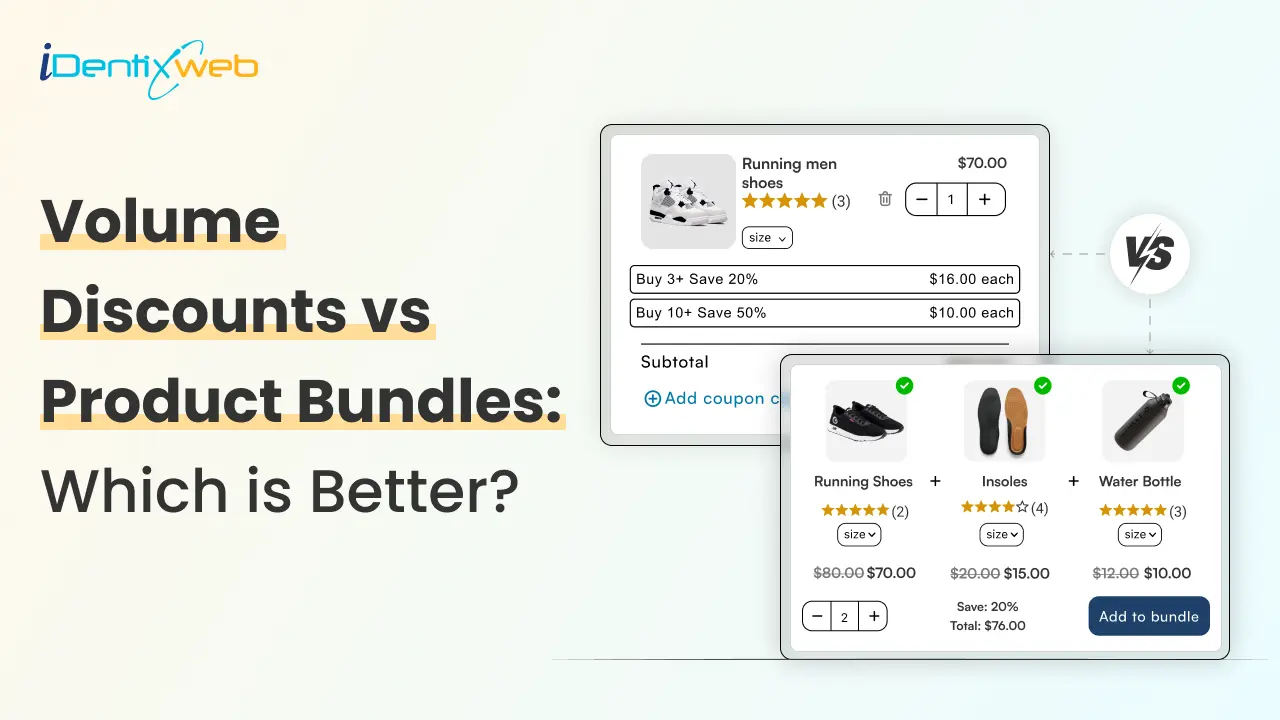
If you’re trying to choose between volume discounts and product bundles, as a Shopify expert, we can conclude volume discounts convert better. This is because when your customers already buy multiples items, the savings feel instant and straightforward. Bundles, on the other hand, shine when you want to increase AOV by pairing complementary products shoppers want to buy together.
Upselling and cross-selling are two of the most popular techniques used by Shopify store owners to increase conversions.
In this article, we will learn about two main techniques that businesses use when they upsell in Shopify: Volume discounts and Bundling.
However, for a majority of companies, it gets a bit tricky to decide when and where they should adapt to upsell on Shopify.
Comparison of Key Differences Between Discounting and Bundling
Both discounting and bundling are effective upselling strategies, but they serve different purposes and impact revenue in distinct ways. Here’s a quick comparison of their key differences:
| Features | Discounting | Bundling |
| Definition | Reducing the cost of a single item or service. | Combining multiple products/services in a bundle and selling at a single cost. |
| Goal | Increase sales and revenue by attracting new and loyal customers. | Encourage bulk purchases and increase the perceived value of the offer. |
| Impact on Revenue | Profit per unit may decline, but more sales can increase overall income. | Encourages customers to buy more products at once, increasing total sales. |
| Risks | It can make the thing less valuable for the customer if it is always on discount. | Consumers may not desire every item in the bundle, leading to a loss of sales. |
Understanding Volume Discounts
You might already know, discounting means reducing an item’s price. But what do volume discounts mean?
Definition of Volume Discount
A volume discount is a pricing strategy where customers pay a lower price per unit when they buy products in larger quantities. It encourages bulk purchases and helps Shopify stores increase overall sales and average order value.
Types of Volume Discounts
There are numerous discount types available to tempt shoppers to make purchases. Let’s explore the top three types of discounts:
1. Tiered Volume Discounts (Tiered Pricing)
This model applies different prices to different portions of the quantity purchased. Customers climb through tiers, and each tier has its own price.
Meaning: The discount is applied incrementally, not to the whole order.
Example:
- 1–4 units → $20 each
- 5–9 units → $18 each
- 10+ units → $16 each
2. Volume (Quantity-Based) Discounts
Once the customer hits a threshold, the lower price applies to every unit purchased, not just the extras.
Meaning: The discount applies uniformly across the whole order once the minimum quantity is met.
Example:
- Buy 10 units → $15 each
- If a customer buys 12 units, each unit will cost $14
3. Wholesale Discounts
These are exclusive discounts for business buyers who purchase large quantities regularly.
Meaning: Wholesale buyers get special negotiated lower prices that differ from retail customers.
Example: A retailer ordering 500 units of a product gets a 35% discount off the MSRP (manufacturer’s suggested retail price).
This is essential for B2B selling and bulk transactions.
4. Flat-Rate Discount (Flat Discount)
A fixed discount amount or percentage is applied when the customer buys in bulk, regardless of how many units exceed the minimum threshold.
Meaning: One fixed discount applies once the buyer reaches the required quantity—no tiers, no gradual increases.
Example:
- Buy 5+ units → Get $10 off the total order
or - Buy 10+ units → Flat 20% off the entire purchase
Advantages of Volume Discounts

Attract New and Loyal Customers
Limited-time discounts help businesses gain new buyers while fostering loyalty. Loyal customers spend 67% more than new customers, so promoting customer loyalty discount programs further helps increase ROI and MER.
Clear Out Unsold Stock
Reducing the price of an unsold product might be the only way to generate customers' interest in buying it.
Improve Average Order Value
Discounts urge customers to check out additional products, thereby improving the average order value (AOU) and sales.
Disadvantages of Discounting
Decreased Brand Value
With regular discounts, customers might perceive your products as of poor quality. This can soon create a negative impact on the brand image.
Loss of Revenue
When a company routinely gives discounts, it might have to increase its advertising and promotional efforts, which could impact the company's budget, especially if the discounts are insignificant or are offered regularly.
Price-sensitive Buyers
Many discount-driven customers only shop during sales, making them less likely to purchase at full price. When discounts are removed, they may switch to competitors.
Choosing the right eCommerce platform can be a game-changer for integrating smart upselling techniques, as it unifies inventory, marketing, and customer experience tools under one roof.
By leveraging the unique features of a well-suited platform, you’ll create streamlined discounting and bundling campaigns that keep customers engaged and drive repeat sales.
Understanding Product Bundling
Product bundling can be an effective strategy to upsell in shopify. It’s all about crafting combinations that are compelling to your customers.
One great example is using the best Shopify bundle apps to combine complementary items and offer them at an attractive price, encouraging customers to add more to their carts without hesitation.
Definition of Bundling
Bundling is a marketing approach in which a seller combines various items or services and sells them together as a single bundle, usually at discounted rates. This strategy is also applicable to an LMS platform, where various learning resources or services can be packaged together. In most cases, the price of an LMS platform bundle is less than the cost of purchasing all items separately.
Types of Bundling
Pure Bundling
Pure bundling is a practice of combining several items into one cohesive package that is offered for sale as a single item with no choice for a separate purchase.
Example: The Philips Multi-Styler only sells the straight, curl, and crimp detachables as a part of the multi-styler pack. Individual sale of these detachments is not possible.
Mixed Bundling
Mixed bundling gives customers the option to buy things separately while also providing a bundled product.
Example: A laptop search result on ‘Amazon’ also shows a bundled option including a laptop, a laptop bag, and a keyboard protection film.
Advantages of Bundling
Promote New Items in a Bundle
Bundling a new product with a best-seller increases its exposure. Customers who trust the popular item may be more inclined to try the new one.
A Higher Average Order Value
By encouraging customers to purchase multiple items once, bundling boosts AOV and overall revenue.
Minimized Marketing Costs
When you bundle products in Shopify, you pay for the entire package rather than each item separately, which increases sales and lowers marketing and distribution expenses like storage, packing, and shipping.
Disadvantages of Bundling
Product Cannibalization
If a high-margin product is sold in a bundle at a discount, it may reduce overall profitability compared to selling it individually at full price.
Negative Customer Opinion
Customers could perceive bundled items as low-quality and might think that the company intentionally bundles them to get rid of outdated or extra products.
When to use Volume Discounts?
While discounting can be an effective strategy, offering discounts too frequently may harm your brand’s value. So, when is the right time to offer discounts? Here are some ideal scenarios:
Minimum Order Discounts
Discounts can be applied when the customer reaches a specific threshold order amount. This way, you can encourage customers to buy more.
First-order or Signup Discounts
To attract new customers, many businesses offer first-time discounts or exclusive deals upon sign-up to encourage conversions.
Example: Adidas offers a 10% discount to customers upon sign-up.
Clearance Discounts
In case you have large inventories left or need to clear old/extra stock, then you can apply stock clearance discounts, which are one of the most effective strategies to attract customers.
For such scenarios, Shopify offers ‘Shopify automatic discounts’ that apply automatically at checkout or when the items are in the cart.
Discounts on Special Occasions
Special occasions such as your store anniversary, Women’s Day, or even your customer’s birthday/anniversary could be made special by offering discounts to celebrate with customers.
Using email template creators, you can easily design and personalize engaging emails to inform customers about these exclusive offers.
Example: Artfelt, a website for art therapy and counseling, offers a 20% discount on its first anniversary.
Best Practices for Volume Discounts
Use Limited-Time Deals
Adding a time limit to your discounts creates a sense of urgency and drives conversions. 60% of millennial customers admit to making impulse purchases due to FOMO (Fear of Missing Out).
Leverage Product Bundling
Instead of simply reducing prices, offer discounted bundles to increase perceived value and encourage multiple purchases.
Offering Tiered Discounts
Encouraging higher spending with tiered discounts may incentivize customers to spend more to receive a larger discount.
A 10% on a purchase of $50 and a 20% discount on a purchase of $100 or above could motivate customers to add more items to their cart.
When to Use Bundling?
Bundling works best when it provides added value to customers while increasing sales. Here are the ideal scenarios where you can consider bundling products in Shopify to be most effective:
Complementary Products
The complementary items in your product line can be bundled together to guarantee sales, like shoes and socks, or a burger with fries.
Introducing New Products
Launching a new product? Bundle it with an existing, popular product at a slight discount to encourage trial and boost sales.
A new smartwatch bundled with a wireless charger is being offered to encourage customers to try the new accessory.
Enhancing Customer Experience
A seamless and personalized shopping experience isn’t just great for customer satisfaction—it’s also a powerful upselling tool. By recommending smart product bundles based on past purchases or browsing behavior, you can subtly guide customers toward higher-value options without seeming pushy.
To make these recommendations even more accessible and engaging, consider integrating text to speech (TTS) technology into your Shopify store. TTS can read out bundle descriptions, assisting visually impaired shoppers and offering a hands-free browsing experience on mobile—both of which encourage deeper product exploration and increase the likelihood of add-on purchases.
Additionally, using QR codes on product packaging, in-store displays, or order receipts can create interactive touchpoints. Customers can scan the QR code to discover curated bundles, how-to guides, or exclusive upsell offers—bridging offline and online shopping journeys while keeping the experience personalized and conversion-focused.
Best Practices for Bundling
Create a Bundle Based on Marketing Strategy
Consider factors like seasonal demand, product sales performance, and promotional campaigns when designing bundles.
Determine the Interests of the Audience
Segment customers based on spending habits and purchase behavior to create bundles that resonate with their needs. One approach is to offer a product quiz, built with a tool like Youform, that helps shoppers find the best bundle for them and rewards completion with a discount code.
To maximize the effectiveness of discounting and bundling strategies, businesses should consider localization and translations to ensure their offers resonate with customers across different regions and languages.
Promote Customer Savings
For most customers, finding a product that matches their budget is the first priority. Therefore, promote and highlight the customer savings from bundled products.
Effectively Market Your Bundles
Use social media, free email marketing campaigns, and website promotions to highlight the benefits of your bundles.
Online retailers with an active social media presence attract 32% more sales than those without. To further boost your online engagement, consider integrating social media automation tools that can streamline your marketing efforts and enhance your reach.
Ready to Upsell Your Business?
Using discounts and bundling strategies could enhance your key motive to upsell. But when creating upsell opportunities, it’s always crucial to take customer experience into account.
Knowing your consumers well, gaining their confidence, and providing the right recommendations play a crucial role in enhancing customer experience.
FAQs
1. How do volume discounts work?
Volume discounts let you lower the price per unit when customers buy more of the same product or spend above a certain quantity threshold. You can structure them as simple quantity breaks (e.g., 5+ units = 10% off) or more advanced tiered pricing where bigger orders unlock better rates.
2. How to do volume discounts on Shopify?
On Shopify, you can set up basic volume pricing from the product admin using the Volume pricing/quantity breaks feature or by using Shopify apps. Most merchants use specialized apps that handle complex quantity rules and display the discounts clearly in the storefront.
3. What is a product bundle in Shopify?
A product bundle is a group of two or more products sold together as a single offer, often at a lower combined price than buying each item separately. Bundles are used to increase AOV, clear inventory, and help customers discover complementary products in one curated package.
4. How to combine products in Shopify?
You can combine products in Shopify by creating bundles, where multiple items are sold through one listing, or by using variants/collections to link related items in a structured way. Many merchants rely on bundle apps to automate inventory syncing, discounts, and “build-a-box” or mix-and-match flows instead of managing everything manually.
5. Which is the best Shopify product bundle app to increase AOV?
Top performers for boosting AOV include iCart Cart Drawer Cart Upsell, Fast Bundle, Bundler – Product Bundles, and Wide Bundles, which all support fixed bundles, mix-and-match, BOGO, and frequently-bought-together style offers.
6. Which is the best app to add volume discounts on Shopify?
For volume discounts and quantity breaks, leading options include iCart Cart Drawer Cart Upsell, Kaching Bundle Quantity Breaks, Qikify Quantity Breaks Volume, and Koala Bundles / Volume Discounts, all of which specialize in tiered pricing and “buy more, save more” structures.
About the author
Bhavesha Ghatode
Explore Content with Bhavesha, a passionate and dedicated technical content writer with a keen understanding of e-commerce trends. She is committed to sharing valuable insights, practical assets, and the latest trends that can help businesses thrive in a competitive environment.