





Deciding between Shopify Plus vs Advanced used to be a straightforward revenue question. Cross a certain GMV threshold, upgrade, and move on.
In 2026, it will be a little more complicated than that. The platform gap between these two plans has widened significantly, and the features that matter most for enterprise brands, including checkout control, native B2B, and agentic commerce, now come exclusively on Plus.
Getting this decision wrong in either direction is expensive. Upgrading before you need Plus means paying for infrastructure you cannot use. Staying on Advanced if your brand doesn't need it means paying for apps for things that Plus handles natively.
Here is my updated and honest breakdown of the comparison between the two plans so enterprise stores can make the call.
Quick answer: Shopify Plus vs Advanced, which plan wins?
Shopify Advanced at $299/month (billed annually) is the right plan for a single-store DTC business that does not need checkout customization, has fewer than 15 staff, and doesn't run a B2B operation.
Shopify Plus at $2,300/month (three-year term) becomes the better investment when you need a second storefront, want native B2B, need full checkout logic through Checkout Extensibility, or your annual third-party transaction fees on Advanced exceed roughly $35,000.
Quick comparison between Plus and Advanced
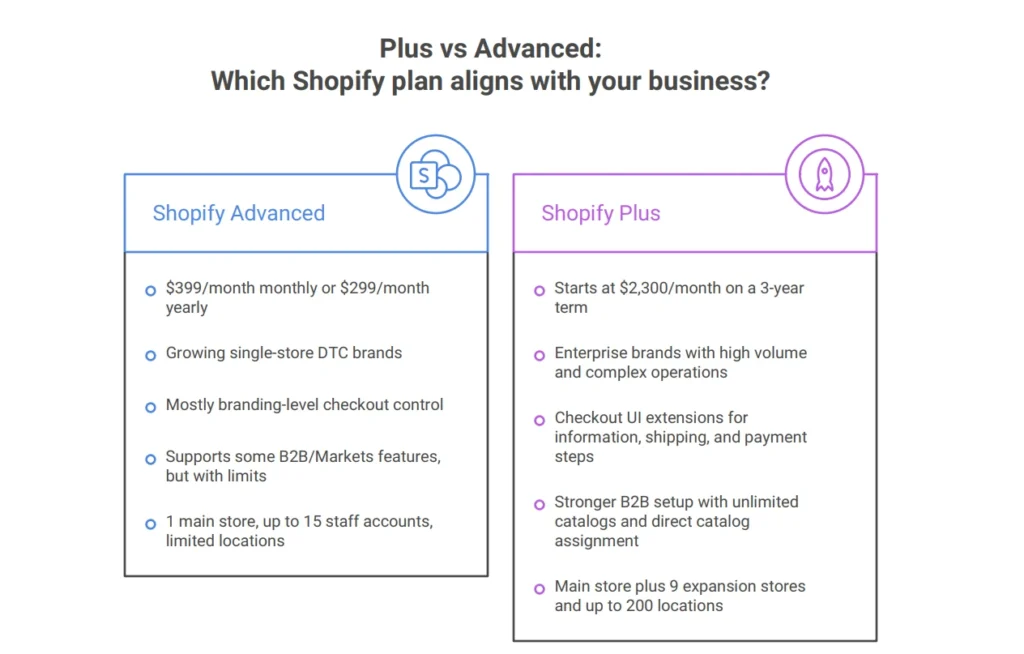
2026 Pricing for Shopify Plus vs Shopify Advanced
| Plan | Pricing | Key fees | What you get |
| Shopify Advanced | $399/month or $299/month billed annually | Online card rates start around 2.5% + 30¢ in the US. The third-party payment gateway fee is 0.6%. | Includes 15 staff accounts, 10 inventory locations, custom reports, enhanced 24/7 chat support, real-time carrier shipping rates, and advanced international selling tools. |
| Shopify Plus | Starts at $2,500/month on a 1-year term or $2,300/month on a 3-year term. | Third-party gateway fee drops to 0.20%. Shopify Payments users can avoid third-party transaction fees. | Includes unlimited staff accounts, up to 200 locations, checkout customization, 9 expansion stores, B2B tools, priority support, and Plus-only features. |
| Shopify Plus trial | Starts at $399/month for eligible merchants. | Trial pricing varies by currency and region. | Gives access to most Plus features for 1–2 months before moving to a full Plus plan. |
The break-even calculation I run for enterprise stores
Before comparing features, I always explain the transaction fee for owners. For me, it is the fastest way to evaluate Shopify Plus and Shopify Advanced.
Advanced charges 0.6% on every order processed through a third-party gateway. Plus charges 0.2%. The 0.4 percentage point difference compounds quickly at scale.
For example, I have worked with a brand processing $7M annually through a third-party gateway, which pays $42,000/year in Shopify transaction fees on Advanced. They then shifted to Plus and paid $14,000/year. The $28,000 saving alone covers more than the annual plan cost difference between the two tiers.
Checkout Extensibility: The feature that changed everything
On Shopify Advanced, checkout customization is limited to visual branding. You can change your logo, colors, and fonts. The structure of the checkout itself is locked. Any checkout logic change requires a third-party app.
The Easiest Upsell Happens At Checkout
The checkout page is one of the easiest places to increase order value because the customer has already decided to pay.
Sell More After Every Sale
Show irresistible one-click post purchase upsells at the right moment that converts.
Install SellMore
SellMore lets you use that moment to show targeted upsell offers without adding friction before checkout.
On Shopify Plus, Checkout Extensibility gives you more control. You can rearrange sections, add custom fields above or below forms, insert upsell blocks in the checkout right column, apply B2B-specific payment flows, and create dynamic shipping rules based on cart contents.
Shopify Functions also lets developers add more backend commerce logic: discount stacking, custom payment conditions, tax exemptions by customer type, and proprietary shipping calculations. All of that requires Plus. Advanced users are limited to whatever predefined Functions are available through public apps.
Multi-store, expansion stores, and global markets in 2026
Shopify Advanced supports exactly one store. International growth on Advanced means either running separate Advanced plans per country at $299/month, or using Shopify Markets to localize within a single store.
Shopify Markets is available on both plans and handles currency, language, and regional pricing. Advanced includes three markets, with additional markets at $59/month each. Plus includes up to 50 markets at no extra charge.
Plus also gives you a different model entirely: your main store plus nine expansion stores, all managed from a single Organization Admin. This is a centralized dashboard that gives you oversight of all stores, users, and settings in one place.
Each expansion store is fully independent, with its own domain, theme, product catalog, language settings, staff permissions, analytics, and bank account for payouts.
Native B2B: The clearest differentiator between plans
If your business runs a wholesale or B2B channel alongside DTC, the Shopify Plus vs Advanced decision is settled by this section alone.
Advanced has no native B2B functionality. Building a wholesale operation on Advanced needs third-party apps, a separate wholesale store, or both.
Shopify Plus includes a full native B2B suite as part of the plan price. You can run B2B and DTC from the same store, or build a dedicated B2B storefront at no extra cost. That B2B store does not count as one of your nine expansion stores.
The B2B feature set covers company profiles with assigned buyers and locations, custom price lists with company-specific or tiered pricing, net payment terms (Net 30, Net 60, and pro-forma invoices), minimum and maximum order quantities, draft orders and quote workflows, and one-off shipping address flexibility.
The real argument for Plus over Advanced is the operational consolidation. For hybrid DTC plus wholesale brands, removing the B2B setup reduces ongoing complexity more than any single feature on the plan comparison table.
Automation: Flow, Launchpad, Functions, and Audiences
Several of the most valuable tools in Shopify's automation layer are now Plus-only in 2026.
- Shopify Flow is available on both plans. It handles rules-based automation across the admin. For example, it automatically tags customers when they cross a lifetime value threshold. Flow now integrates with Klaviyo, Gorgias, Yotpo, Recharge, LoyaltyLion, and several other platforms.
- Shopify Launchpad is Plus-only. It schedules merchandising changes to fire at a precise time: flash sales, price changes, product drops, theme swaps, and discount activation or deactivation.
Brands running major promotional events use Launchpad to execute without manual intervention at midnight. There is no equivalent on Advanced.
- Shopify Audiences is another Plus-only. It builds high-intent lookalike audiences for Meta, Google, TikTok, and Pinterest using commerce data across the Shopify Plus merchant network.
Enterprise operations: Staff, APIs, security, reporting, & POS
Staff accounts and permissions
Advanced supports 15 staff accounts with standard admin roles. Plus supports unlimited staff with store-level access controls.
API access
Advanced supports 4 REST API requests per second and 200 GraphQL points per second. Plus raises that to 20 REST requests per second and 1,000 GraphQL points per second, with prioritized webhook delivery and access to staging environments. Custom apps on Plus can also access PII data, while on Advanced, they cannot access PII.
POS Pro
Advanced requires $89/month per retail location for POS Pro. Plus includes POS Pro for the first 20 retail locations at no additional cost. If you use Shopify Payments and process at least one retail transaction per month at any location, POS Pro is waived on all retail locations up to a maximum of 200.
Inventory locations
Advanced supports 10 inventory locations. Plus supports 200. I suggest brands running multiple warehouses definitely go with Plus on this one.
Reporting
Advanced gives you Shopify's full reporting suite, including custom reports. Plus adds ShopifyQL Notebooks, a custom reporting tool that lets data teams write queries, combine data sources, and build tailored dashboards.
Headless storefronts
Advanced supports one Hydrogen storefront. Plus supports up to 25 Hydrogen storefronts hosted on Oxygen, making it the right setup for brands launching headless campaign sites, B2B portals, or international storefronts with custom front-end experiences.
What is new in 2026: Sidekick, agentic commerce, & MCP
Shopify Sidekick, the AI assistant embedded in the admin, is now available across all plans. It writes copy, configures discounts, builds Flow automations, and answers analytics questions in plain language.
The gap between Advanced & Plus at the agentic layer. Advanced agentic capabilities, where the AI takes actions across the store, are better supported on Plus because of higher API limits, broader permissions, and staging environments for safe action testing. A merchant asking Sidekick to "set up a flash sale for this weekend across all three regional stores" needs Plus to execute that.
MCP (Model Context Protocol) integration, which lets AI tools connect directly to Shopify's backend, is used by enterprise brands that need AI agents with direct admin access. For me, Plus is always better for MCP-based workflows because the API and security controls make those integrations safe to connect.
If you are deciding for the next 3 years, Plus is a much better choice just because of the agentic commerce feature.
5 signals your store is ready to move from Advanced to Plus
Signal 1: You need a second storefront
If you want a separate domain, a dedicated B2B store, or a different storefront under the same brand, Advanced cannot support that. Plus gives you up to nine expansion stores under one contract with one Admin.
Signal 2: Your B2B channel is growing
If your wholesale revenue is good and your current app stack is creating a problem, native B2B on Plus removes this issue. Company profiles, net terms, custom catalogs, and a buyer self-serve portal are all native and free with the plan.
Signal 3: Your checkout has a requirement that it cannot meet
Any checkout that needs custom fields, dynamic shipping logic, upsell blocks inside checkout, or discount stacking rules requires Plus. Advanced's checkout only works for visual branding.
Signal 4: Your third-party transaction fees exceed $35,000/year
At that threshold, the 0.4% fee reduction on Plus covers more than the annual plan cost difference. The upgrade saves your money from day one.
When Shopify Advanced is the right call
Advanced is the right plan if you
- Run a single-store DTC business
- Your team is under 15 people
- You use Shopify Payments as your primary gateway
- You have no current B2B operations, and your checkout does not need customization
Making the right Shopify Plus vs Advanced decision
▶ Advanced is the best plan for a growing single-store DTC business.
▶ Shopify Plus is the right setup for brands that need more than one storefront, a native B2B channel, full checkout control, automation, or the API and security that enterprise operations demand.
At Identixweb, we work with Shopify brands at exactly this decision point and through the implementation that follows.
If you want a clear plan, evaluation and an upgrade roadmap built around your actual operational constraints, our Shopify consulting team can give you a direct answer without the guesswork.
FAQs
1. Is Shopify Plus better than Shopify Advanced?
Yes. Shopify Plus is better in capability, but not better for every store. Shopify Advanced already gives you 15 staff accounts, carrier-calculated shipping, custom reports, international selling tools, and enhanced chat support. Plus becomes better when you need enterprise features like unlimited staff, 200 inventory locations, unlimited B2B catalogs, priority support, checkout customization, expansion stores, bot protection, and higher API limits.
2. Is it worth upgrading to Shopify Plus?
It is worth upgrading to Shopify Plus only when the business problem is bigger than what Advanced can solve. The strongest reasons are checkout customization, advanced B2B setup, expansion stores, higher API limits, bot protection, priority support, and high-volume sales events.
3. Is Shopify Advanced worth it?
Yes. Shopify Advanced is worth it for stores that are growing internationally, need better reporting, or want more operational control without paying Plus pricing. It gives you custom reports, carrier-calculated shipping, international commerce tools, lower standard transaction fees, 15 staff accounts, and enhanced 24/7 chat support.
4. How much is Shopify Advanced per month?
Shopify pricing is localized by country, and subscriptions can be billed in currencies such as INR, USD, GBP, or EUR, depending on location. In the USA, Shopify Advanced currently costs $399/month when paid monthly, or $299/month when paid yearly.
5. Why is Shopify Plus so expensive?
Shopify Plus is expensive because it is priced for enterprise-level control, scale, and support. You are paying for things like full checkout customization, unlimited staff, 200 inventory locations, unlimited B2B catalogs, priority support, free expansion stores, bot protection, higher API limits, and feature testing environments.
About the author
Vineet Nair
Vineet is an experienced content strategist with expertise in the ecommerce domain and a keen interest in Shopify. He aims to help Shopify merchants thrive in this competitive environment with technical solutions and thoughtfully structured content.