





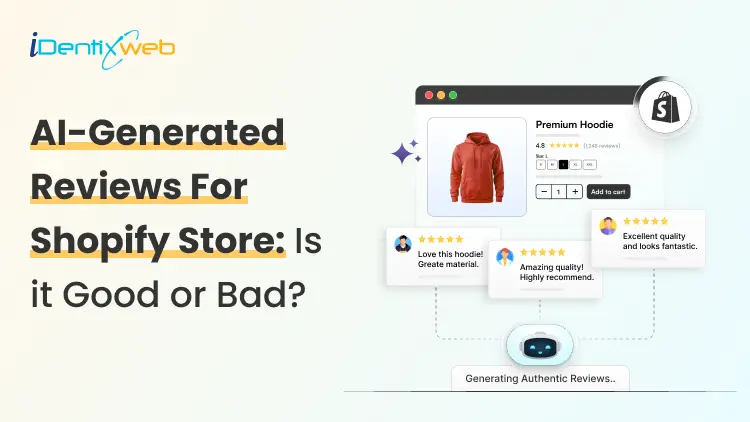

AI-generated product reviews may look like an easy way to build social proof, but the risks go far beyond customer skepticism. Fake or misleading reviews can damage brand trust, trigger refunds and chargebacks, put payment and advertising accounts at risk, violate review-app policies, and attract regulatory attention. In the US, FTC enforcement and state consumer-protection laws can also turn fabricated reviews into a costly legal and compliance problem.
If you have just opened your store in 2026, you definitely need proof that real people actually buy from you. This gap is exactly where AI-generated reviews start to look like an easy fix.
Here's the problem: The risks of using AI-generated product reviews on Shopify changed shape in the last year, and it goes beyond reviews just reading a little generic.
Late previous year, the rules got sharper, real enforcement started, and both Shopify and Google made their positions harder to miss. Here's what's true right now if you are using or thinking about adding AI-generated product reviews on Shopify.
What counts as an AI-Generated product review?
An AI-generated product review is any review text a tool writes in place of a real customer. There are different types of reviews that I have come across.
- Fully invented reviews. The entire experience is made up. It's the version everyone pictures, and it's also the clearest violation of every policy I will cover below.
- AI-rewritten real feedback. You take genuine supplier reviews, marketplace comments, or old customer notes and ask AI to restyle them. If done carefully, this won’t be a problem. Issue arises when AI adds emotions, timelines, or outcomes that weren't in the original.
- AI-assisted, human-approved content. AI drafts a summary of reviews you've already collected, and the person checks it before anything goes live. It's the version that causes the least trouble.
The difference between these three isn't how polished the writing sounds. It's whether the experience described actually happened to a real person.
The Legal Risk Just Got Real
Here's what I think most Shopify advice on this topic misses, and it's the part that matters most right now.
The Federal Trade Commission has a specific rule about fake and AI-generated reviews, and as of the end of 2025, the agency started enforcing it for real.
In the FTC's Rule on the Use of Consumer Reviews and Testimonials (16 C.F.R. Part 465) it bans.
- Reviews from people who don't exist, or who never actually used the product
- Buying reviews, or paying anyone to write only positive ones
- Suppressing or hiding negative reviews
- Reviews from employees or family members that don't disclose the connection
- Company-run "independent" review sites that aren't actually independent
The rule specifically names AI-generated fake reviews as one of the practices it targets. Violations can carry civil penalties of up to $53,088 each, adjusted yearly for inflation. That figure is per violation, not per company.
On December 22, 2025, the FTC sent its first wave of warning letters to 10 companies over likely violations. It wasn't the first time the FTC had gone after review manipulation, either.
The message for merchants is clear: The FTC is chasing whoever publishes the fake content and presents it as a real customer's experience. The responsibility sits with the store owner.
What Shopify and Google actually say
Shopify has a plain standard for reviews shown through Shop: no fake ones, no conflicts of interest, no asking only happy customers to speak up.
Shopify's Shop product review guidelines are direct about it. Merchants, employees, family members, and friends shouldn't review their own products, and store owners shouldn't solicit reviews in a way that pushes for a specific sentiment.
Most stores today collect and display reviews through an app like Judge.me, Loox, or Yotpo. This means the risk usually sits with how you use that app.
Google is more explicit about this. If you send product ratings into Google Shopping or run Shopping ads, Google Merchant Center's Product Ratings policy states plainly that it doesn't allow reviews generated by AI. It expects merchants to flag any they identify using the is_spam attribute in their feed.
Humans and AI shopping agents both catch on
AI-generated reviews are getting worse at their one job, which is making shoppers trust you.
Reviews that all sound the same length, use the same phrases, or praise everything without mentioning a single specific detail read as suspicious faster than they used to. Shoppers have had years of practice spotting this pattern.
A 2026 research report found that 43% of U.S. online shoppers had used an AI assistant like ChatGPT for product research. These tools focus on consistency across reviews over the internet.
A group of generic five-star reviews with nothing to back it up reads as a weak signal to an AI agent, not a strong one.
The real risks of AI-Generated product reviews on Shopify
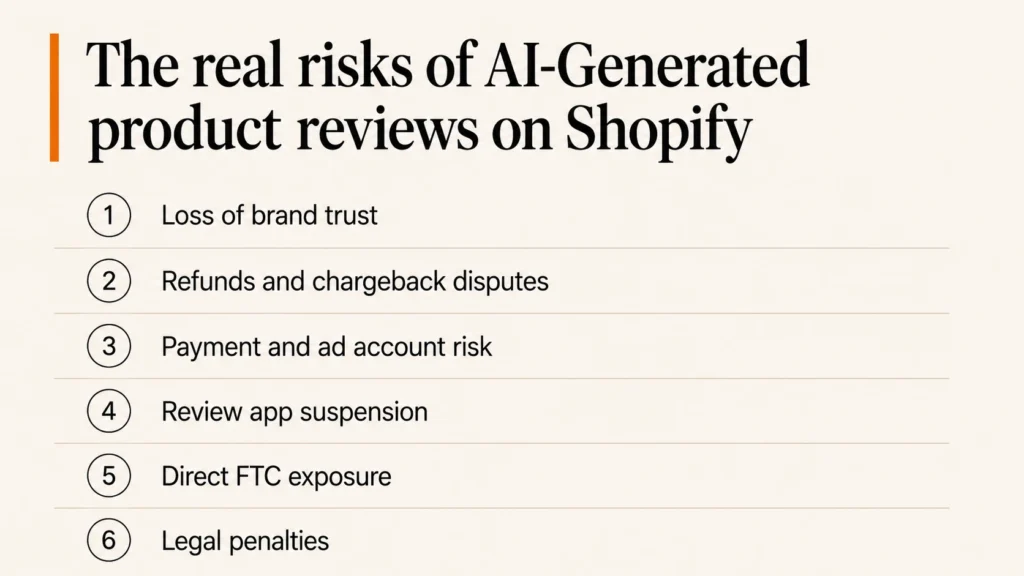
Loss of brand trust
Fake reviews do not stay hidden for long. A review that doesn't match a real customer's actual experience gets noticed and gets screenshotted and shared on Reddit or TikTok. Once shoppers decide a brand faked its social proof, they stop trusting everything else offered by your brand.
Refunds and chargeback disputes
When a real customer's experience doesn't match what the reviews promised, they have grounds to dispute the charge. The review itself can end up as evidence in that dispute.
Payment and ad account risk
Payment processors and ad platforms both watch for mismatches between product claims and real customer experience. Either can freeze payouts or reject ads over it.
Review app suspension
Apps like Judge.me, Loox, and Yotpo remove fabricated reviews, and repeated violations can get your account suspended.
Direct FTC exposure
Given the warning letters sent by FTC, this can definitely happen. A new or small store isn't automatically off the FTC's radar just because of its size.
Legal penalties
A batch of fake reviews spread across even a small catalog becomes a real problem. Most states have their own consumer protection laws that mirror the FTC Act, so a state attorney general can pursue separate action on top of anything the FTC does.
The right way to use AI for your reviews
AI isn't off-limits here, and I wouldn't tell you to avoid it. The line I'd draw is simple: use it on reviews that already happened.
If you've already collected real feedback, AI is genuinely useful for turning long reviews into short highlights. It can also draft a reply for you to check before it posts. Several Shopify review apps now build this in directly.
If you're dropshipping, label reviews clearly as sourced feedback rather than rewriting them into first-person claims about your own store's shipping or service.
AI can also speed up the boring parts of getting real reviews, like personalizing post-purchase request emails or timing them around delivery data.
Use AI Where It Adds Real Value
AI can still be useful in a Shopify business when it is applied to areas where automation does not misrepresent customer experiences.
Identixweb works with Shopify businesses on AI automation and integrations for workflows, operations, and customer experiences where AI can reduce manual work without creating the trust risks associated with fabricated reviews.
How to build trust other than reviews?
Reviews aren't the only trust signal in your store. Using other signals takes pressure off needing reviews to do all the work. Here’s a few I use to build trust.
Adding trust badges near your checkout button is a fast, low-effort update, and social proof placed at checkout works even before your review count builds up.
A Fast pre-publish check
Before you publish any batch of reviews, run through this:
- Did a real person actually buy or use this product?
- Is the reviewer's identity accurate, no invented names, no stock photos standing in for a customer?
- If there's an incentive attached, is it tied to leaving a review, not to what the review says?
- If this is a supplier or marketplace review, is the source labeled clearly?
- If it's heading into your Google Shopping feed, is any AI-generated content flagged or excluded?
- Would this hold up if you had to explain it next to your actual order data?
If any answer is no, that review isn't ready to publish, no matter how good it reads.
What’s next now?
There are risks of using AI-generated product reviews on Shopify.
There's a federal rule with real penalties behind it, policies from both Shopify's Shop channel and Google Merchant Center, and shoppers, who are getting better at spotting the difference.
Real reviews take longer to build. They're also the only kind that hold up for a long term if you want to build trust and increase sales.
FAQs
1. What are the risks of using AI-generated product reviews on Shopify?
Publishing AI-generated reviews that pretend to come from real customers can violate Shopify’s Shop review requirements. This requires reviews to be authentic and not artificially created by bots or automation. It can also create legal risk under the FTC’s Consumer Review Rule in the US. Google Merchant Center explicitly prohibits reviews primarily generated by AI or automated programs.
2. Can AI detect fake reviews better than human moderators?
AI can analyze large numbers of reviews and spot patterns, suspicious reviewer networks, and other signals much faster than human moderators. But it is not consistently better in every case. Recent research found that both humans and general-purpose LLMs can struggle to distinguish sophisticated AI-generated reviews from genuine ones.
3. How to add more product reviews on Shopify in 2026?
The best approach is to request reviews from verified customers after their orders are delivered; Shopify lets merchants set Shop review requests from 1 to 180 days after delivery. For reviews on the online store, merchants can also use apps such as Judgeme or Loox, while keeping requests neutral and avoiding fake or improperly incentivized reviews.


About the author
Vineet Nair
Vineet is an experienced content strategist with expertise in the ecommerce domain and a keen interest in Shopify. He aims to help Shopify merchants thrive in this competitive environment with technical solutions and thoughtfully structured content.