



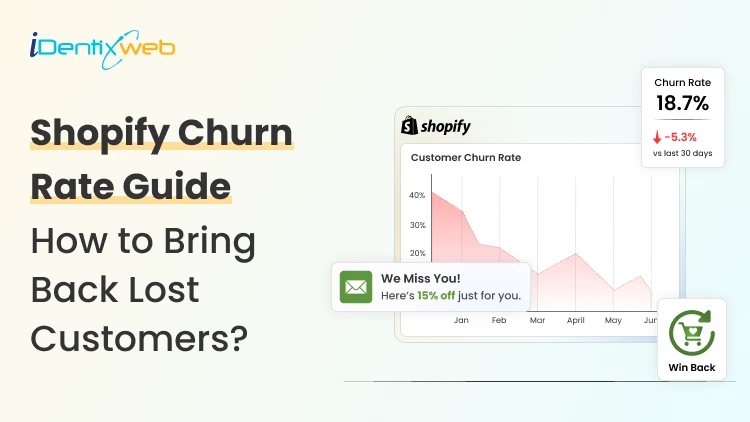
I've spent the last few years helping Shopify store owners plug their sales leak, and the same pattern shows up every single time. Owners invest in ads while their best buyers leave their stores, never to return.
According to the latest data, the average churn rate across all industries is 20-30% (Source). The Shopify churn rate in 2026 confirms what I see with merchants every week.
Here's the good news. Churn is fixable. Lost customers are easier and cheaper to win back than chasing strangers on Meta ads.
I’m going to walk you through what churn really means, where you stand against industry benchmarks, why your customers are leaving your business, and the exact 6-step win-back playbook I run on real Shopify stores.
What is Shopify's Churn Rate?
Churn rate in Shopify is the percentage of customers who stop buying from your store within a set time period.
For example, if 100 people bought from you last quarter and 30 never came back, your churn rate is 30%.
Why does this matter more now than ever? Ad costs keep climbing. AI-driven competitors are spinning up overnight. Buyers have more options than they can handle. According to the latest Shopify update, AI-referred shoppers convert at almost 50% higher rate.
Shopify's Current Churn Rate 2026: The Real Numbers
Shopify's churn rate in 2026 baseline sits between 70% and 75% for the average e-commerce store. Painful, but true.
Here's what the data actually says:
- Annual e-commerce churn: 70–75% (Source)
- Shopify merchant churn: ~28% per year
- New store survival past 90 days: only 10%
- Traditional retail retention: 63% annually
95% of stores fail before they even hit their first quarter, mostly because the owner never built a system to bring buyers back. Survival depends on what you do on days 0–90 with the customers you already have.
Shopify churn rate benchmarks by industry
Here are the 2026 repeat purchase rates by industry (Source)
- CBD: 36.2%
- Grocery and food delivery: 65.2%
- Pet supplies: 30%+
- Health and supplements: 29%
- Beauty and cosmetics: 25.9%
- Fashion: 24.4% (luxury drops to just 9.9%)
- Electronics: 18%
- Home and furniture: 14.7%
If you're below your industry average, it’s fixable. If you're above? You still have room to push higher. Top performers in every category beat the benchmark by 2x.
Want to Lower Churn? Start With Your Cart
A stronger first-purchase experience builds the kind of loyalty that keeps buyers coming back.
The cart is where most stores quietly leak revenue.
iCart Cart Drawer Cart Upsell turns your default Shopify cart into a conversion engine with a sticky slide-out drawer, AI-powered upsells, free shipping progress bars, volume discounts, and urgency timers.
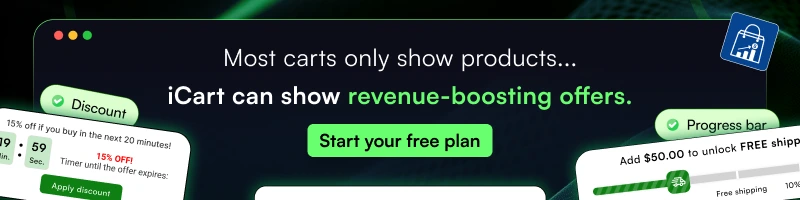
Stores I've seen install it usually push their AOV up by 15–30% within the first month, which directly reduces the churn problem before it even starts.
How to calculate your Shopify churn rate (with examples)
Pull up your Shopify dashboard. Here's the formula:
Churn rate = (lost customers ÷ total customers at start of period) × 100
Quick example. You started the quarter with 1,000 customers. By the end, 200 hadn't been bought again. Your quarterly churn rate is 20%.
Another simple version if you already track retention:
Churn rate = 100 − retention rate
So if 75 out of 100 customers stay, your retention rate is 75%, and your churn rate is 25%.
Here’s how you can do a simple self-audit:
- Open Shopify Analytics
- Compare the returning vs. the first-time customer rate
- Calculate churn for the last 3 months, 6 months, and 12 months
- Look at the trend
How eCommerce failure happens: Why do Shopify customers leave?
After auditing more than 100 Shopify stores, here's what kills retention. Most of the time, store owners are doing one or more of these without realizing it.
No campaigns after checkout
You take their money, ship the product, send a tracking link, and they receive the product and disappear. No thank-you note, no product tips through email or SMS. Customers forget you exist within 30 days.
Bad customer service
Research shows 67% (Source) of churn could be prevented if the issue were resolved during the first interaction. Slow replies kill loyalty faster than a bad product.
Slow site speed and clunky mobile UX
If your store takes more than 3 seconds to load on mobile, you've already lost a chunk of buyers. They won't even tell you they're leaving.
Generic email blasts
Sending the same message to a first-time buyer and a VIP customer won't do you any good. Buyers can smell a mass email instantly.
Too many discounts
I have experienced this a lot. Promos every week will train customers to wait for the next sale. This way, you stop being a brand and start being a coupon source for customers.
Failed payments on subscriptions
Involuntary churn from expired cards leads to 20–40% of subscription losses. Most stores never set up a proper flow for retention for subscription losses.
How to reduce Shopify’s churn rate? My 5-step playbook
Here's the system I run on real Shopify stores. Works for DTC, subscription, fashion, supplements, and home decor.
Step 1: Segment your lapsed customers
Define what "lapsed" means for your store. For most non-subscription brands, 90+ days without a purchase is the sweet spot. Subscription brands can go shorter, around 30–45 days post-cancellation.
Then split them by:
- Past total spend (VIP vs. casual)
- Product category bought
- Last channel they engaged with (email, SMS, social)
Step 2: Run a churn survey
Before you launch any campaign, send a single-question email: "What stopped you from buying again?"
Common answers reveal real problems. Slow shipping, ran out of money, found a competitor, didn't like the product, forgot about the brand. Each one tells you what to fix and what offer to make.
Create a simple Google form with a dropdown to start this survey.
Step 3: Build a retention email + SMS sequence
Here's the timing that works:
- Day 7: Soft "we miss you" nudge with new arrivals or a content piece
- Day 14: Value reminder, highlight what makes your brand worth coming back to
- Day 30: Real incentive, 15–25% off, free shipping, or a free add-on
- Day 60: Last-chance message with genuine urgency
Step 4: Fix the reason they left
If shipping is slow, fix logistics first or if support is unresponsive, hire help or install a chatbot
Bringing customers back to the same problems just speeds up the second churn.
Step 5: Track your retention campaign
Recovering a customer isn't enough. You need them to stick.
Watch this number: do 50%+ of recovered customers make a third purchase within 90 days? If yes, your win-back creates real reactivation. If they redeem the offer and vanish, you bought a transaction, not a relationship.
Compare win-back cohort LTV against new customer LTV. In most stores I audit, recovered customers actually have higher LTV than fresh ones because they already know the brand.
Tools I use to reduce churn rate in Shopify (2026)
A few I trust and use regularly:
- Klaviyo or Omnisend for email and SMS automation
- Recharge or Loop Subscriptions for subscription dunning and flexibility
- Gorgias for fast customer support
- Smile.io or Yotpo for simple loyalty programs
2026 trends shaping Shopify retention
I see 4 trends in retention in the Shopify ecosystem for merchants.
- AI-driven churn prediction inside Shopify is becoming useful
- Predictive risk scoring flags customers about to drop off before they do
- Conversational commerce through AI chat handles 60–80% of routine queries 24/7
- Real-time AI-translated shipping updates reduce first-order churn by around 15%
KPIs to track for Shopify churn rate in 2026
Churn rate alone won't give you the full picture. I track these along
- Repeat Purchase Rate (the most underrated number)
- Customer Lifetime Value (CLV) trend month over month
- 30/60/90 day cohort retention to spot the cliff
- Average Order Value (AOV) for win-back cohorts vs. new buyers
- Win-back recovery rate (what % of lapsed customers come back)
Do not ignore your churn rate in 2026
You can decrease your churn rate easily. I have always experienced that lost customers are the cheapest growth channel.
Every store I've helped grow revenue started with looking at who already bought from them.
Pick one section of this guide. Just one. Run it this week. Whether it's a churn survey, a 4-touch win-back sequence, or fixing your post-purchase emails, momentum starts with one move.
FAQs
1. What is Shopify’s current churn rate?
Shopify's current churn rate for 2026 sits at roughly 28% annual merchant churn, with only 10% of new stores surviving past 90 days. Your number will swing higher or lower depending on your industry and how seriously you treat retention.
2. How to calculate ecommerce churn rate?
Use this formula: Churn Rate = (Lost Customers ÷ Total Customers at Start of Period) × 100. If you started the month with 500 customers and 75 didn't come back, your churn rate is 15%.
3. What is the retention rate in Shopify?
The average customer retention rate for Shopify stores in 2026 hovers around 25–30%, basically the flip side of that 70–75% churn number. Top performers in categories like grocery and CBD pull retention rates of 36–65%, while fashion and electronics often sit below 20%. A good Shopify retention rate is whatever beats your industry benchmark by at least 5–10 percentage points.


About the author
Vineet Nair
Vineet is an experienced content strategist with expertise in the ecommerce domain and a keen interest in Shopify. He aims to help Shopify merchants thrive in this competitive environment with technical solutions and thoughtfully structured content.