



Most Shopify store owners who install apps from the app store hit one common problem.
The existing apps work, but they do not match the exact workflow. One app solves half the problem. Another app adds an extra monthly cost. A third app slows down the store.
That is when custom Shopify app development becomes a serious option.
As a Shopify expert, I usually see store owners consider a custom app when they want to automate operations, connect Shopify with another system, build a unique customer experience, or reduce the number of apps running on the store.
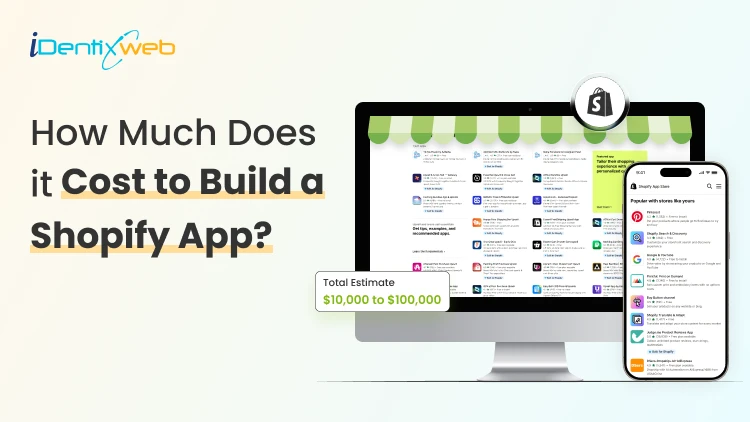
The big question is simple: How much does Shopify app development cost in 2026?
The short answer is:
Shopify app development cost in 2026 usually starts from $5,000 to $10,000 for a basic custom app, $10,000 to $25,000 for a mid-level app, and $40,000 to $80,000+ for an advanced app.
Note: These numbers may vary depending on the scope of work of the client.
The final cost of building a Shopify app depends on the app’s features, design, backend logic, third-party integrations, testing, hosting, and long-term support.

Custom Shopify app development cost: basic, mid-level, and advanced
We have built 100+ combined custom Shopify apps & stores for merchants, so based on this, I divide custom Shopify app development into 3 categories: Basic, mid-level, and advanced.
Basic Shopify app development cost
The cost of building a Shopify app for basic purposes is around $5,000 to $10,000.
A basic app usually solves one focused problem. It does not need complex workflows, advanced dashboards, or multiple third-party integrations.
A basic Shopify app may include:
- Simple order automation
- Product tag automation
- Basic discount logic
- Simple admin settings
- Small reporting dashboard
- Basic product or customer data sync
- Simple theme app extension
For example, a store owner may need an app that automatically tags customers based on order value. Another store may need a simple app that exports orders in a specific format for its warehouse team.
Mid-level Shopify app development cost
A mid-level Shopify app can cost around $10,000 to $25,000.
Most serious custom Shopify app projects fall into this range. These apps usually need better planning, stronger backend logic, Shopify API work, custom UI, testing, and post-launch support.
A mid-level Shopify app may include:
- Inventory sync
- ERP or CRM integration
- Custom shipping rules
- B2B pricing logic
- Custom product bundle workflow
- Advanced discount rules
- Customer segmentation
- Custom reporting dashboard
- Multi-step merchant settings
For example, a growing Shopify store may want to sync inventory between Shopify and an ERP system. Another store may need custom pricing for wholesale buyers based on customer tags, company accounts, or purchase volume.
Advanced Shopify app development cost
An advanced Shopify app can cost around $40,000 to $80,000+
Advanced apps are usually built for Shopify Plus stores, enterprise brands, public Shopify apps, or stores with complex operations.
An advanced Shopify app may include:
- Shopify Plus checkout extensions
- AI product recommendations
- Complex post-purchase workflows
- Multi-store management
- Advanced analytics
- Large ERP integration
- Warehouse and fulfillment workflows
- Public Shopify app with billing and onboarding
- Custom app dashboard for multiple merchants
For example, building a public Shopify app is very different from building a private app for one store. A public app needs merchant onboarding, billing setup, permissions, error handling, app review preparation, support flows, and scalable hosting.

Build Your Custom Shopify App With Experts
Cost breakdown: What goes into Shopify app development cost?
Step 1. Planning and requirement gathering
Good Shopify app development starts with proper planning. Before development starts, the team understands:
- What problem will the app solve?
- Which Shopify data does the app need?
- Which features are must-haves?
As a Shopify expert, I always suggest starting with the simplest version of the app. Build the core workflow first, then add extra features after the app proves useful.
Step 2. UI and UX design
Design is not only for the storefront. Custom apps also need a great admin experience.
The app may need:
- Settings page
- Dashboard
- Onboarding screen
- Reports
- Filters
- Storefront widget
- Mobile-friendly layout
A good UI/UX Shopify design of the app reduces support questions from you and your staff.
Step 3. Backend development
This usually takes the largest part of the building cost for Shopify apps. That’s because it handles:
- App logic
- Database setup
- Shopify API calls
- Webhooks
- Authentication
- User permissions
- Error handling
- Performance setup
For example, an inventory sync app needs to check product data, update stock, handle failed syncs, and avoid duplicate updates. That kind of logic takes proper development time.
Step 4. Shopify API and third-party integrations
Shopify apps often need to connect with other tools. Common integrations include:
- Shopify Admin API
- Storefront API
- Checkout extensions
- ERP systems
- CRM tools
- Email marketing tools
- Warehouse systems
- Payment tools
For example, connecting Shopify with an ERP is usually more expensive than building a simple product tag app. The app has to manage real business data, and errors can affect orders, inventory, or accounting.
Step 5. Testing and quality assurance
Testing plays a big role in Shopify app cost factors. A proper testing process may include:
- Feature testing
- Browser testing
- Device testing
- Theme compatibility testing
- App conflict testing
- API response testing
- Webhook testing
Skipping testing may reduce the first quote, but it can increase the real cost later. Bugs after launch can affect sales, orders, customer experience, and staff productivity.
Step 6. Deployment, hosting, and maintenance
A custom Shopify app also needs setup and long-term care. Merchants will need to pay for:
- Hosting
- Database
- Domain and SSL
- Monitoring
- Bug fixes
- Shopify API version updates
- Security updates
- Feature improvements
- Support hours
Always remember that custom apps are rarely a one-time cost. Shopify keeps improving its platform, APIs, checkout, and app standards. Your app should stay updated.
Freelancers vs agencies: Which one should you choose?
The developer you hire will also affect the Shopify app development cost. Both freelancers and agencies are good choices. Here’s my experience with both of them.
Hiring a freelancer
Freelancers are usually a good fit for small and simple apps. They usually cost less than agencies, and communication can be direct and fast.
I would choose a freelancer for a simple automation or a small internal app. I would be more careful if the app affects checkout, order processing, inventory, or revenue. For those, I would hire an agency.
Hiring a Shopify app development agency
Building cost for Shopify apps increases with agencies, but they bring a stronger process. They give you a team that includes project managers, developers, designers, QA testers, and support people.
From my experience, an agency makes more sense when the app touches revenue, operations, customer experience, or multiple systems. A cheaper build can become expensive if it breaks during real store activity.
Another alternative is app builders.
Are app builders effective for building Shopify apps?
App builder tools like Appbrew can help in some cases, but they are not the right answer for every store.
When app builders work well
App builders can work for simple and standard needs, like:
- Simple mobile apps
- Basic loyalty features
- Simple customer-facing tools
- Template-based app experiences
- Quick MVP testing
- No-code experiments
Main Shopify app cost factors in 2026
App complexity
More features, rules, and user roles increase cost. A simple product sync app will cost less than a full warehouse automation app.
Type of app
The type of app matters a lot. For example, public apps and Shopify Plus apps usually cost more because they need stronger systems, better testing, and long-term scalability.
Integration needs
Every integration adds development and testing time. A Shopify app connected with one system may stay affordable. An app connected with ERP, CRM, shipping, accounting, and email tools will cost much more.
Data volume and performance
A store with 100 orders per month has different needs from a store with 50,000 orders per month. High data volume needs better architecture, faster processing, and stronger error handling.
Security and permissions
Apps may access products, customers, orders, discounts, or checkout data. Sensitive data needs proper security. Developers must handle permissions carefully because poor security can create business and customer trust issues.
Ongoing support
Support should be part of the cost discussion from the start. A custom Shopify app without support can become hard to manage later.
Final thoughts: Is custom shopify app development worth it?
Custom Shopify app development is worth it when the app solves a specific problem you have.
New Shopify stores should avoid building custom apps too early. Use existing apps first when they solve the problem properly.
Growing stores should compare the monthly cost of multiple apps with the cost of building one custom app. Sometimes a custom app can save time, reduce manual work, and create a smoother workflow for the team.
FAQs
1. How much does Shopify app development cost in 2026?
Shopify app development cost in 2026 usually starts from $5,000 to $10,000 for a basic app, $10,000 to $25,000 for a mid-level app, and $40,000 to $80,000+ for an advanced app. The final cost depends on the app’s features, Shopify API work, integrations, design, testing, and long-term support.
2. What are the factors affecting the cost of custom Shopify app development?
The main Shopify app cost factors include app complexity, number of features, UI design, backend logic, Shopify API usage, third-party integrations, data volume, security needs, and ongoing maintenance.
3. Why should I go for custom Shopify app development?
You should go for custom Shopify app development when ready-made apps cannot match your store’s workflow or business needs. A custom app can help you automate tasks, reduce manual work, connect Shopify with other tools, improve customer experience, and build features that support your store’s growth.

About the author
Vineet Nair
Vineet is an experienced content strategist with expertise in the ecommerce domain and a keen interest in Shopify. He aims to help Shopify merchants thrive in this competitive environment with technical solutions and thoughtfully structured content.