




To create a discount code on Shopify, go to Shopify Admin > Discounts > Create discount, choose the discount type, select Discount code, enter your code, set the value and rules, and save it. You can create discount types like Amount-off products, Buy X Get Y, amount off-order, and free shipping discount codes.
Discount codes are one of the few things in Shopify you can launch in five minutes that actually move revenue.
I have set them up for stores running flash sales, welcome offers, influencer campaigns, and abandoned-cart recovery flows. The difference between a code that converts and one that doesn't usually comes down to a few settings most merchants skip past.
In this guide, I'll walk you through how to create a discount code on Shopify the right way: which type to choose for your goal, how to set rules and limits, when to use the native tool versus an app, and what to check when a code isn't working at checkout.
Why use discount codes on your Shopify store?
Discount codes work because they give a buyer a reason to act now instead of later. Here are the specific scenarios I use discount codes for, and the situations each one fits.
To convert visitors who are sitting on the fence
Most Shopify stores I've worked with see a sizable chunk of traffic that adds items to cart but doesn't check out. A first-time-buyer code (something like WELCOME10 for 10% OFF) is the cheapest nudge available. This is much cheaper than running another round of paid ads to bring those people back.
To get a customer's first order
A welcome discount lowers the barrier for someone who has never bought from you. The first order is what gets them onto your email list, lets you retarget them, and starts the relationship. The discount is essentially the cost of acquiring an email address that converts.
To bring back lapsed customers
Hasn't the customer ordered in 90 days? A targeted code in a "we miss you" email reopens the door without you having to compete with their inbox on full price.
To recover abandoned carts
A discount code in your abandoned-cart email sequence is one of the highest ROI uses of codes I have seen. The customer was already buying the code, which removes the last bit of friction.
To clear specific inventory
End-of-season stock, slow movers, products you're discontinuing, a code that applies only to specific products or collections, lets you discount strategically without lowering your store-wide price perception.
To run partner and influencer campaigns
Unique codes are how you measure which influencer or affiliate is actually driving sales. Each one gets their own code, you track usage by code, and you'll know in two weeks who's worth paying again.
The trap to avoid: using discount codes as a default. If every customer is buying with a code, you've trained them to wait for one. Codes work best when they have a clear reason and a clear end date.
The 4 types of discount codes Shopify supports
Before you start creating codes, decide which type of discount fits the goal.
1. Amount off products (percentage or fixed)
A percentage or fixed amount off specific products or collections.
When I use it: Clearing slow-moving inventory, promoting a new collection, or pushing seasonal items, the discount is targeted, so your store-wide pricing perception stays intact.
Real example: "20% off all Summer Dresses" applies only to the
The Summer Dresses collection leaves the rest of the catalog at full price.
Tip from experience: Percentage off scales with order size, so it's better for premium products. A fixed amount feels bigger on lower-priced items (a flat $10 off looks more compelling than 10% off a $25 product).
2. Amount off order (percentage or fixed)
The same percentage/fixed-amount logic, but applied to the entire cart total.
When I use it: Site-wide sales (Black Friday, end-of-season), welcome offers, and broad reactivation campaigns. Use this when the goal is "more people, more orders" rather than pushing specific products.
Real example: "WELCOME10. 10% off your entire first order."
Tip from experience: I almost always pair this with a minimum purchase amount. WELCOME10 with a $50 minimum is much healthier for margin than WELCOME10 on a $15 order.
3. Buy X Get Y
The customer buys a specified quantity and gets another item free or discounted. Sometimes called "BOGO" (Buy One Get One).
When I use it: Moving units, increasing average order value, and clearing inventory where you have plenty of supply. Particularly strong for stores selling consumables, accessories, or anything where buying two feels reasonable.
Real example: "Buy 2 T-shirts, get 1 cap free." Or the classic "Buy 3, get 1 free."
Tip from experience: Buy X Get Y has a higher AOV impact than percentage discounts in most stores I've tested it on. Customers add the extra item to qualify, which means each order goes up by one product.
4. Free Shipping
Removes shipping costs at checkout, either across all orders or above a minimum.
When I use it: When shipping cost is the reason for abandonment reason. If you look at your checkout data and see customers dropping off at the shipping step, this is the code to test first.
Real example: "FREESHIP50 free shipping on orders over $50." The minimum nudges customers to add one more item to qualify.
Tip from experience: Free shipping converts better than equivalent dollar discounts in a surprising number of stores. A $5 shipping waiver often outperforms $5 off the order, even though the math is the same.
How to create a discount code on Shopify [Step-by-step tutorial]
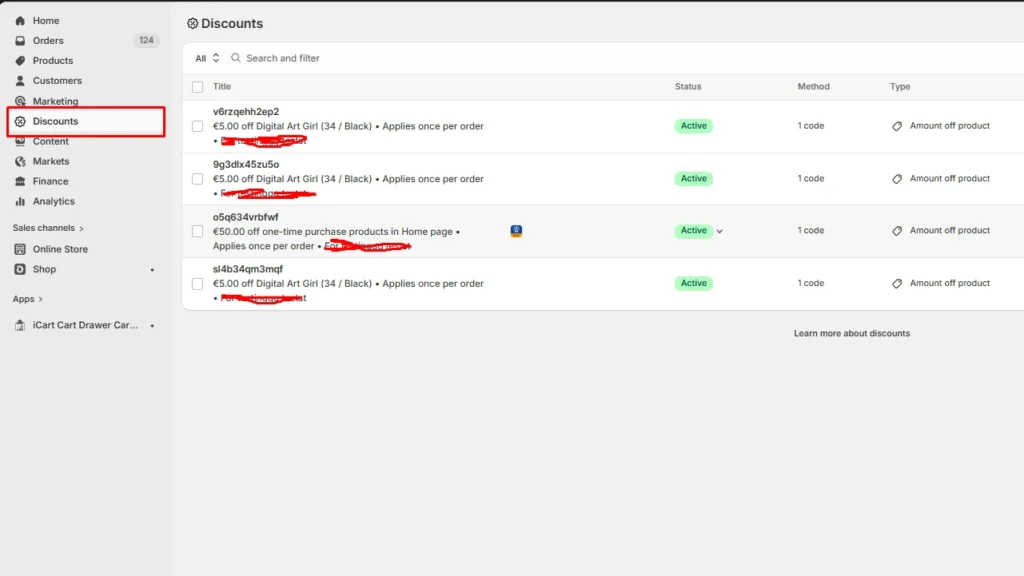
Step 1: Go to Discounts in your Shopify admin
Log in to your Shopify admin, go to the Discount section in the left sidebar.
Step 2: Click Create discount
Now, go to the top-right corner and click on the Create discount button.
Step 3: Choose the type of discount code you want to create
You will be offered four discount types:
- Amount off products
- Buy X get Y
- Amount off order
- Free shipping
Select one discount type based on your goals and proceed to create the code.
Step 4: Select the discount method
Here, there are two discount methods: A manual method and an automatic method.
In the manual method, customers have to type this code at checkout. In automatic, the code will appear in the cart or checkout.
Step 5: Configure your discount code
There are different rules and values you need to add to create your discount code. I normally select automatic to make things easier for me, but it depends on the brand’s goals.
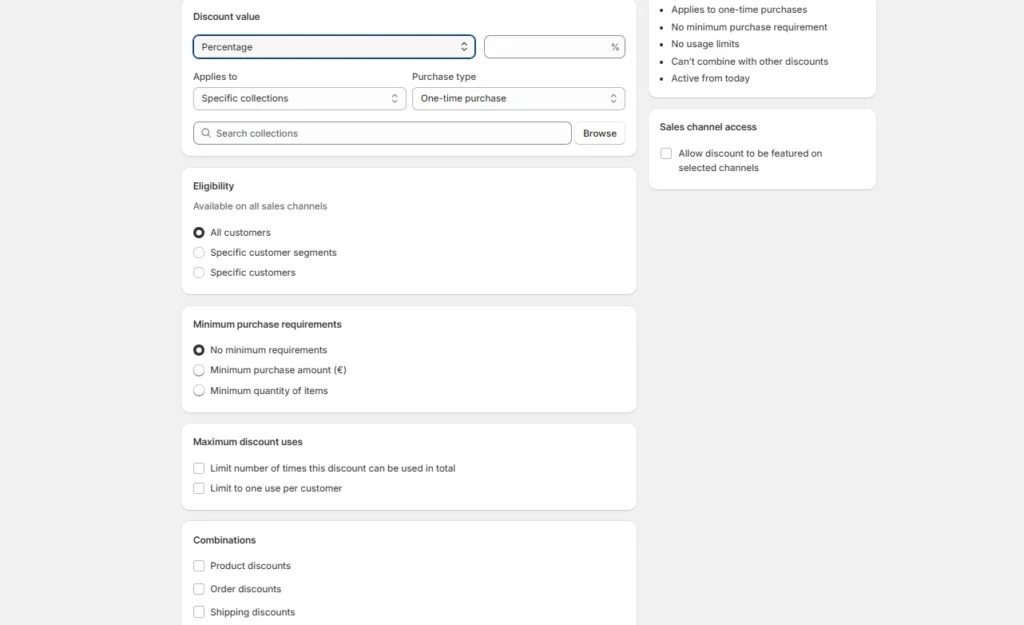
Do not forget to set active dates. I always add an end date when the code will expire. Make sure to add this date to your marketing content as well when you promote the code.
Step 6: Click Save
Go through the values and rules one last time and click Save to activate the code.
Add codes where purchases happen
Once you have created your discount code in Shopify, the next step is making that offer more visible where purchases happen.
This is where iCart Cart Drawer Cart Upsell fits naturally.
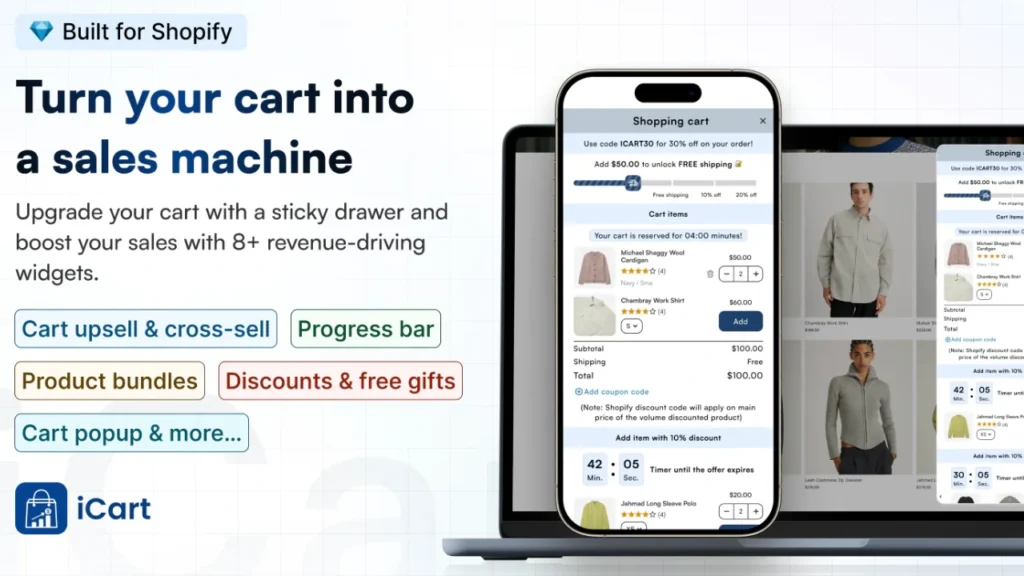
Instead of relying only on a code at checkout, you can use iCart to show discounts alongside upsells, cross-sells, product bundles, volume discounts, and a cart progress bar, which helps turn a basic offer into a stronger cart conversion strategy.
Best practices while creating a discount code on Shopify
✔️ Start with one clear goal
Before you type a code name or choose a value, decide what the code is supposed to do.
These are the reasons to go for each discount type based on my experience:
- Percentage off for first-order offers.
- Fixed amount off for simple price-led promotions.
- Free shipping for creating shopify free shipping discount code
- Buy X Get Y when you want to move more units per order.
✔️ Set combinations on purpose
One of the most important best practices is deciding whether your discount code should combine with other offers.
You can set rules for whether a discount can be combined with other product, order, or shipping discounts. But be careful because it also creates a bigger discount than you planned if you do not check the stack carefully.
✔️ Use a simple code name
I recommend avoiding special characters in discount code names so they are added correctly to your store’s checkout URL.
I prefer short and simple code that is easy to type and easy to remember. For example, something like WELCOME10, FREESHIP50, or SUMMER15.
✔️ Test the discount code at checkout
I missed this step when I created the discount code for the first time, and it didn't go well. I recommend testing the code at checkout so you can confirm that it works exactly the way you expected.
A good tip here is to always test the offer like a customer would.
✔️ Share the code the easy way
Once the code is ready, do not just paste the code text everywhere. You can create a shareable discount link from the Discounts section, and you can choose which page, product, or collection the link should open to.
✔️ Track performance after launch
After the code goes live, watch what it actually does. I use the Sales by discount report to see how often my codes are used, and review discounts directly from the Discounts section in admin.
Built-in vs app: a quick decision
The native Discounts tool handles 80% of what most stores need. Here's a straight answer to "which should I use":
Use Shopify's built-in discounts tool when:
- You're creating one code at a time, or a few codes manually
- The discount logic is straightforward (percentage off, free shipping, Buy X Get Y)
- You have a small budget and want to keep your app stack lean
- You don't need automation, popups, or bulk unique codes
Use a Shopify discount app when:
- You need 100+ unique codes for a campaign
- You want codes triggered by behavior (exit intent, abandonment, birthdays)
- Your discount logic is conditional or multi-tiered beyond what Shopify supports
- You want to display the discount visually (pop-up, cart drawer, banner)
- You need advanced reporting or A/B testing
A practical rule: start with the native tool. Only install a discount
App, when you hit a specific limitation, you can name it. Apps add cost, complexity, and potential conflicts. Install them when there's a clear need, not "just in case.
Discount codes are simple yet effective
Creating a discount code on Shopify is easy once you know which discount type fits your goal. But you need to set the right value, rules, combinations, and active dates so it helps you get more conversions when the code is applied.
I always treat discount codes as part of a bigger conversion strategy. When you pair the right code with better cart visibility, strong timing, and proper testing, you give your store a much better chance to turn visitors into paying customers.
FAQs
1. How to create a discount code on Shopify?
Go to Shopify Admin > Discounts > Create discount, then choose the type you want, such as amount off, percentage off, Buy X Get Y, or free shipping. After that, add the code name, choose the products or collections it applies to, set eligibility, usage limits, combinations, and start/end dates, then save and test it before sharing it.
2. Can you create bulk discount codes in Shopify?
Stores use an app when they need large batches of codes for influencer campaigns, email offers, or one-time coupons. Apps like Bulk Discount Code Bot or Coupon X are good choices.
3. Can I use the same discount code for multiple products?
Yes. The same discount code can apply to multiple products, collections, variants, or even the whole order, depending on how you configure it.
4. What is the maximum number of discount codes you can create on Shopify?
The store-wide limit of discount codes is 20,000,000.
5. Which are the best discount code Shopify apps?
Bulk Discount Code Bot or Coupon X are the best Shopify apps I have used to create discount codes.

About the author
Vineet Nair
Vineet is an experienced content strategist with expertise in the ecommerce domain and a keen interest in Shopify. He aims to help Shopify merchants thrive in this competitive environment with technical solutions and thoughtfully structured content.