



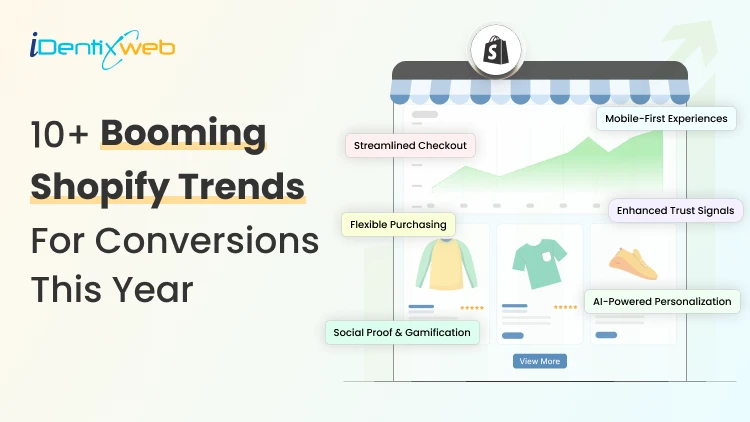

The key Shopify trends for 2026 are AI personalization, mobile-first design, smarter checkout, social commerce, zero-party data, subscriptions, AR/3D product pages, AEO, automation, and stronger fraud prevention. Merchants should focus on the trends that directly improve conversions, customer experience, and long-term growth instead of trying to implement everything at once.
I've spent the last few years auditing Shopify stores, forecasting where the platform is headed, and helping merchants make the changes that actually move revenue.
And I'll tell you straight up: 2026 is the year the bar got higher overnight.
Shopify crossed 2.8 million active stores [Source: Store Leads]. New merchants are launching every minute. Shoppers expect Amazon-level speed from a brand that has just started three months ago.
The merchants winning right now are the ones picking 3–4 Shopify trends, executing them well, and ignoring the rest.
That's exactly what I want to help you do today.
I'll walk you through 15 Shopify trends I'm betting on in 2026, why each one matters, and what you can ship this week. Each trend gets the same treatment: what it is, why I care, and the move for new store owners.
Let's get into it.
10+ Booming Shopify Trends for Conversions, AI, Designs, and More
1. AI Personalization becomes the default
Generic stores are a thing of the past. Shoppers in 2026 expect the store to feel like it was built for them, even on visit one.
I'm seeing AI-powered product recommendations, dynamic PDP content, and AI-curated bundles consistently lift AOV by 15–30% across the stores I audit. The brands that ignore this are losing revenue to competitors who don't.
Tools worth a look: Shopify Magic (native), Shopify's Search & Discovery app, and iCart Cart Drawer Cart Upsell
Quick win for new stores: Don't overthink it. Install one solid recommendation app, test it and only then go for paid plans.
Let AI Pick the Right Upsell Before Your Customer Leaves
Show smarter product recommendations inside the cart based on what shoppers are already buying.
With iCart, you can display AI-powered upsells that feel relevant, timely, and easy to add before checkout.
2. Conversion-first Shopify store design trends 2026
Pretty stores don't convert. Stores are designed around how shoppers are the ones that have great conversions.
In 2026, the Shopify store design trends I keep recommending: bigger editorial typography, sticky add-to-cart bars, swipeable mobile product galleries, soft scroll-triggered motion, and ruthless cuts to anything that doesn't help someone buy.
Hero carousels are mostly over. Replace yours with one strong above-the-fold value prop, a clear CTA, and social proof within the first scroll.
My honest take: You probably don't need a full redesign. Audit your top 3 pages by traffic, fix the friction, and you'll see results in weeks, not months.
3. Mobile-First Isn't a Buzzword. It's the Whole Store
Although this Shopify trend has been going on for years, I still open stores every week that were clearly designed on a desktop, with mobile checked last.
Roughly 65%+ of Shopify traffic now comes from mobile [Source: Shopify].
What mobile-first actually looks like in 2026: page speed under 2 seconds, sticky add-to-cart, one-thumb checkout, full-screen popups that close easily, CTAs in the bottom 60% of the screen.
Shop Pay, Apple Pay, and Google Pay should already be live in your checkout. If they aren't, do it right away.
4. Headless commerce goes mainstream (Especially on Shopify Plus)
Headless just means your storefront (what shoppers see) is separated from your Shopify backend (where orders live). The result is a faster, more flexible custom experience.
Shopify Plus brands are leaning hard into Hydrogen and Oxygen for 2026, especially for campaign micro-sites, B2B portals, and international expansion stores. Performance gains directly improve Core Web Vitals, SEO, and conversion rates.
Honest advice: If you're a new store doing under $1M, skip headless for now. Master your Liquid theme first.
5. Social commerce + live selling
TikTok Shop, Instagram Shopping, and YouTube Shopping are full revenue channels with native Shopify integrations.
Live selling is having a real moment in beauty, fashion, food, and hobby niches. UGC-first product pages, with real customer videos pulled in via apps like Loox or Fera, are outperforming polished studio content in most categories I've tested.
If you sell anything visual, ignoring social commerce in 2026 is leaving 20–30% of potential revenue on the table.
6. Zero-party & first-party data take center stage
Cookie deprecation and tighter privacy rules mean cheap retargeting is over. The brands that own their customer data are the ones with stable CAC.
What's working: quiz funnels (Octane AI, Shop Quiz), gamified popups (Privy, Klaviyo), post-purchase surveys, and SMS opt-ins at checkout.
If I were launching a Shopify store in 2026, I'd build a zero-party data flow before my first ad campaign. Collect email + one preference signal per visitor. That's your real moat.
7. Subscription, bundles & predictable revenue
One-time purchases are fine, but recurring revenue is much better.
Apps like Recharge, Loop Subscriptions, and Shopify's native subscriptions are used by merchants to add subscription options in their storefronts. Bundle builders and "build your own box" experiences are also driving real AOV lifts.
A small skincare brand I worked with last year added a 3-product refill subscription and doubled customer LTV inside 6 months.
8. AR, 3D & visual commerce on product pages
Static product images aren't enough anymore for furniture, jewelry, eyewear, beauty, and home decor categories.
Shopify supports 3D models natively. AR try-on tools (Camweara, YouCam) are getting cheaper. Shoppable videos on PDPs consistently lift conversion by 10–20% in my tests.
You don't need to 3D-scan your entire catalog. Start with your top 5 SKUs and measure what happens.
9. Sustainability & ethical commerce
Gen Z shoppers will fact-check your sustainability claims. Greenwashing backfires fast in 2026.
Carbon-neutral shipping (Shopify Planet, EcoCart), recyclable packaging, and transparent sourcing pages are the moves that build trust. Real receipts beat vague "eco-friendly" badges every time.
My take: Don't claim it if you can't prove it. A single honest section on "Where Our Materials Come From" outperforms any page that explains how you are saving the planet.
10. Omnichannel & POS unification
Shoppers expect one consistent experience across online, in-store, marketplace, and social platforms.
Shopify POS got serious upgrades for 2026, with better inventory unification, local delivery support, and same-day fulfillment integrations. If you have any physical presence at all, even pop-ups or wholesale, your inventory should live in one place.
Local delivery for nearby customers is also quietly becoming a conversion lever for food, plants, gifts, and same-day need categories.
11. Voice search, AI search & answer engine optimization (AEO)
ChatGPT, Perplexity, and Google AI Overviews are now sending real traffic to Shopify stores. According to the latest reports, AI-referred shoppers on Shopify convert at 50% higher rate than organic search. [Source: Shopify]
The brands cited in AI answers are winning trust before a shopper even visits the site.
How to show up: structure product descriptions with clear specs, write FAQ sections that directly answer buyer questions, use proper schema markup, and keep your content factual and well-organized.
12. Smarter checkout: BNPL, one-page, Shop Pay expansion
Cart abandonment is still painfully high, but most of it is fixable at checkout.
Buy Now Pay Later is not optional anymore. Shop Pay Installments, Afterpay, Klarna, and Affirm cover most use cases. One-page checkout is the new default. Trust signals (badges, guarantees, contact info) on the checkout page itself consistently lift conversion by 5–10%.
If you haven't reviewed your checkout conversions in the last 6 months, that's where I'd start.
13. Shopify Plus design trends 2026
For brands scaling past 7 figures, Shopify Plus design trends in 2026 are all about flexibility and unified experiences.
Where are Plus brands investing in designs? Combined B2B + D2C storefronts, custom checkout extensions (made possible by Checkout Extensibility), expansion stores for international markets via Markets Pro, and proper design systems instead of one-off page builds.
The Functions API has also opened up custom discount logic, shipping rules, and payment customizations that weren't possible a year ago.
14. Automation, apps & Shopify Flow
App bloat is the number one reason the speed of your Shopify store decreases. Every app you add costs you milliseconds, which costs you conversions.
The lean 2026 app stack I recommend for new stores: one reviews app, one email/SMS platform (Klaviyo), one upsell app, and one analytics layer. Anything beyond that needs to earn its place.
Shopify Flow is also massively underused in my experience. Automate abandoned cart tagging, VIP customer rewards, low-stock alerts, and fraud-risk order holds. Saves hours every week with zero code.
15. Security, fraud prevention & compliance
Chargeback rates climbed through 2025. Fraud is more organized than ever.
Shopify's native fraud analysis is decent. For higher-risk categories (electronics, luxury, supplements), I'd add Signifyd or NoFraud. ADA accessibility compliance is also no longer optional in many regions, both legally and for SEO.
GDPR, CCPA, and accessibility (WCAG 2.1) are 2026 table stakes. Use Shopify's privacy & compliance tools, and audit your store with a free tool like AccessiBe or TestParty.
How would I prioritize these Shopify ecommerce trends if I were launching today?
Look, you don't need to research and implement all 15 Shopify trends. You need the right 3–4 for your stage.
Here's the prioritization framework I use with merchants:
Foundational (do these first, no exceptions):
- Mobile-first design + page speed
- Smarter checkout (Shop Pay, BNPL, one-page)
- One solid AI personalization layer
Growth (once foundations are solid):
- Zero-party data collection
- Social commerce + UGC
- Subscription or bundle offers
- Conversion-first design refresh
Advanced (for Plus and 7-figure brands):
- Headless commerce
- AR/3D product experiences
- Omnichannel + POS unification
- Custom checkout extensions
Pick a tier. Pick 3 Shopify trends from this list. Ship them well over the next 90 days. Come back for the next tier when you're ready.
Stay ahead of the Shopify trends in 2026
More than following the Shopify trends every year, I would fix your mobile experience, clean up your checkout, and add one solid AI personalization layer. That alone will outperform 80% of Shopify stores out there right now.
The merchants who win this year are the ones who stop chasing trends and start executing them.
Drop your store URL or your biggest 2026 challenge in the comments. Always happy to point you toward what I'd tackle first.
FAQs
1. What are the Shopify ecommerce trends to look out for in 2026?
The biggest Shopify ecommerce trends I'm watching in 2026 are AI personalization, social commerce, zero-party data collection, subscription and bundle offers, and smarter checkout with BNPL options. Mobile-first design and AEO (showing up in AI search results) are also critical.
2. What are the Shopify store design trends to look out for in 2026?
Shopify store design trends in 2026 are all about converting, not just looking good. I'm seeing bigger editorial typography, sticky add-to-cart bars, swipeable mobile galleries, and soft scroll-triggered motion. The brands winning right now design mobile-first and prioritize the first scroll above everything else.
3. Which Shopify Plus design trends will be on top in 2026?
In 2026, the Shopify Plus design trends I expect will combine B2B and D2C storefronts, custom checkout extensions powered by Checkout Extensibility, expansion stores via Markets Pro, and proper design systems replacing one-off page builds. Headless commerce with Hydrogen is also having a real moment for Plus brands that need speed and flexibility.
Post Tags

About the author
Vineet Nair
Vineet is an experienced content strategist with expertise in the ecommerce domain and a keen interest in Shopify. He aims to help Shopify merchants thrive in this competitive environment with technical solutions and thoughtfully structured content.