






Shopify is a much better choice as compared to Volusion because of its superior features. Shopify offers unlimited products, a much larger app and theme ecosystem, stronger POS tools, and no GMV-based sales caps. Volusion is suitable for smaller stores that prefer simpler operations.
Shopify vs Volusion comes up constantly when store owners start comparing ecommerce platforms. The gap between them has only gotten wider in 2026.
Volusion still works for a small, specific type of merchant. Shopify has spent the past year adding AI-driven selling tools, a much bigger app store, and pricing built for real growth.
I'll walk through pricing, features, and reliability for both platforms, and I'll show you exactly where BigCommerce lands if you're weighing all three.
Shopify vs Volusion at a glance
If you want the short version: Shopify is the better pick for almost every new store in 2026.
Volusion still makes sense for merchants already running on it who don't want the hassle of switching or who genuinely need its low-transaction-fee structure at low sales volume.
Here's the quick breakdown before we get into details.
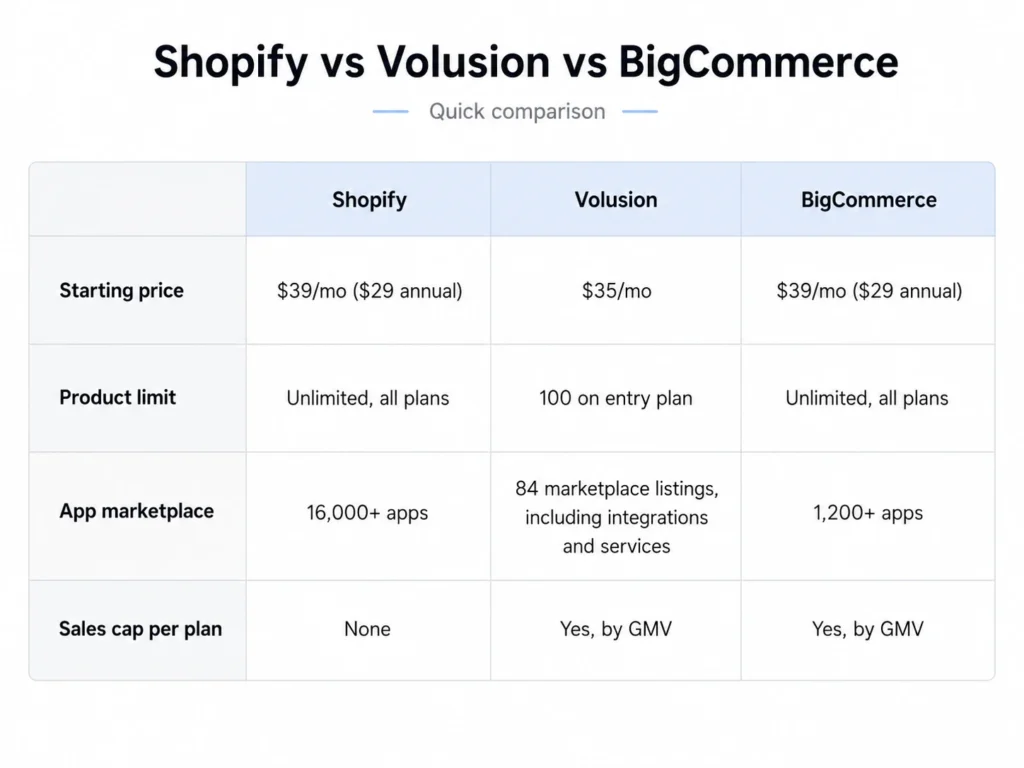
| # | Shopify | Volusion | BigCommerce |
| Starting price | $39/mo ($29 annual) | $35/mo | $39/mo ($29 annual) |
| Product limit | Unlimited, all plans | 100 on entry plan | Unlimited, all plans |
| Platform transaction fees | Yes, unless using Shopify Payments | No gateway maintenance fee with preferred providers; 1.25%–0.35% on non-preferred gateways, depending on plan | 0% with Embedded Payment Providers; 2%, 1% or 0.6% with Open Payment Providers, depending on plan |
| App marketplace | 16,000+ apps | 84 marketplace listings, including integrations and services | 1,200+ apps |
| Sales cap per plan | None | Yes, by GMV | Yes, by GMV |
Shopify vs Volusion pricing compared
Shopify costs more upfront. It does remove the sales caps that Volusion's plans have. Volusion is cheaper at the entry level and skips platform transaction fees entirely, but it locks lower tiers behind strict yearly revenue limits. Here's how the current plans stack up.
Shopify Plans in 2026
| Plan | Monthly cost | Annual cost | Notes |
| Starter | $5/mo | N/A | Buy Button and social selling only, no full storefront |
| Basic | $39/mo | $29/mo | Full store, unlimited products |
| Grow | $105/mo | $79/mo | Formerly called the "Shopify" plan |
| Advanced | $399/mo | $299/mo | Lower card rates, more staff accounts |
| Plus | From $2,300/mo | 3-year term | Enterprise checkout and B2B tools |
Volusion pricing in 2026
| Plan | Monthly cost | Max GMV/year | Product limit | Staff accounts |
| Personal | $35/mo | $50K | 100 | 1 |
| Professional | $79/mo | $100K | 5,000 | 5 |
| Business | $299/mo | $400K | Unlimited | 15 |
| Prime | Custom | Unlimited | Unlimited | Unlimited |
Pricing changes over time on every platform, so treat these numbers as a snapshot and confirm current rates before you commit.
Volusion vs Shopify vs BigCommerce: Where does BigCommerce fit?
BigCommerce sits in an interesting spot between the two. It matches Shopify's unlimited products and staff accounts, but it shares Volusion's feature of capping plans by yearly sales volume.
If you're deciding between Shopify, Volusion, or BigCommerce, BigCommerce is usually the pick for merchants who want more built-in functionality and don't mind installing fewer apps overall.
BigCommerce pricing in 2026
| Plan | Monthly cost | Annual cost | GMV threshold |
| Core | $39/mo | $29/mo | Auto-upgrades above $30K |
| Growth | $105/mo | $79/mo | Auto-upgrades above $100K |
| Scale | $399/mo | $299/mo | 0.9% overage above $33,333/mo |
| Performance | Custom pricing | Starts at $1,499/month, billed annually | Custom |
BigCommerce added a new Open Payment Provider Fee on self-service plans: 2% on Core, 1% on Growth, and 0.6% on Scale, charged on orders processed through a gateway outside its approved list (Stripe, PayPal/Braintree, Adyen, and Checkout.com are exempt).
I don’t think BigCommerce's old "we never charge transaction fees" pitch against Shopify fully holds anymore unless you stick to an approved processor.
Features compared: Apps, payments, themes, and POS
Shopify's app ecosystem is the biggest gap between all three platforms.
Shopify's App Store now lists more than 16,000 apps. Volusion has more than 80 native integrations. BigCommerce lands in the middle with over 1,000+ marketplace apps and stronger native features that reduce how many apps you need in the first place.
I noted a few other differences as well:
> Payment gateways
Shopify integrates with more than 100 payment providers. BigCommerce supports over 130 payment solutions, including 21 Embedded Payment Providers that avoid its Open Payment Provider Fee. Volusion also supports several established gateways.
> Point of sale
Shopify has the most developed POS ecosystem, with hardware you can buy directly and a POS Pro add-on for multi-location retail. Volusion's POS support exists but is far less polished.
> Themes
Shopify has the largest overall theme ecosystem, with 1,000+ free and premium themes. BigCommerce offers a smaller selection of free and paid themes, while Volusion provides 24 no-cost themes but has a more limited overall third-party theme ecosystem.
Platform reliability and company history
Shopify is publicly traded, has been profitable for several years, and continues investing heavily in its platform.
Volusion filed for Chapter 11 in 2020 and was acquired by Newfold Digital, the company behind Bluehost and HostGator, in 2021. It's continued operating since under new leadership, and it's still PCI DSS compliant with a full security program in place, but that history is worth knowing if platform longevity factors into your decision.
BigCommerce is also publicly traded and posted its first full year of GAAP profitability in 2026, which gives it a similar stability profile to Shopify.
None of this means Volusion is unsafe to build on today. It means you're choosing a platform with a smaller team and a narrower recovery margin if things go wrong again.
Shopify, Volusion, or BigCommerce: Which one is better?
Choose Shopify if:
- You're starting a new store and want the largest app and theme selection.
- You plan to sell through multiple channels.
- You want built-in POS for a physical retail location.
- You expect meaningful growth and don't want a sales cap slowing you down.
Pick Volusion if:
- Your sales volume is modest and predictable, and avoiding transaction fees matters more than app selection.
- You don't need a built-in blog or a large third-party app catalog.
Choose BigCommerce if:
- You want more features built in in exchange for installing fewer apps.
- Your store has strong B2B or wholesale requirements.
- You're comfortable managing GMV thresholds and the new payment provider fee structure.
Migrating to Shopify in 2026
If you are on Volusion and planning to migrate to Shopify, it’s easier than most merchants expect.
You'll want to export your product catalog, customer records, and order history from Volusion, then map that data into Shopify's format before import.
Rebuilding your theme and setting up 301 redirects for every changed URL protects the SEO equity you've already built. Most small to mid-sized stores complete this in two to four weeks.
The bottom line
Shopify vs Volusion isn't really a close contest anymore. Shopify wins on apps, themes, payment flexibility, and growth. On the other hand, BigCommerce is a legitimate alternative if you want more built-in in exchange for a smaller app catalog.
Volusion still has a place for merchants already comfortable there or who do not want transaction-fee-free sales.
Whichever direction you go, run the numbers on your actual sales volume and app needs before committing. The up-front price rarely tells the whole story.
FAQs
1. How to migrate from Volusion to Shopify?
Export your products and customer records from Volusion, format them using Shopify’s CSV templates, and import them into your new Shopify store. For order history, custom fields or a large catalogue, use a Shopify migration app, then rebuild your theme, configure payments and shipping. Add 301 redirects and test the store before transferring your domain.
2. Who is Shopify's biggest competitor?
WooCommerce is Shopify’s biggest competitor when measured by overall website adoption. BigCommerce is one of Shopify’s closest direct competitors in the hosted SaaS ecommerce market because both provide managed hosting, built-in commerce tools and plans for growing and enterprise businesses.
3. How much does it cost to migrate to Shopify?
Shopify does not charge a fixed migration fee. A small store can migrate manually with CSV files at no additional cost beyond its subscription, which starts at $39 per month or $29 per month with annual billing. Migration apps will charge according to the number of products, customers and orders transferred, while Shopify Partners set their own prices for custom migrations.
4. Is Shopify better than Volusion in 2026?
For most ecommerce businesses, Shopify is a better choice because it supports unlimited products across its main plans and offers more than 16,000 apps for extending store functionality. Volusion is a good fit for smaller stores, but its lower plans limit the number of products you can sell and how much revenue your store can generate
About the author
Vineet Nair
Vineet is an experienced content strategist with expertise in the ecommerce domain and a keen interest in Shopify. He aims to help Shopify merchants thrive in this competitive environment with technical solutions and thoughtfully structured content.