







Shopify is a hosted ecommerce platform that lets you build and run your own branded online store on your own domain, with full control over design, checkout and customer data. Etsy is an online marketplace where buyers already shop for handmade, vintage and craft supply items. Shopify gives you the store and Etsy gives you the audience.
If you sell handmade or made-to-order products and want buyers on day one, Etsy is the faster start. If you want to own your brand, your customer list, and your margins, Shopify is the better long-term option.
But that’s just the gist of it. There are still a lot of things you need to consider before you make a choice.
I have built and migrated Shopify stores for over a decade, and sellers who ask me "Etsy or Shopify?" almost always mean the same thing:
"Where will I keep more of what I earn?"
Selling on Etsy vs Shopify depends on what you want from your online business. Etsy gives sellers access to an existing marketplace audience, while Shopify helps businesses build their own brand, customer base, and store experience.
So here is the comparison on fees, audience, control, and print-on-demand rules as they stand in 2026.
A conversation that changed how I look at ecom platforms

I still remember a conversation with a merchant who was deciding where to start selling online.
Their first thought was Etsy. It made sense. They could upload products, reach existing shoppers, and avoid the challenge of bringing their own traffic. For a new seller, that simplicity was attractive.
But as we discussed their bigger goals, the plan changed immediately. They wanted to build a recognizable brand, understand their customers, and have more control over how their business grew.
That discussion made one thing clear to me: choosing between Etsy and Shopify depends on whether a seller wants the reach of a marketplace or the ownership that comes with building their own ecommerce store.
Shopify vs Etsy: The short version
- Etsy is a marketplace. No monthly fee, but Etsy takes roughly 10 to 12% of every US sale before ad costs.
- Shopify is a store platform. From $39 per month, you keep your customer data and pay only card processing per sale.
- Etsy wins when you are testing products, selling under roughly $1,000 a month, or selling gift items people already search for on Etsy.
- Shopify wins when repeat customers, email marketing, branding, or higher order values matter.
What is Shopify?

Shopify is a popular e-commerce platform for starting and growing an online store. It is trusted by millions of businesses globally and is perfect for all types of businesses.
With Shopify, you have complete control over your store customization. It provides many marketing tools, apps, themes, and other tools to scale your business.
Shopify pros
- Ease of use: Shopify has an easy-to-use interface that is easy for both beginners and experienced users.
- Customization: Shopify provides customization options for themes, apps, and other tools.
- Scalable & secure: As Shopify can handle high traffic and transactions, it will scale with your business and provide high security.
- Integrated payment gateways: Shopify supports various payment gateways like ShopPay, PayPal, Stripe, and many more.
- Shopify App Store: The Shopify App Store provides thousands of Shopify apps that merchants can use to boost their sales.
Shopify cons
- Monthly fees: Monthly fees could be challenging for startups or small businesses that don't generate significant revenue.
- Transaction fees: Shopify provides different pricing plans, some of which include transaction fees.
- App dependency: Sometimes, relying on third-party apps can lead to compatibility issues or extra charges.
- Success time: Just like other platforms, you must be patient and wait for substantial success.
What is Etsy?
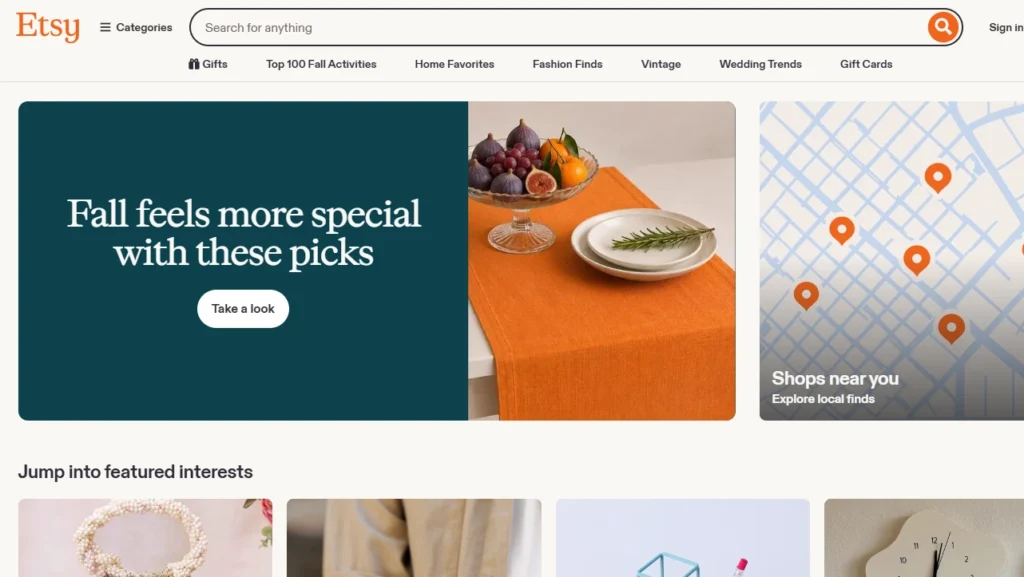
Etsy is an online marketplace focusing on handmade, vintage, and unique goods.
It has grown into a global platform where artisans, crafters, and independent creators can sell their products directly to consumers. It also offers a wide range of categories, such as jewellery, clothing, crafts, etc.
Etsy pros
- Large audience: Etsy has a massive built-in audience of buyers who specifically visit the platform to discover unique products.
- Built-in trust and reputation: Etsy has established itself as a reputable marketplace known for its focus on handmade and unique products.
- Global reach: Etsy operates internationally, allowing sellers to reach customers worldwide.
Etsy cons
- Limited growth opportunities: Some sellers may find it difficult to scale their businesses on Etsy due to its focus on handmade, unique products and the limitation of other categories.
- Limited branding and customization: Etsy sellers have limited control over their shops' overall design and functionality.
- Dependency on platform: Sellers on Etsy rely on the platform's algorithms and policies to reach customers and manage their businesses.
- Marketing you do not control: Etsy gives you listing tags and its own search, but you cannot control site structure, schema, page speed, or blog content the way you can on your own domain. You also cannot email Etsy buyers to sell to them again, since Etsy restricts marketing to buyers off-platform.
Shopify vs Etsy fees in 2026: What each platform takes
Shopify charges a subscription: Basic $39 per month, Grow $105, Advanced $399, with roughly 25% off annually.
There is also a $5 Starter plan and Plus from around $2,300. Card processing through Shopify Payments runs about 2.9% plus 30 cents on Basic, 2.7% on Grow and 2.5% on Advanced.
Use an outside gateway, and Shopify adds 2%, 1%, or 0.6% depending on the plan.
Etsy charges per sale instead: a $0.20 listing fee, a 6.5% transaction fee on the full amount the buyer pays, including shipping, and 3% plus $0.25 processing for US sellers.
New shops pay a one-time setup fee of $15 to $29. Offsite Ads add 15%, and become a mandatory 12% once you pass $10,000 in trailing annual sales.
Here’s a simple breakdown. For example, on a $50 order:
- Etsy: $0.20 + $3.25 + $1.75 = $5.20, about 10.4%. If Offsite Ads triggered it, add $7.50.
- Shopify Basic: $1.75 in card fees, plus $39 spread across the month.
Know more about Etsy fees before choosing this platform.
Difference between Etsy and Shopify: Which platform fits your business?
| Comparison | Shopify | Etsy |
| Cost model | $39–$399/month on monthly plans (or lower with annual billing) + payment processing fees | No monthly subscription required. Sellers pay listing fees, transaction fees, payment processing fees, and optional advertising fees |
| Audience | You build your own audience through SEO, ads, social media, and marketing channels | Access to Etsy’s marketplace audience with more than 86 M active buyers already shopping for products |
| Product rules | Sell almost any legal product category with fewer marketplace restrictions | Focused on handmade items, vintage products (20+ years old), and craft supplies |
| Branding | Full control over storefront design, domain, checkout experience, and customer journey | Marketplace-based storefront with Etsy’s layout, branding, and shopping experience |
| Customer data | You own customer relationships, including customer information and remarketing opportunities (subject to privacy laws) | Etsy controls the marketplace relationship; seller access to buyer data is limited |
| SEO & discovery | Own domain, blog, structured data, technical SEO, and complete control over organic growth strategy | Discovery mainly depends on Etsy search ranking, listings, tags, and marketplace algorithms |
| AI discovery | Supports AI-powered commerce experiences and integrations that help products appear in emerging shopping channels | Etsy has a native ChatGPT app (beta) allowing shoppers to discover Etsy products through conversations |
| Best for | Brands building long-term assets, repeat customers, higher-value products, and scalable ecommerce businesses | New sellers, handmade creators, gift products, niche items, and testing product demand |
Shopify vs Etsy for print on demand
When comparing Shopify vs Etsy for print on demand, Etsy is better for creators who want marketplace visibility, while Shopify works better for sellers who want complete control over branding, pricing, and customer relationships.
Etsy allows print on demand in 2026 and shows no sign of banning it. But it has three rules:
- The design must be your original work. Buying an SVG or commercial-licence file and printing it does not count.
- Every production partner, whether Printify, Printful or Gelato, must be disclosed in your shop settings and on the listing.
- AI-assisted designs must be disclosed.
Etsy tightened the final rule in 2026, when items made with computerised tools from templated designs stopped qualifying unless the design is yours. Most suspended POD shops I have looked at failed on rule one or two, not on using POD itself.
Shopify has no rules like this. You connect a POD app, set your margin, and sell. The trade is that nobody arrives on their own, so you pay for ads or build SEO from zero.
Ready to move your store from Etsy to Shopify?
If Shopify is the right fit for your ecommerce goals, working with an experienced Shopify migration agency like Identixweb can help you move your products, customer data, and store settings safely without affecting your business operations.
From migration planning to post-launch optimization, we handle the technical process so you can focus on growing your store.
Etsy or Shopify, what should you choose?
After a decade of building these, my decision rule is short.
Pick Etsy if you make things by hand, you have no audience yet, and you want sales this month. Its 86.6 million active buyers are a real asset, and spend per buyer hit $124 in Q2 2026, so demand is holding up.
Pick Shopify if you want a business rather than a shop. You own the domain, email list, checkout, and data, and the fee stack stops eating a bigger share as you grow. Still weighing it?
Here are a few more comparison blogs if you are choosing an e-commerce platform in 2026.
FAQs
1. Is Shopify better than Etsy for selling online?
It depends on volume. Etsy costs nothing monthly but takes roughly 10 to 12% of every US sale, while Shopify charges from $39 a month and then only card processing at 2.9% plus 30 cents on Basic. Past about 25 to 30 orders a month, Shopify keeps more in your pocket and hands you the customer data too.
2. Does Shopify integrate with Etsy?
Yes, but through a third-party app, not natively. Shopify's own Marketplace Connect dropped Etsy, and its App Store listing now covers only Amazon, Target Plus, Walmart and eBay. Any guide still recommending Marketplace Connect for Etsy is out of date, including Shopify's own blog post.
3. How to link Etsy to Shopify?
Install a dedicated Etsy sync app from the Shopify App Store: CedCommerce from $9 a month, QuickSync from $19, or DPL from $19.99, all built on the Etsy API. Authorise your Etsy shop, map every SKU so stock counts match, set Shopify as the single source of truth, then switch on two-way order sync. Budget an hour, and expect SKU mapping to be where things break.
4. Which is better: Shopify or Etsy?
Match the platform to what you sell. Etsy suits handmade, vintage or craft supply products under about $40 when you have no audience yet. Shopify suits everything else, and becomes the right answer the moment repeat purchases, an email list or a real brand start mattering.
5. Can I sell on both Etsy and Shopify?
Yes, and it is the setup I recommend most often. Both platforms allow it, and the only requirement is real-time inventory sync so a sale on one side updates the other. Etsy fees still apply to Etsy orders and Etsy keeps the buyer relationship, so treat Etsy as discovery and Shopify as where you build the list.
About the author
Sajini Annie John
Meet Sajini, a seasoned technical content writer with a passion for e-commerce and expertise in Shopify. She is committed to helping online businesses to thrive through the power of well-crafted content.