





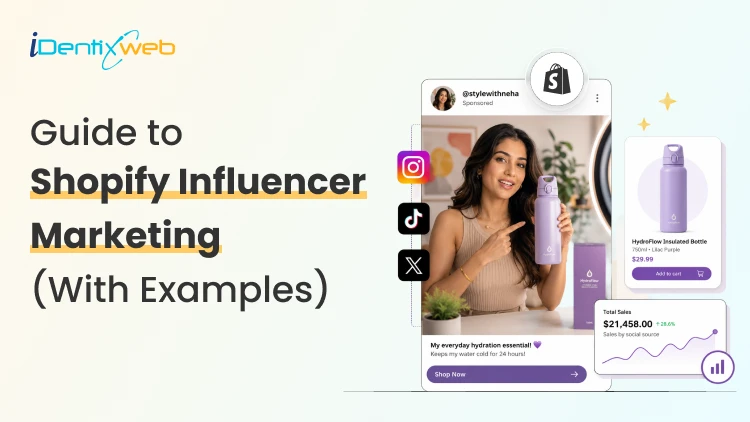
Influencer marketing can put your Shopify products in front of people who may never discover them through ads or search.
A creator can review your product, show how it works, share a discount code, or simply introduce your brand to an audience that already trusts their recommendations.
But getting sales from influencer marketing takes more than sending products to popular creators.
You need the right audience match, the right campaign approach, and a clear way to track what actually drives clicks, orders, and revenue.
This guide covers how Shopify influencer marketing works, which strategies are worth trying, and how to measure the results.
What is Shopify influencer marketing?
Shopify influencer marketing is a strategy in which Shopify brands partner with content creators to promote products, reach relevant audiences, and generate sales.
These partnerships can include product gifting, sponsored content, affiliate programs, reviews, tutorials, unboxing videos, and long-term brand ambassadorships.
The best creator is not necessarily the one with the largest following. Audience relevance, content quality, engagement, brand fit, and the creator’s ability to influence purchase decisions are more important.
For smaller Shopify brands, nano and micro-influencers can be particularly useful because they often serve focused communities and are more accessible than large-scale creators.
Best influencer marketing strategies for Shopify brands
1. Set a clear goal before choosing influencers
Decide what the campaign should achieve before contacting creators. Common goals include increasing brand awareness, generating product-page traffic, launching a new product, collecting creator content, and acquiring customers.
Match the goal with measurable KPIs. For example, in awareness campaigns, track reach, impressions, and engagement.
2. Prioritize audience fit over follower count
A creator with a smaller but highly relevant audience can be more valuable than an influencer with millions of unrelated followers.
Review the creator’s audience, content quality, engagement patterns, previous brand partnerships, and whether their style naturally fits your products.
Nano and micro-influencers are particularly useful when a Shopify brand wants to reach a focused niche without committing to a large creator budget.
3. Combine paid partnerships with performance incentives
Shopify brands do not have to choose between sponsorships and affiliate marketing.
A creator can receive a fixed content fee along with a commission for sales generated through an affiliate link or creator-specific discount code.
This gives the creator guaranteed compensation while creating an additional incentive to generate conversions.
4. Give creators a clear brief without over-scripting
Specify campaign objectives, key product information, deliverables, deadlines, required disclosures, and any claims that should or should not be made.
At the same time, leave room for the creator to communicate in their own style. Influencer content works best when it feels consistent with the content the creator’s audience already follows.
If the brand plans to reuse creator content in paid ads, product pages, emails, or other marketing channels, content usage rights should also be agreed upon before the campaign begins.
5. Build long-term relationships with top performers
Instead of continuously replacing influencers after one post, identify creators who consistently generate qualified traffic, sales, or high-quality content.
Long-term creators become more familiar with the products and can promote them naturally across product launches, seasonal campaigns, and other marketing activities.
Shopify brands can support these relationships with commissions, early product access, exclusive offers, and performance-based incentives.
6. Make disclosure part of every influencer brief
Sponsored, gifted, and affiliate relationships should be disclosed clearly.
For brands marketing to US consumers, the FTC requires material connections between brands and endorsers to be disclosed in a way consumers can easily notice and understand.
Influencer marketing examples Shopify Brands can learn from
1. Good Girl Snacks: Product Gifting
Good Girl Snacks built its influencer strategy around product seeding rather than paid sponsored posts.
The brand gifted its Hot Girl Pickles to creators including Alix Earle, Hallie Batchelder, and Kit Keenan, choosing people who were already likely to enjoy and naturally talk about the product.
According to cofounder Leah Marcus, the approach generated buzz and sales while maintaining a zero-dollar customer acquisition cost for its influencer marketing.
For smaller Shopify brands, it shows how carefully targeted gifting can be an alternative to paying creators upfront.
2. Graza: Influencer seeding before and around launch
Olive oil brand Graza used product seeding to get its Sizzle and Drizzle products into the hands of relevant food creators such as Molly Baz and Samin Nosrat.
Instead of requiring creators to publish sponsored posts, the brand focused on getting the product to people whose content and audiences naturally matched what it was selling.
The campaign helped create significant launch buzz, and Shopify reports that Graza sold out of olive oil during its first week.
The key lesson is to identify creators who genuinely fit the product rather than treating every gifted product as a guaranteed promotion.
3. Gymshark: Long-term creator partnerships
Gymshark takes influencer relationships beyond individual sponsored posts. Its creator partners, known as Gymshark Athletes, can provide product feedback and participate in collaborations.
Fitness creator Whitney Simmons, for example, has worked with Gymshark on multiple collections.
This approach turns influencers into long-term brand partners rather than temporary advertising channels.
Shopify brands that find creators who consistently connect with their audience can similarly develop longer partnerships across launches, content campaigns, and product collaborations.
How can influencer marketing boost sales on Shopify?
1. Builds trust through creator recommendations
Influencers can make product recommendations feel more relatable than traditional advertisements.
Reviews, tutorials, demonstrations, and real-life product use give shoppers additional context before they decide to buy.
2. Reaches more relevant audiences
The right influencer gives a Shopify brand access to an audience that already has an interest in its product category.
This can bring more qualified visitors to product and collection pages instead of simply increasing overall reach.
3. Creates social proof for products
Creator reviews, unboxing videos, testimonials, tutorials, and user-generated content show potential customers how a product looks and works in real situations.
This type of content can reduce uncertainty and strengthen purchase confidence.
4. Drives traffic directly to Shopify stores
Influencers can send shoppers directly to a Shopify store through product links, affiliate links, campaign landing pages, and social commerce content.
Brands can use creator-specific links and UTM parameters to understand which influencers are driving valuable traffic.
5. Generates sales through affiliate links and discount codes
Shopify brands can give creators unique affiliate links or discount codes to encourage purchases and track attributed sales.
Performance-based partnerships can also reward influencers with commissions when their referrals convert into orders.
For better attribution, assign a unique discount code to each creator rather than using one generic campaign code.
Shopify Collabs can create and track affiliate links and discount codes for creator partnerships.
Merchants can still directly invite creators and accept creator applications, although Shopify currently states that Collabs is not accepting new creator signups.
Shopify influencer sales tracking methods
Shopify brands can track influencer-driven sales using affiliate links, creator-specific discount codes, UTM-tagged URLs, Shopify Analytics, and post-purchase attribution.
Using more than one method is usually better because customers do not always purchase immediately after seeing influencer content.
1. Shopify Collabs affiliate links and codes
For creators working through Shopify Collabs, merchants can provide affiliate links and creator-specific discount codes.
Collabs tracks performance such as visits, sales, and conversions for individual creators, making it useful for performance-based partnerships and commissions.
2. Creator-specific UTM links
Give each creator a trackable URL using UTM parameters. For example, the campaign structure can distinguish the source, influencer campaign, and individual creator.
UTMs make it easier to analyze influencer traffic in Shopify reports and Google Analytics 4, including sessions, landing-page behavior, and conversions.
Avoid giving every influencer the same campaign URL. Creator-level tracking makes it much easier to identify which partnership actually generated qualified traffic.
3. Unique influencer discount codes
Give every influencer a unique code instead of using one generic discount such as SAVE10.
Creator-specific codes provide another attribution signal when customers remember the influencer’s recommendation but do not purchase through the original affiliate link.
Track redemptions, order value, and revenue for each code and compare the results with link-based attribution.
4. Shopify marketing and attribution reports
Shopify Analytics can help brands analyze sessions, orders, sales, conversion rate, average order value, and other marketing metrics.
Shopify also supports multiple attribution models, including first click, last click, last non-direct click, any click, and linear attribution.
Comparing models can provide a more complete picture when customers interact with an influencer and then return through another channel before purchasing.
5. Post-purchase surveys
Not every influencer-assisted sale can be captured through a click or discount code.
A shopper might watch a TikTok or Instagram Reel, search for the brand later, and purchase directly.
Adding a simple post-purchase question such as “How did you hear about us?” can help identify creator influence that link-based attribution misses.
Metrics Shopify brands should track
| Metric | What it shows |
| Influencer-attributed sales | Revenue associated with a creator |
| Orders | Number of purchases generated |
| Conversion rate | Percentage of referred visits that become sales |
| Average order value | Average value of influencer-generated orders |
| Discount code usage | Orders using a creator-specific code |
| Commission | Amount payable to the creator |
| CPA | Cost required to acquire a customer |
| ROAS | Revenue generated compared with campaign spend |
| ROI | Financial return after campaign costs |
Do not judge influencer performance from likes or follower count alone. Combine creator engagement data with store traffic, conversions, and revenue to determine which partnerships are actually contributing to growth.
Making influencer marketing work for your store
Influencer marketing can be a practical growth channel for Shopify brands when the right creators, campaign format, and tracking methods are in place.
By combining authentic creator content with affiliate links, discount codes, and clear performance measurement, merchants can turn influencer partnerships into more qualified traffic, stronger trust, and measurable sales.
FAQs
1. How to track influencer sales on Shopify?
Shopify merchants can track influencer sales using creator-specific affiliate links and discount codes. Shopify Collabs reports each creator’s visits, orders, sales, and conversion rate. For more complete attribution, use unique UTM-tagged links alongside these codes so influencer traffic and conversions can also be analyzed in Shopify Analytics or GA4.
2. How to find Instagram influencers for Shopify?
Use Shopify Collabs’ Recruiting section to search for relevant creators and send direct invitations, or use Instagram’s Creator Marketplace where available to discover creators recommended for your brand. Before partnering, review audience relevance, engagement quality, previous brand collaborations, and content style rather than choosing creators based only on follower count.
3. What influencer discovery tools work best for Shopify stores?
Shopify Collabs is a strong native option because it connects creator recruitment, affiliate links, discount codes, sales tracking, and commissions directly with Shopify. For broader discovery and larger programs, platforms such as Modash, GRIN, and Upfluence offer Shopify integrations and more extensive creator discovery, vetting, campaign management, and performance-tracking capabilities.
About the author
Priyanka Chaudhari
Priyanka Chaudhari is an enthusiastic tech writer with a horizon of experience in multiple domains. She loves writing about marketing, e-commerce, and technology. Currently, she is employed with Identixweb as a senior content writer.