





It's late. You're scrolling through your Shopify analytics. Your last 100 customers cost you $4,800 in ad spend. Most were bought once and disappeared.
Meanwhile, your competitors are sending email campaigns with "You've earned 500 points" subject lines. Their repeat-purchase rate is 47%. Yours is 12%.
That's the loyalty gap. And in 2026, it's the difference between a store that scales and one that bleeds.
This guide isn't about which app to install. It's about the 10 Shopify loyalty reward strategies that actually move retention numbers. These are the ones I've watched work across 50+ DTC brands, plus the mistakes that keep most loyalty programs flat.
Let's get into them.
Why a Strong Shopify Loyalty Rewards Strategy Beats Loyalty Software
Most stores launch Shopify loyalty rewards programs, set “1 point per $1,” and walk away. Six months later, they wonder why the redemption rate is at 8%, and the repeat-purchase rate hasn't moved.
The app isn't the problem. The strategy is.
A points program without a tier structure earns 1.8x less ROI than one with tiers. A program without email reminders sees 49% of members never use it (Source: Statista). A reward worth less than $5 at the first tier gets ignored.
The strategies below fix those gaps. Use them in order, and you'll outperform stores that just installed an app and hoped for the best.
Strategy 1: Pick the Right Reward Model Before Launching
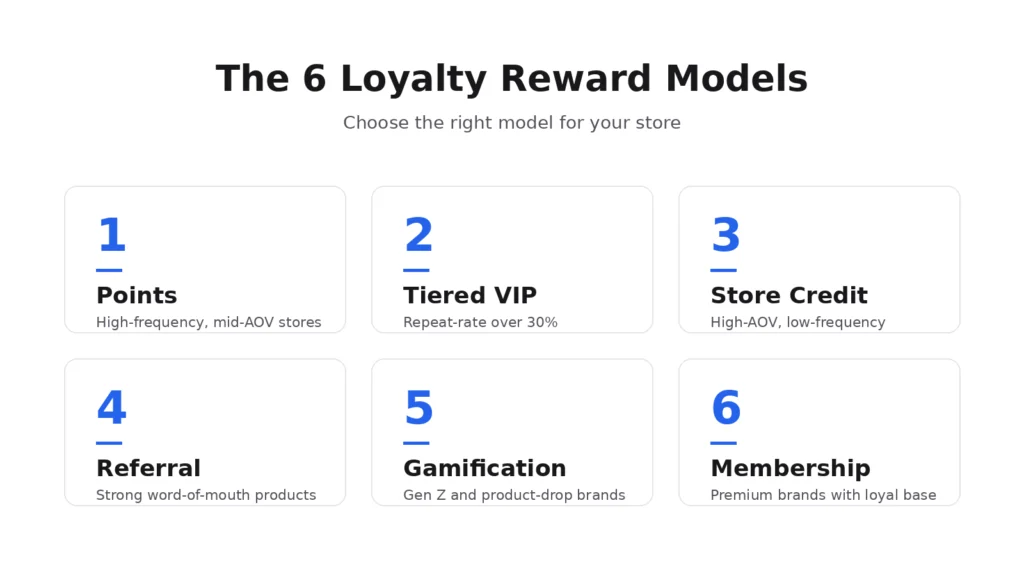
The biggest mistake Shopify merchants make with Shopify loyalty rewards is choosing the wrong reward structure. Points are one of six valid reward models, and the wrong fit kills participation.
Match your reward model to your product's purchase frequency and average order value (AOV):
- Points work for high-frequency, mid-AOV stores (skincare, supplements, coffee, pet food). Customers earn enough points fast to feel rewarded.
- Tiered VIP programs work for stores with 30%+ repeat-purchase rates. They turn casual buyers into status-driven loyalists.
- Store credit / cashback works for high-AOV brands (jewelry, furniture, electronics) where points feel abstract but $25 back feels real.
- Referral programs work for any store with a strong word-of-mouth product. Skincare and apparel see 20%+ referral rates when the incentive is right.
- Paid memberships work for premium brands where customers will pay $50-$100/year for VIP perks. Songmont made $110K in 14 days using this model.
- Gamification works for younger audiences (Gen Z) and stores with frequent product drops. Spin wheels, badges, and missions drive between-purchase engagement.
Action step: Look at your last 90 days of orders. Your repeat-purchase window averages under 60 days, so start with a points-based Shopify loyalty rewards model. If it's over 90 days, start with tiered VIP. If you're high-AOV with infrequent purchases, start with store credit.
Strategy 2: Set Reward Values That Actually Feel Worth It
One of the fastest ways to kill engagement in Shopify loyalty rewards programs is offering rewards that feel too small. The reward feels insignificant, and they forget the program exists.
The minimum reward value that drives action is $5 at the first redemption tier. Below that, you're underselling the customer's effort to track and redeem.
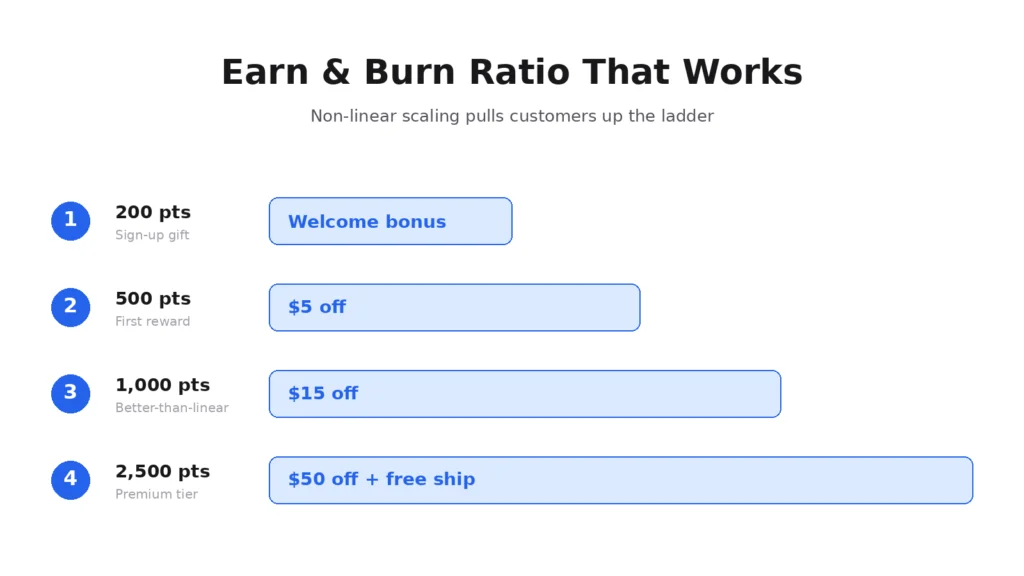
Here's a tested earn-and-burn ratio that works for most Shopify stores:
- Earn: 1 point per $1 spent
- Welcome bonus: 200 points for signing up
- First reward: 500 points = $5 off (achievable after one $300 order or via signup + small purchase)
- Mid-tier reward: 1,000 points = $15 off (better-than-linear value to encourage saving)
- Premium reward: 2,500 points = $50 off + free shipping
Notice the non-linear scaling. The premium reward gives more value per point than the first reward. This is intentional. It pulls customers up the ladder.
Action step: Calculate your gross margin. Cap point liability at 3-5% of revenue. If your margin is 60%, a $5 reward at 500 points means you're giving up $5 on every $300 of customer spend, well within healthy limits.
Strategy 3: Build VIP Tiers That Actually Mean Something
Flat Shopify loyalty rewards programs almost always underperform tiered systems by 1.8x in ROI.
But most tier structures are theater. They have names like "Silver, Gold, Platinum" but the perks are nearly identical. Real tiers create real status differences.
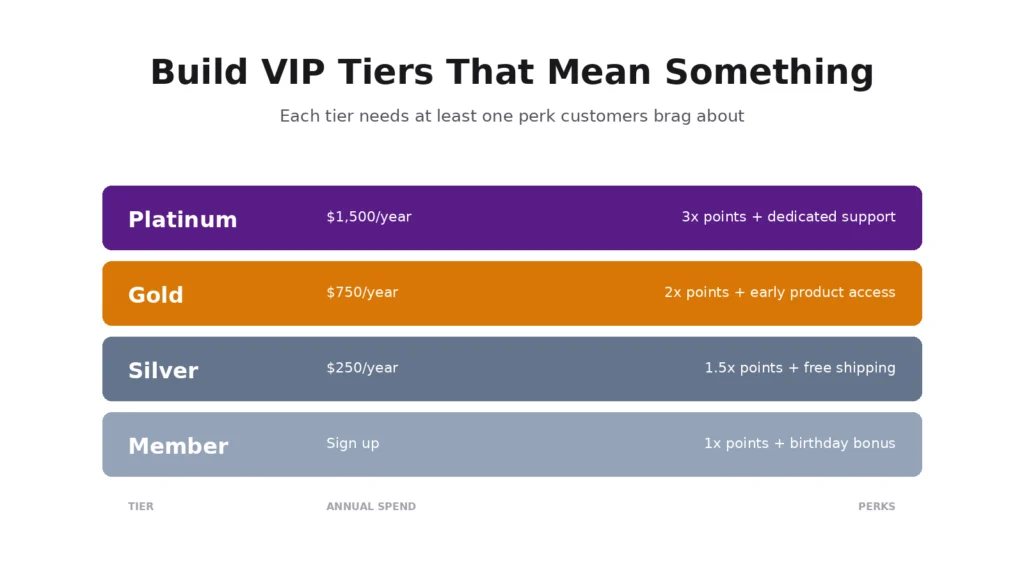
Here's a tier structure that drives behavior:
| Tier | Threshold | Real Perks |
| Member (default) | Sign up | 1x points, birthday bonus |
| Silver | $250/year spend | 1.5x points, free shipping over $50, early access to sales |
| Gold | $750/year spend | 2x points, free shipping any order, exclusive products, surprise gifts |
| Platinum | $1,500/year spend | 3x points, free returns, dedicated support line, annual gift |
The key isn't the names. It's making each tier feel meaningfully different. Free shipping at Silver. Exclusive products at Gold. Dedicated support at Platinum. Each tier needs at least one perk that a customer will brag about.
Action step: Survey your top 10 customers. Ask: "What's one perk you'd love that we don't currently offer?" Build that into your top tier.
Strategy 4: Email Your Members 3 Times They'll Actually Open
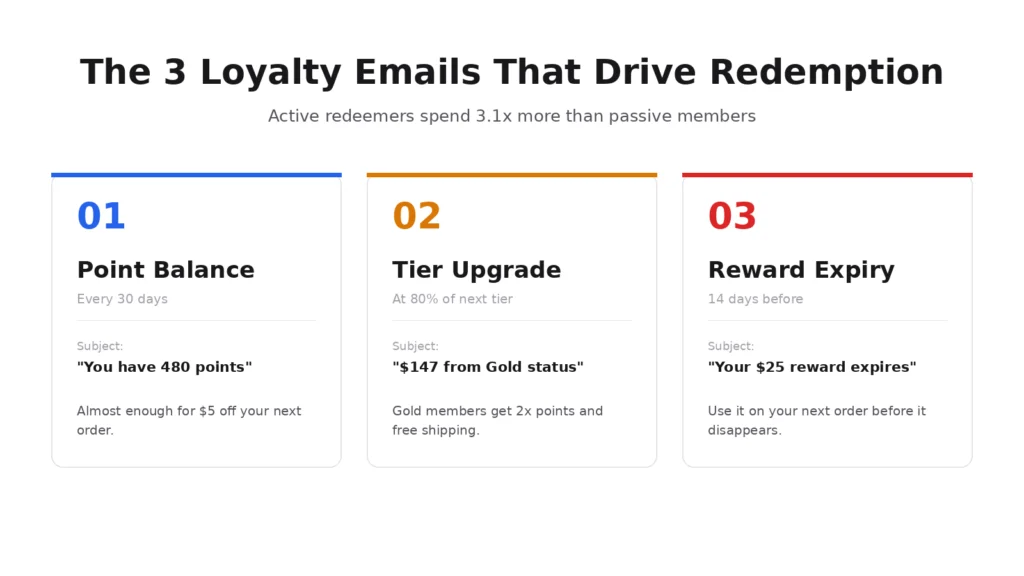
In most Shopify loyalty rewards programs, active redeemers spend 3.1x more than passive members.
Most loyalty programs send a generic welcome email and stop. The members who never use the program never get pulled back in.
Three emails do the heaviest lifting:
1. The point-balance reminder (every 30 days)
"You have 480 points. That's almost enough for $5 off your next order."
Specific number. Specific value. Specific next action.
2. The tier-upgrade nudge (when 80% of the way to the next tier)
"You're $147 away from Gold status. Gold members get 2x points and free shipping on every order."
Loss aversion + concrete benefit. This email has the highest click-through rate of any loyalty trigger.
3. The reward-expiry warning (14 days before)
"Your $25 reward expires April 30. Use it on your next order before it disappears."
Urgency + specific deadline. Recovers 30-40% of customers who would have churned silently.
Action step: Set up these three flows in Klaviyo (or your email tool) before you do anything else. They'll generate more revenue than any other loyalty optimization.
Strategy 5: Reward Actions Beyond Just Purchases
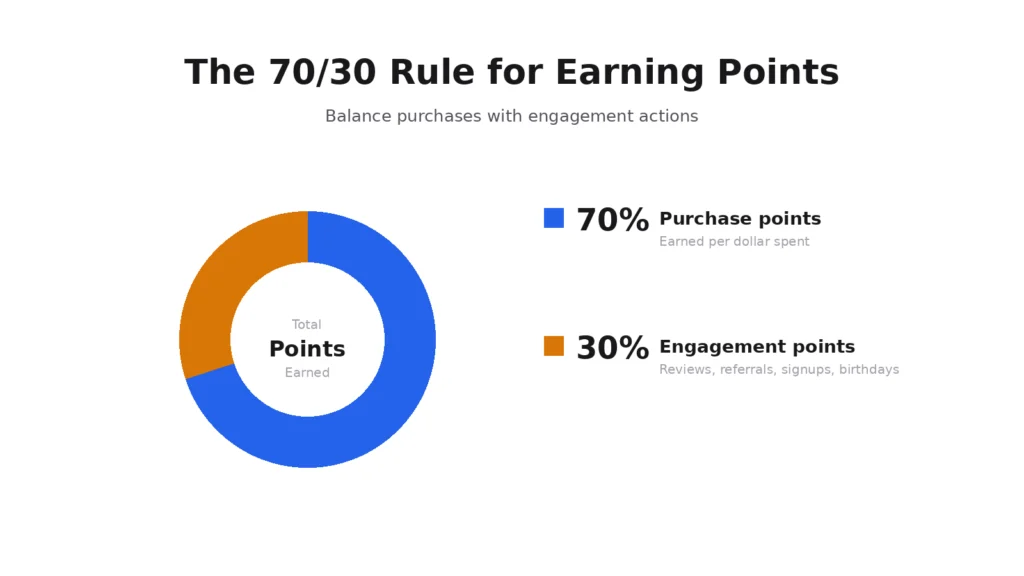
Most Shopify loyalty rewards programs only reward purchases. That misses 70% of the engagement opportunity.
Customers do many valuable things between purchases. Reward those, and you build engagement that compounds:
- Account creation → 100 points (low-cost, high-acquisition signal)
- Email signup → 50 points (builds your most valuable channel)
- Birthday → 200 points (drives a "thank you" purchase)
- Product review → 50 points (UGC fuels conversion)
- Photo review → 150 points (better UGC, better social proof)
- Social follow → 25 points (low-effort engagement)
- Referral that converts → 500 points (highest LTV channel)
- Anniversary of first purchase → 100 points (retention nudge)
The 70/30 rule applies: 70% of points should be earned via purchases, 30% via engagement actions. More than 30% from engagement, and you devalue purchases. Less than 30% and you miss the engagement compounding effect.
A note on tooling: combining loyalty, reviews, and referrals into a single workflow is what makes this strategy practical.
Platforms like Yuko bundle all three into one dashboard, so a customer earning points for a photo review is the same record as the customer earning points for a referral, no syncing, no broken attribution. Whatever tool you use, keep these three reward channels under one roof.
Action step: Audit your current earning rules. If you only reward purchases, add 3-4 engagement actions this week. Start with reviews and referrals - both pay back immediately.
Strategy 6: Make Redemption Frictionless at Checkout
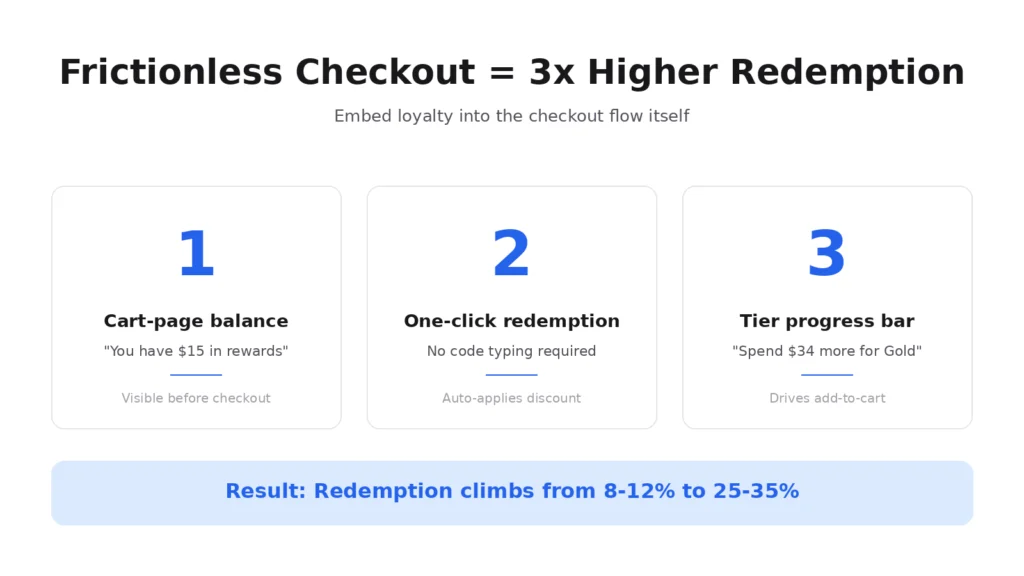
A Shopify loyalty rewards system where customers can't redeem points at checkout is a system nobody uses.
The best Shopify stores embed loyalty into the checkout flow itself, so customers see their available rewards at the moment of purchase. No copy-paste codes. No emails. No friction.
Three checkout integrations matter:
- Point balance display on cart page - customers see "You have $15 in rewards" before they hit checkout
- One-click redemption - clicking a reward auto-applies the discount, no code typing
- Tier progress bar - "Spend $34 more to unlock Gold benefits" pulls customers to add to cart
Stores that implement checkout-level loyalty see redemption rates climb from 8-12% (industry average) to 25-35%. That's not a small lift; that's the difference between a program that works and one that doesn't.
Action step: Test your own checkout. Try redeeming a reward as a customer. If it takes more than 2 clicks or requires copy-pasting a code, fix it before launching any other strategy.
Strategy 7: Use Tier Status as a Marketing Channel
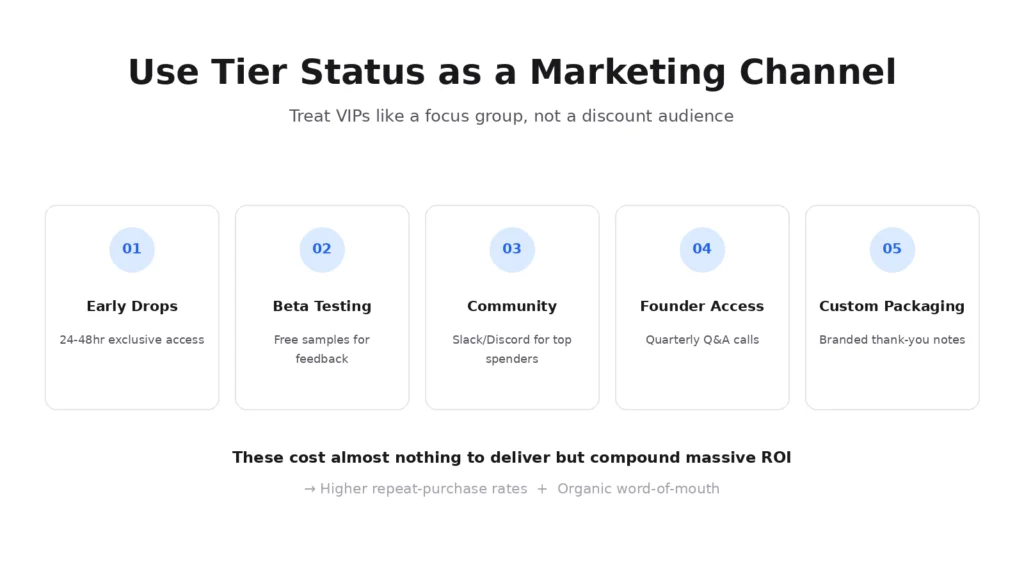
In mature Shopify loyalty rewards programs, VIP members become the highest-value customers.
Treat them like a focus group, not a discount audience.
Here's what high-performing Shopify stores do with their top tiers:
- Early product drops - Gold and Platinum members get 24-48 hour exclusive access
- Beta product testing - Send free samples to top-tier members in exchange for honest feedback
- Private community - A Slack, Discord, or Circle community just for top spenders
- Founder access - Quarterly Q&A calls with the founder for Platinum members
- Custom packaging - Branded thank-you notes or premium packaging for top-tier orders
These perks cost almost nothing to deliver but generate two outcomes that drive massive ROI: higher repeat-purchase rates and organic word-of-mouth.
A customer who spends $1,500/year and gets a personal video from the founder doesn't churn. They become a advocates.
Action step: Identify your top 50 customers by lifetime value. Send them a personal email this week, thanking them. Watch what happens to their next-90-day spend.
Strategy 8: Set Smart Point Expiration (Not Too Short, Not Too Long)
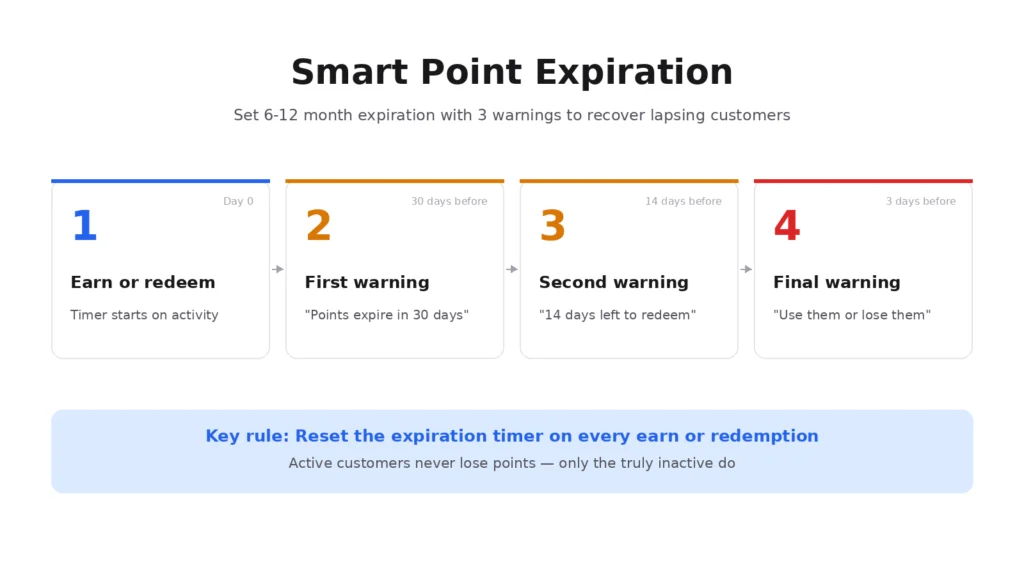
Points that never expire become a financial liability on your balance sheet. Points that expire in 30 days kill redemption and frustrate customers.
The goldilocks zone for most Shopify stores is 6-12 month expiration, with two clear rules:
- Reset the timer on activity - If a customer earns or redeems points, their full balance gets a fresh expiration date. This rewards engagement instead of punishing it.
- Send 3 expiration warnings - 30 days out, 14 days out, and 3 days out. Customers who get all three reminders redeem at 4x the rate of those who get one.
Why expiration matters financially: unused points sit on your balance sheet as unredeemed liability. A store with 50,000 members earning 100 points/month creates $50,000+ in potential payouts. Without expiration, that liability grows forever. With smart expiration, it stays manageable.
The B2B ecommerce industry holds $48 billion in unredeemed loyalty points liability (Source: Statista). Don't add to that number unnecessarily.
Action step: Set your point expiration to 12 months from last activity (earn or burn). Add the 3-warning email sequence. Review your point liability quarterly.
Strategy 9: Build Referrals Into the Reward Stack
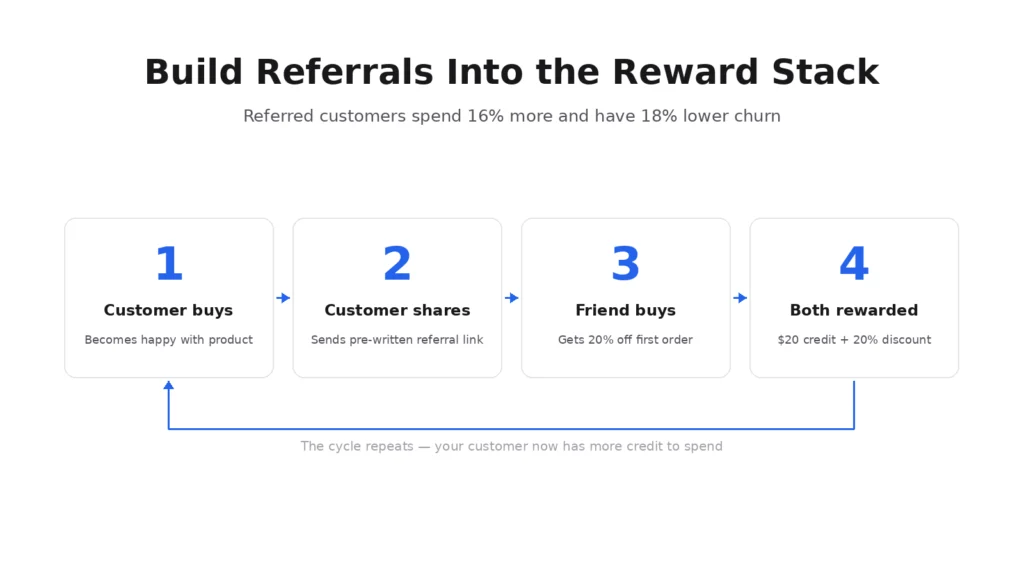
Referrals are one of the highest-performing channels inside modern Shopify loyalty rewards ecosystems. Customers acquired via referral spend 16% more and have 18% lower churn than customers from any other channel.
Yet most loyalty programs treat referrals as a side feature. Make them the core.
A referral program that works has four components:
1. A two-sided reward - both the referrer and the friend get something. Lopsided rewards feel selfish.
The referrer gets $20 in store credit. The friend gets 20% off their first order. Both win.
2. A pre-written share message - make it easy for the customer to share. Most won't write their own.
"I love [Brand Name]'s [product]. You get 20% off your first order with my link, and I get $20 toward my next order. [link]"
3. Multi-channel sharing - email, SMS, WhatsApp, Instagram DM, Facebook Messenger. Different customers share on different platforms.
4. Anti-fraud protection - IP matching, email-domain checks, and per-user codes prevent self-referrals and coupon site abuse.
Most Shopify stores stitch referrals together with separate apps for loyalty, reviews, and referral tracking. That fragmentation creates attribution problems. Unified platforms like Yuko keep all four components - two-sided rewards, share messages, multi-channel sharing, anti-fraud in one workflow, so a referral that converts updates the same customer record as their points and reviews.
Action step: If your current referral reward is under $20 (or 20% off), raise it. The cost feels high until you calculate the LTV of a referral customer. Then it feels cheap.
Strategy 10: Track the Three Numbers That Actually Matter
Most stores measure loyalty programs by signups. That's the wrong number.
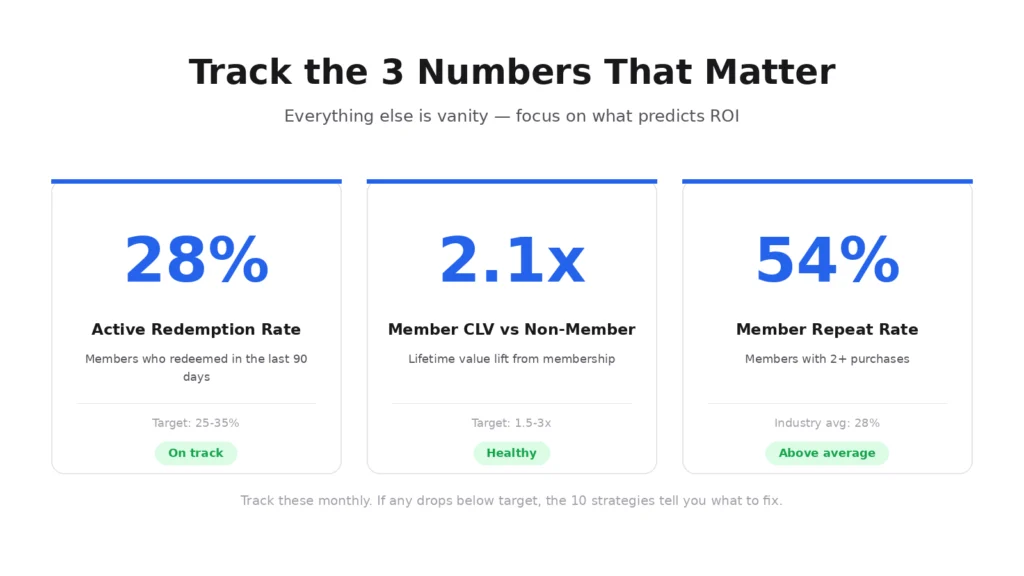
Three metrics tell you whether your program is working:
1. Active redemption rate
Members who've redeemed at least once in the last 90 days, divided by total members.
Target: 25-35%. Below 15% = your program isn't sticky.
2. Member vs. non-member CLV
Average lifetime value of loyalty members compared to non-members.
Target: 1.5-3x higher for members. Below 1.5x = your tiers don't matter.
3. Repeat purchase rate of members
Percentage of members who've made 2+ purchases.
Target: 50%+. Industry average is 28%. Your members should be far above average.
Track these monthly. If any drops below target, the strategies above tell you what to fix:
- Active redemption low? → Strategy 4 (email reminders) and Strategy 6 (checkout friction)
- CLV gap small? → Strategy 3 (better tier perks) and Strategy 7 (top-tier marketing)
- Repeat rate low? → Strategy 1 (wrong reward model) and Strategy 2 (reward values too small)
Action step: Build a simple dashboard with these three numbers. Review them monthly. Treat them as the KPIs your program lives or dies by.
How These 10 Strategies Work Together
Each strategy on its own moves the needle a little. Together, they compound.
A store that picks the right reward model (Strategy 1), sets meaningful values (Strategy 2), builds real tiers (Strategy 3), sends three emails (Strategy 4), rewards engagement (Strategy 5), removes checkout friction (Strategy 6), markets to top tiers (Strategy 7), uses smart expiration (Strategy 8), runs strong referrals (Strategy 9), and tracks the right metrics (Strategy 10) consistently outperforms a store that just installed an app.
The brands earning 4.8x ROI from loyalty aren't running better software. They're running better strategies on the same software.
Common Mistakes That Sabotage These Strategies
Even merchants who follow the framework above can fall into these traps. Watch for them:
- Launching everything at once - pick 3 strategies for month one, add 2 more each month. Trying to deploy all 10 immediately overwhelms your team and confuses customers.
- Discounting too aggressively - if your loyalty program stacks on top of every other promotion, you'll erode margin. Set rules: loyalty rewards don't stack with sale items, or only one discount applies per order.
- Forgetting to communicate value - customers don't know they're VIP unless you tell them. Make tier status visible in account pages, order confirmations, and email signatures.
- Letting the program run on autopilot - review your KPIs monthly. Adjust earn rates, reward values, and tier thresholds quarterly. A program you don't tune declines steadily.
- Treating loyalty as separate from your brand - your loyalty program should feel like an extension of your brand, not a generic widget. Match colors, voice, and tone.
The Bottom Line
Shopify loyalty rewards programs aren't a 2026 trend - they're a 2026 survival strategy.
Acquisition costs aren't dropping. Ad targeting isn't getting easier. The Shopify brands that win this year will be the ones that turn one-time buyers into repeat customers automatically, while they sleep.
The good news: you don't need a bigger budget to do this. You need a better strategy. The 10 above will move your customer retention numbers further than any new app, any new ad campaign, or any new product launch.
Start with three strategies this week: Strategy 4 (the three emails), Strategy 6 (frictionless checkout), and Strategy 10 (the three KPIs). Those three alone will generate measurable lift in 30 days.
Then layer in the rest over the next 90 days. By month four, you'll have a loyalty program that compounds - one that pulls customers back without needing you to push them.
That's the loyalty gap, closed.
FAQs
1. What's the most important loyalty strategy for a new Shopify store?
Start with Strategy 1 (picking the right reward model) and Strategy 4 (the three emails). Without the right model, no other strategy works. Without the emails, members forget they're members. These two alone account for 60-70% of your potential lift.
2. How long until loyalty strategies show measurable ROI?
Most stores see early signals (signups, first redemptions) within 30 days. Meaningful repeat-purchase shifts typically take 90-180 days as members earn enough points to redeem. Full 4.8x ROI usually shows up by year 2-3 as the member base matures.
3. Should I run a loyalty program if my repeat-purchase rate is already 40%+?
Yes, but focus on tier upgrades and referrals (Strategies 3 and 9) rather than basic points. Your customers have already come back. Use loyalty to make them come back more often and bring friends.
4. How much should I budget for loyalty rewards?
Cap point liability at 3-5% of revenue. For a store doing $50,000/month, that's $1,500-$2,500/month in potential reward payouts. Adjust your earn rate and reward values to stay within that envelope.
5. Do loyalty rewards strategies work for low-margin stores?
Yes, but with adjustments. Low-margin stores should favor non-monetary rewards (early access, exclusive products, branded gifts) over discount-based rewards. The perceived value can be high while the actual cost stays low.
About the author
Bala Valli
Bala Valli is a content writer specializing in eCommerce, Shopify, customer retention, loyalty programs, and digital marketing. She work focuses on creating content that helps merchants grow their businesses and build lasting customer relationships.