



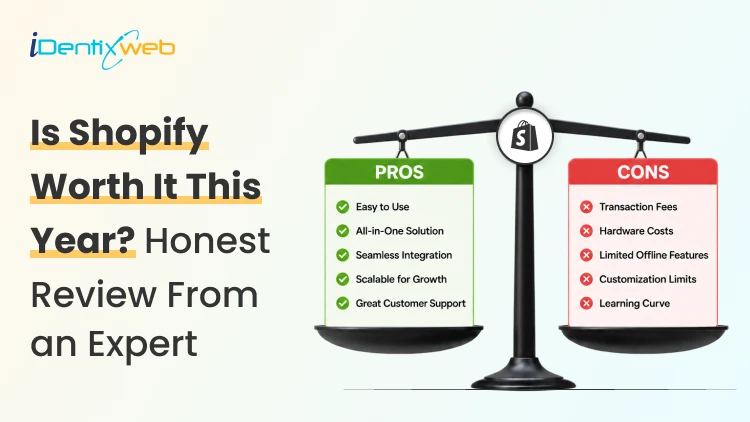

Yes, Shopify is worth it in 2026 for businesses that want an easy-to-manage, scalable ecommerce platform with built-in hosting, payments, security, AI tools, B2B features, and multichannel selling. Plans start at $29 per month when billed annually, but apps, themes, and payment fees can increase costs. It suits product-based businesses best, while content-heavy brands may find its CMS restrictive.
Yes, Shopify is worth it for most people selling online in 2026. It is the platform I recommend by default to anyone launching their first store.
You get hosting, SSL, a checkout that is genuinely the best in the industry, and a route to selling in AI chat channels without writing a line of code. The only catch is the price that comes with its added features.
Here is where Shopify actually stands as of Q2 2026 [Source: Shopify Q2 Results]
- $115.6 billion in gross merchandise volume in a single quarter, up 32% year over year
- $3.58 billion in quarterly revenue, up 34%
- More than 14% of all US e-commerce runs on Shopify
- Shopify Payments now handles 68% of global GMV on the platform
- AI-driven traffic and orders to Shopify stores tripled year over year
But is a Shopify store worth it in 2026? I will break it down in this blog so you can decide the right e-commerce platform this year.
What is Shopify?
Shopify is a hosted commerce platform. You pay a monthly fee, and Shopify handles the servers, security patches, PCI compliance, CDN, and checkout infrastructure.
What you handle is the products, the design, and the marketing.
What do you get from Shopify?
- A storefront builder
- Product and inventory management
- Order and shipping management
- Discount codes
- Abandoned checkout recovery
- A free SSL certificate
- Unlimited bandwidth
- Sidekick, Shopify's built-in AI assistant.
Shopify is certified Level 1 PCI DSS compliant, which means card data handling is their liability, not yours.
Around that core sits the Shopify App Store with more than 18,000 apps, and the Theme Store with 1,000+ themes for your business.
The thing most new merchants misunderstand is this: Shopify is not a marketplace. Amazon and Etsy are marketplaces, where your listing competes against a dozen near-identical listings for the same search.
Shopify gives you an independent store on your own domain. That means no built-in audience, and every visitor is one you have to earn through ads, SEO, social, or email.
That distinction cuts both ways. You keep the customer relationship and the data, and you are not one policy change away from losing your business. But traffic is entirely your problem.
Is Shopify worth it?
The most honest way I can answer this is by knowing what you expect to sell and how complex your store will be in the first twelve months.
At very low sales volumes, Shopify's plans and app costs can take a noticeable bite out of revenue.
On the Basic plan, you're looking at $39 a month when paying monthly, plus online card rates starting at 2.9% + 30¢ per transaction with Shopify Payments.
At $1,000 a month in sales, the above can become a meaningful cost before you've paid for products, marketing, or fulfillment.
Once you're consistently generating a few thousand dollars a month, I find Shopify much easier to justify. The platform fee becomes a smaller percentage of revenue, Shopify's checkout is among its biggest advantages, and its app ecosystem can save growing stores from having to custom-build every new feature they need.
The one area where I would think carefully is content. If content publishing or SEO is central to your growth strategy, Shopify's native CMS can feel restrictive compared with a dedicated CMS.
Shopify can still handle structured content through metaobjects or work alongside an external headless CMS, but that adds another layer to your setup.
How much does Shopify cost in 2026?
| Shopify plan | Price | Staff | Online card rate | Best reason to choose |
| Basic | $39/mo or $29/mo annually | 0 additional staff | 2.9% + 30¢ | Full online store for solo merchants |
| Grow | $105/mo or $79/mo annually | 5 | 2.7% + 30¢ | Lower payment and third-party gateway fees |
| Advanced | $399/mo or $299/mo annually | 15 | 2.5% + 30¢ | Calculated shipping, regional customization and higher API limits |
| Plus | From $2,300/mo | Unlimited | — | Advanced checkout, B2B, expansion stores and higher API limits |
| Agentic | $0/mo | — | 2.9% + 30¢ | Sell through AI channels and Shop without a storefront |
| POS Pro | $89/mo per location | — | — | Advanced features for physical retail |
The costs that are not on the pricing page
This is where budgets break. The plan fee is usually the smallest line item.
- Card processing.
- The third-party gateway penalty.
- Apps.
- Themes.
What is Shopify’s retention rate?
On the Q2 2026 earnings call, Shopify's CFO Jeff Hoffmeister stated that over the last five years, merchants who reached $1 million in annual GMV had a 92% retention rate.
This rises to 97% for merchants at $10 million. Once a store works, it tends to keep working.
Pros of Shopify
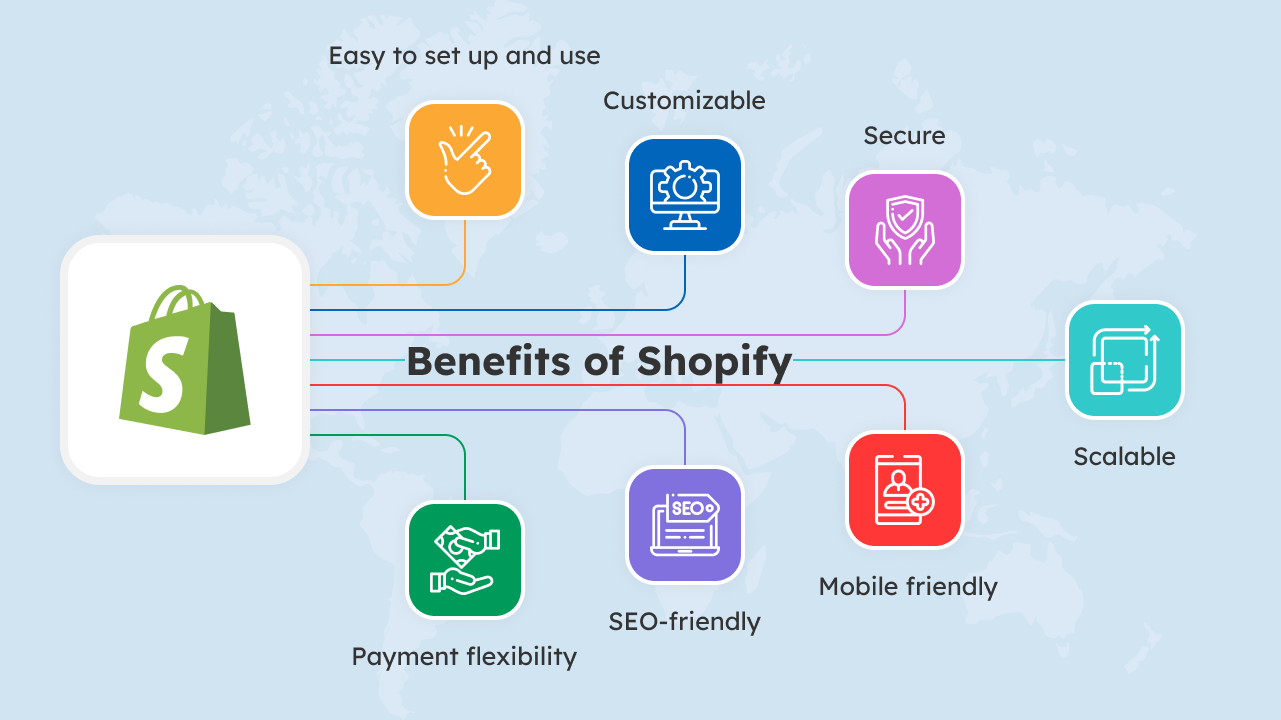
Easy to set up and use
You can have a store live in an hour. No hosting to configure, no SSL to install, no plugin conflicts to debug.
Shopify's admin is genuinely well designed, and Sidekick, the built-in AI assistant, now handles tasks like generating purchase orders, filling out customer forms, and building simple apps from a text description.
Customizable
The Theme Store has 1000+ free and paid themes. Horizon, Shopify's newest free theme framework, ships with ten design presets and AI content generation built in. Dawn remains the stable, fastest-loading default.
Secure
Shopify is Level 1 PCI DSS certified, and every store is PCI compliant by default. SSL is free and automatic.
Fraud analysis is built in when you use Shopify Payments, and Shopify's machine learning models now score transactions specifically to block card testing attacks.
Scalable
Shopify raised the cap from 100 variants per product to 2,048, available on every plan at no extra cost. The 3-option-per-product limit stayed the same, and you still get 250 media files per product.
If you sell apparel or furniture, Shopify should be your go-to platform.
Mobile-friendly
Every Shopify theme is responsive by default, and the checkout is mobile-optimized without any work from you.
You can also now edit your storefront from the Shopify mobile app with a preview that stays on screen while you work.
SEO friendly
Shopify handles the technical foundation well: automatic sitemaps, canonical tags, editable meta titles and descriptions, clean URLs, and fast hosting.
I would call this a solid base rather than a strength. The URL structure is rigid, and collection pages can generate duplicate product URLs that need canonical management.
Payment Flexibility
Shopify Payments is available in 40 countries as of 2026. Beyond cards, you can accept Shop Pay, PayPal, Apple Pay, Google Pay, local methods like MobilePay, TWINT, BLIK and Przelewy24, installments through MSI in Mexico, and USDC on Ethereum and Base.
Built for selling in AI channels
This is the biggest change to Shopify in 2026.
Shopify Catalog automatically standardizes and enriches your product data so AI assistants can read it. Shoppers can now buy directly inside Copilot and pay with Shop Pay, powered by UCP.
You can also run your store from inside Claude, ChatGPT, or Perplexity, adding products and managing orders from the chat, and run Shop Campaigns across ChatGPT, Pinterest, and Microsoft Monetize.
B2B is now included on every plan
B2B used to be a Plus-only feature. As of 2026, company profiles, volume pricing, and up to three B2B catalogs are included on Basic, Grow, and Advanced at no extra cost.
Cons of Shopify
App costs compound faster than you expect
Features that competing platforms include natively often require a paid app in Shopify. Product reviews, advanced filtering, subscriptions, upsells, loyalty. This adds significantly to your budget.
The blogging and CMS layer is basic
I believe Shopify's blog tool is basic. There is no real editorial workflow, no flexible content modelling, and limited control over URL structure.
If content is your primary acquisition channel, you will feel this constraint quickly.
The third-party payment penalty
If Shopify Payments is not available in your country, you pay an extra 0.2% to 2% on every order on top of your processor's fees. There is no way around it short of upgrading your plan.
So who is Shopify worth it for?
Shopify is worth it if you:
- Are launching your first store and want to be selling this week
- Sell physical products with a clear niche and a traffic plan
- Want to sell online and in person from one inventory system
- Run wholesale alongside DTC, since B2B is now included on every plan
- Want your catalog visible in AI shopping channels without building that yourself
Shopify is probably not worth it if you:
- Expect under $1,000 a month in revenue for the foreseeable future
- Depend on content marketing and SEO
- Want to own your code and data outright with no platform dependency
- Sell mainly digital products or services, where the fee structure works against you
You can check out my comparison blogs if you are still thinking about an e-commerce platform in 2026.
FAQs
1. Is a Shopify store worth it in 2026?
Yes, Shopify is worth it in 2026 for businesses that want a reliable ecommerce platform with hosting, payments, checkout, multichannel selling, AI tools, and an app ecosystem built in. Basic starts at $29/month when billed annually, but your total cost can increase as you add paid apps, premium themes, or more advanced functionality.
2. Is Shopify good for beginners?
Yes. Shopify is one of the easier ecommerce platforms for beginners because you can build, manage, and launch a store without coding. You can also use tools such as themes, the AI website builder, and Sidekick to help with setup and everyday store tasks.
3. Is there a better option than Shopify?
The e-commerce platform you choose depends on what you sell. WooCommerce can be a better fit if you already use WordPress and want open-source control over your site and code. Shopify is generally the simpler choice if you want an all-in-one hosted ecommerce platform with less technical maintenance.
4. How much does Shopify take from a $100 sale?
On the US Basic plan using Shopify Payments, the standard online card rate is 2.9% + 30¢. Shopify Payments would charge $3.20 on a $100 transaction, leaving $96.80 before other business costs.
5. What are the pros and cons of Shopify?
Shopify's main advantages are its easy store setup, strong checkout, built-in payments, multichannel selling, and extensive app ecosystem. The downsides are recurring subscription and app costs, and additional transaction fees when using third-party payment providers.

About the author
Sajini Annie John
Meet Sajini, a seasoned technical content writer with a passion for e-commerce and expertise in Shopify. She is committed to helping online businesses to thrive through the power of well-crafted content.