




If you're running a Shopify store with more than one warehouse, supplier, or fulfillment location and orders are slipping through the cracks you need Distributed Order Management (DOM). This guide explains exactly what it is, why it matters, and how to set it up with Shopify using Stellar Delivery Date & Pickup.
What Is Distributed Order Management (DOM)?
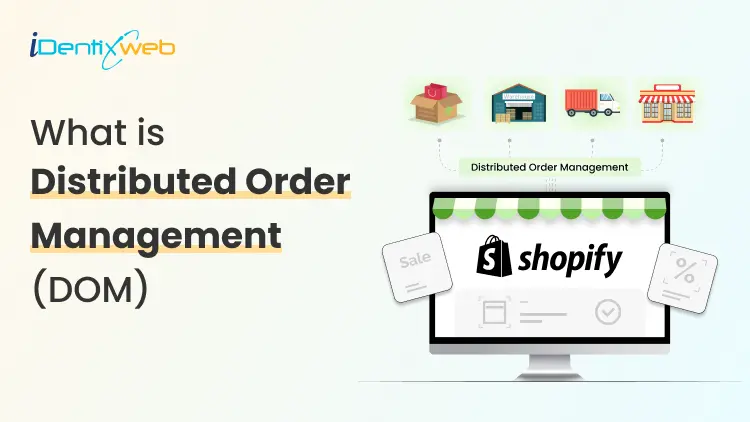
Distributed Order Management is a system that intelligently coordinates order fulfillment across multiple locations warehouses, stores, vendors, and distribution centers in real time.
For ecommerce DOM specifically, this means: no more manual routing decisions, no more overselling from a warehouse that's already out of stock, and no more missed delivery windows because the wrong location picked the order.
How DOM Actually Works in an Ecommerce Context
A DOM system sits between your storefront and your fulfillment network. When an order comes in, it doesn't just pass it downstream blindly. It evaluates:
- Which location has the inventory available right now?
- Which location is geographically closest to the customer?
- What delivery date has the customer been promised?
- Which fulfillment node has the capacity to ship today?
- Is a split shipment faster, or does it create more confusion?
Based on this, it routes the order automatically. And crucially, it communicates the right delivery date to the customer before they even checkout.
This is the part most Shopify merchants miss: DOM isn't just about routing orders efficiently. It's about showing customers an accurate, reliable delivery promise at the moment they're deciding whether to buy. That promise is what converts browsers into buyers.
While Distributed Order Management (DOM) optimizes the entire order fulfillment process across multiple locations, there are specialized tools that enhance local delivery efficiency and customer experience. One such tool is the Stellar Delivery Date & Pickup app. Although not a full-fledged DOM solution, Stellar plays a critical role in local order fulfillment by allowing customers to choose their preferred delivery date and pickup time.
For businesses that deal with local deliveries or store pickups, Stellar can complement your DOM strategy by improving the customer experience and ensuring that delivery schedules are managed effectively.
DOM vs. OMS vs. Basic Order Routing
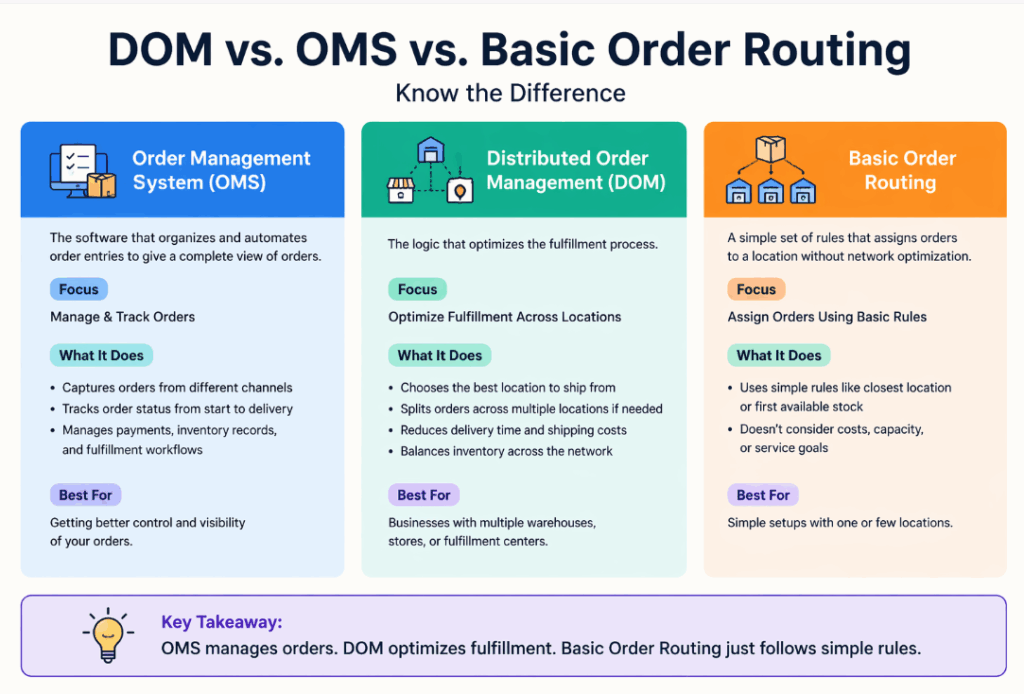
Vendors often blur these categories and use "order management" as a catch-all term. The clearest way to define each of these terms and show their differences is as follows:
1. Order Management System (OMS)
The software that organizes and automates order entries to give a complete view of orders. It tracks orders from inception to fulfillment and manages people, processes, and data. The OMS is responsible for the core order processing, including payment, inventory management, and fulfillment updates.
In short, it's the system that handles the entire order lifecycle.
2. Distributed Order Management (DOM)
The logic that optimizes the fulfillment process. It ensures products ship from the correct sources at the correct times to meet service goals and minimize costs. DOM intelligently routes orders to the best warehouse or location for fulfillment, taking into account factors like inventory levels, delivery time, and shipping costs.
It’s ideal for businesses that need to manage complex fulfillment networks and provide a seamless omnichannel experience.
3. Basic Order Routing
A simple set of rules that assigns orders to locations without network optimization. It often relies on basic decision-making, such as choosing a warehouse based on proximity or availability, but lacks the advanced optimization that DOM provides.
While this method may work for small-scale operations, it doesn't leverage the full potential of a distributed fulfillment network.
Final Thoughts
For businesses with complex fulfillment needs, integrating DOM with an OMS can lead to enhanced customer satisfaction, reduced operational costs, and improved efficiency across the order lifecycle. As e-commerce continues to grow and become more multi-channel, adopting a robust order management and fulfillment strategy will be key to staying competitive and meeting customer expectations.
Frequently Asked Questions
1. What is distributed order management in simple terms?
It's a system that automatically decides which warehouse or store should fulfill each order, based on stock availability, customer location, and delivery speed so you don't have to make that decision manually.
2. Does Shopify have built-in distributed order management?
Shopify has basic multi-location inventory features, but it doesn't offer full DOM capabilities like location-aware delivery dates, routing rules, or pickup slot management out of the box. You need an app like Stellar to fill that gap.
3. How does ecommerce DOM improve the customer experience?
By showing customers an accurate delivery date before they check out and reliably fulfilling from the best available location, DOM eliminates delivery uncertainty the number one reason customers abandon carts or don't return.
4. Is DOM worth it for smaller Shopify stores?
If you have more than one fulfillment location or offer local pickup alongside shipping, yes.
About the author
Sajini Annie John
Meet Sajini, a seasoned technical content writer with a passion for e-commerce and expertise in Shopify. She is committed to helping online businesses to thrive through the power of well-crafted content.