



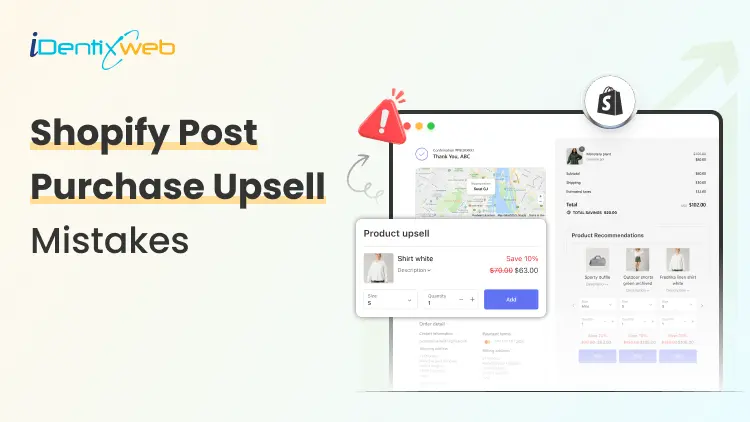
A well-executed Shopify post purchase upsell is one of the highest-ROI tactics available to online store owners, yet most merchants leave significant money on the table by falling into predictable, avoidable traps. This guide exposes the 8 most damaging mistakes and shows you exactly how to fix them.
8 Common Shopify Post Purchase Upsell Mistakes
Showing Irrelevant Offers to Every Customer
The most common reason a Shopify post purchase upsell fails is simple: the offer has nothing to do with what the customer just bought. Showing a yoga mat to someone who purchased a gaming headset is not upselling - it is noise. Customers who just completed checkout are in a high-trust, high-receptivity moment. Wasting it on a generic offer destroys that trust instantly.
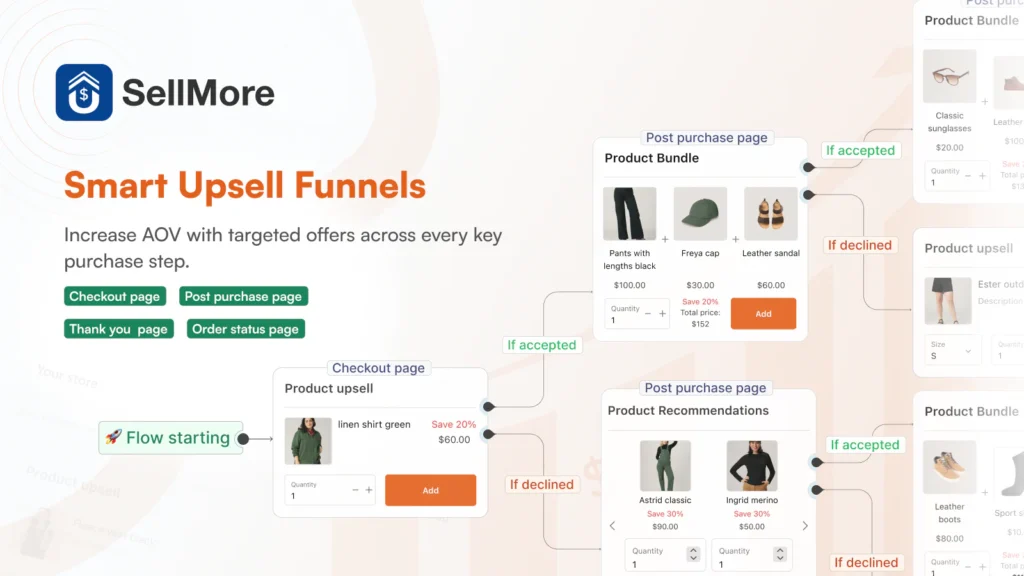
Relevance is the cornerstone of every high-converting Shopify post purchase upsell strategy. This is where merchants prefer apps like SellMore that help Shopify merchants create more relevant post-purchase offers based on what the customer has already bought. Instead of showing the same upsell to every shopper, SellMore allows you to build targeted upsell funnels, recommend related products, and present one-click offers on the post-purchase and thank-you pages. This makes the offer feel like a useful next step rather than a random promotion.
Getting the Timing of Your Post Purchase Offer Wrong
Timing is everything in a Shopify post purchase upsell sequence. There are two distinct windows merchants confuse: the one-click upsell shown immediately after checkout (before the thank-you page), and the post-purchase email sequence sent hours or days later. Each requires a completely different approach. The best approach is to use apps like Sellmore to create a proper funnel when and where to show offers.
Showing a high-ticket upsell 30 seconds after payment can cause buyer's remorse and even chargebacks. On the flip side, waiting too long, say, three days means the emotional high of the purchase has evaporated.
Overloading Customers With Too Many Choices
Decision fatigue is real, and it kills conversions. Many Shopify merchants think presenting five or six upsell options increases the chance of a "yes." The psychology of choice says the opposite. When a customer faces multiple competing offers right after completing a purchase, the most likely outcome is that they click away without choosing anything.
A high-performing Shopify post purchase upsell page focuses on a single, compelling offer or at most two, presented in a clear hierarchy. One primary offer with a clear accept button and a secondary fallback (such as a lower-cost downsell) is the structure that consistently outperforms cluttered multi-offer pages.
Pricing the Upsell Incorrectly
Pricing your Shopify post purchase upsell offer incorrectly is a silent revenue killer. Price it too high and customers feel manipulated, they just spent money and now you're asking for significantly more. Price it too low and you erode your margins without meaningfully increasing average order value.
Additionally, always frame the post purchase price as a special, one-time-only discount because on Shopify's native checkout, a post-purchase offer accepted in one click means the customer never has to re-enter payment details. That convenience alone increases acceptance rates dramatically.
Neglecting Mobile Optimization
Over 70% of Shopify store traffic comes from mobile devices, yet countless Shopify post purchase upsell pages are designed with desktop in mind and never properly tested on a phone. Tiny text, slow load times, buttons that are hard to tap, and product images that don't render correctly on small screens will gut your mobile conversion rate regardless of how compelling your offer is.
A Shopify post purchase upsell that converts on desktop but breaks on mobile is essentially a broken funnel. Since mobile users are more likely to be distracted and impatient, the post-purchase page must load in under two seconds and present the offer in a format that requires zero horizontal scrolling and minimal reading.
Skipping A/B Testing Entirely
Setting up a Shopify post purchase upsell once and never testing it is like planting a garden and never watering it. Most merchants launch one offer, see mediocre results, and conclude that post-purchase upselling "doesn't work for their store" - when in reality, they just never found the right combination of product, price, and messaging.
A/B testing even small elements of your Shopify post purchase upsell - the headline, the product image, the button color, the discount percentage can produce dramatic improvements.
Using Weak, Generic Copywriting
"You might also like…" is not a post-purchase upsell headline. It's a placeholder. Weak copy is one of the most underappreciated reasons why a Shopify post purchase upsell fails to convert. The copy on your upsell page carries a disproportionate amount of weight because the customer is reading it immediately after making a financial decision they are in evaluation mode.
Strong Shopify post purchase upsell copy does three things: it acknowledges the purchase just made, it frames the new offer as a natural next step, and it creates genuine urgency without manufactured scarcity. Phrases like "Customers who bought [Product X] also protect it with [Product Y] - get it now for 20% off, today only" outperform generic promotional language by a significant margin.
Having No Follow-Up Strategy After the Initial Offer
A Shopify post purchase upsell strategy that ends at the thank-you page is only half-built. The majority of customers who decline the initial one-click offer are not saying "never" - they are saying "not right now." Without a thoughtful follow-up sequence, you permanently lose that revenue.
The best-performing Shopify post purchase upsell systems include a 3-email follow-up flow that re-introduces the declined offer (or a related one) at 24 hours, 72 hours, and 7 days post-purchase. By the third touchpoint, the customer has typically received their original order, experienced the product, and is in the optimal mental state to consider an add-on purchase. Pair this with SMS if your audience has opted in, and you have a genuinely powerful multi-channel post-purchase revenue engine.
Final Thoughts: Turn Your Thank-You Page Into a Revenue Machine
A properly optimized Shopify post purchase upsell is not a trick or a pressure tactic, it is a genuine service. When you present the right product, at the right price, at the right moment, with the right message, you are helping customers get more value from purchases they have already decided to make.
The 8 mistakes outlined above are all fixable. Start with the two or three that resonate most with your current setup, make the changes, and measure the impact over 30 days.

About the author
Sajini Annie John
Meet Sajini, a seasoned technical content writer with a passion for e-commerce and expertise in Shopify. She is committed to helping online businesses to thrive through the power of well-crafted content.