






Do you think customers just buy products when they land on your Shopify store?
The answer is No. They buy convenience and certainty.
When someone lands on your storefront, they are asking three things.
- How fast can I get it?
- How much will it cost me?
- And can I trust that it will actually show up when you say it will?
That’s why choosing between local delivery and shipping should be your top priority in 2026.
Some shoppers will pay extra for same-day delivery because they need the item now. Others will happily wait a few days if shipping is free or low-cost. It depends on both the products & customer expectations.
In this guide, you’ll learn what Shopify customers expect today from both local delivery and shipping. You’ll also learn how to meet these expectations with simple setups and fixes.
What does ‘local delivery’ mean on Shopify?
Local delivery means you deliver orders to customers who live close to you. If your customers are in the same city or nearby neighborhoods, local delivery is ideal.
Shopify Local delivery is best when:
- You can deliver within a predictable window (same-day).
- Your customers buy for events or products with limited shelf life (flowers, bakery, gifts).
- Shipping feels expensive because items are heavy or fragile.
What does ‘shipping’ mean on Shopify?
Shipping means a carrier delivers the order for you. For example, in the US, that means UPS, FedEx, or another service you use through Shopify Shipping or your own carrier account.
On Shopify, you set shipping zones and rates so customers see the right options at checkout. For example, you can offer standard shipping for the US, and a separate rate for Alaska.
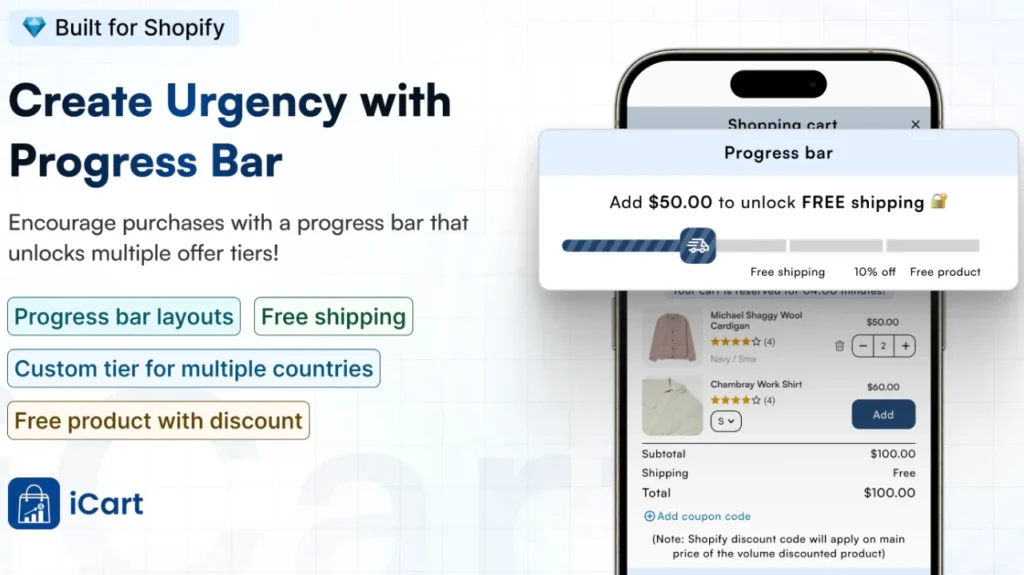
You can also use Shopify apps like iCart to offer free shipping above a threshold to boost conversion.
Shipping is best when:
- Your Shopify store sells globally, not just locally.
- You want a scalable setup that doesn’t depend on your team delivering.
- Customers expect tracking and carrier updates.
Local Delivery vs Shipping: The Difference
| What you control | Local delivery | Shipping |
| Where you deliver | Locally or nearby neighborhood | Shipping zones (regions/countries) |
| Cost rules | Minimum order, delivery fee, and free threshold | Flat rates, free threshold, calculated rates |
| Speed promise | Same-day/next-day if you can handle it | Depends on the carrier and service level |
| Complexity | Less complex. Route + scheduling + instructions | More complex. Rates + packaging + profiles + tracking |
| Best fit stores | Florists, bakeries, meal prep, gifting, local retailers, bulky-item sellers | Apparel, beauty, accessories, supplements, dropshippers, nationwide brands |
What do customers expect from local delivery?
- When the purchase feels time-sensitive. Customers don’t want to wait three to five days for something they need today or tomorrow. They expect convenience and products immediately.
- Gift & holiday products. Flowers, bakery items, meal kits, balloons, and local gifts. Customers shopping for these items shop late & still expect the order to arrive on time.
- Free shipping: Since products are delivered locally, customers expect cheaper or no shipping fees when their items are delivered. This helps in reducing cart abandonment.
- They will pay for speed: Birthdays, parties, holidays, and last-minute surprises all create the same behavior. Customers pay for speed when the date matters.
- Personal touch: There’s a high chance you know your local floral or bakery stores. Customers ordering from these stores expect a direct interaction with the business, and owners oblige to build community loyalty.
What do customers expect from Shipping?
They want clear delivery dates: Customers don’t like “ships in 3–5 days” if they can’t tell when it will arrive. They want an estimated delivery date they can trust.
Apps like Stellar show an estimated delivery date and time on your product page/cart page, and checkout. This way, shoppers know when their order should arrive before they checkout.
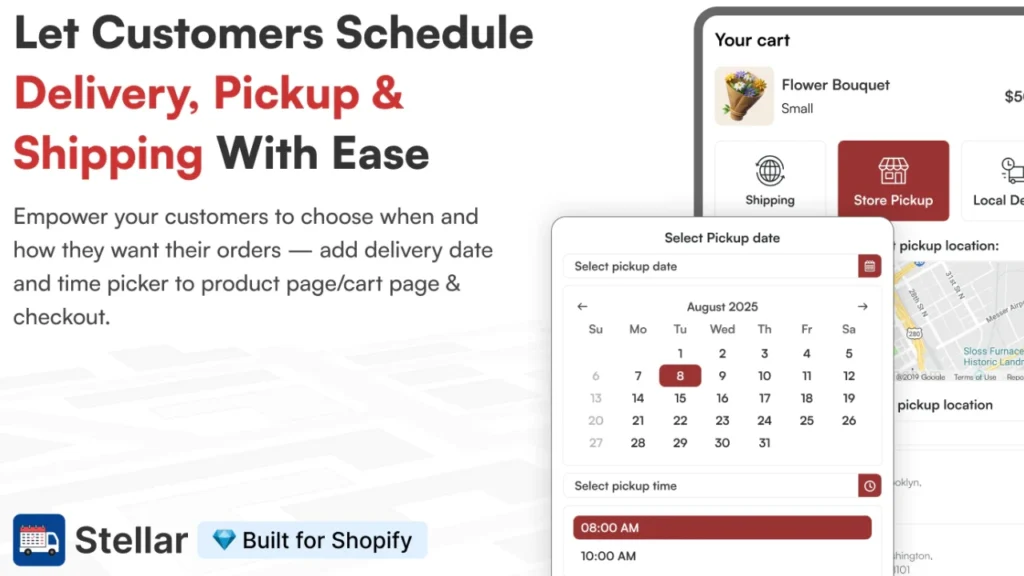
- They expect fair shipping costs: A lot of shoppers will accept standard shipping time if the cost feels reasonable. What hurts conversions is seeing a product price that looks good, then getting hit with a big shipping fee at checkout.
- Customers want tracking and updates without asking: Once they place the order, they want tracking, shipping confirmation emails, and delivery updates. This reduces anxiety and cuts down “Where is my order?” messages.
- Shoppers do not want too many shipping choices: Most shoppers are happy with two options. One affordable standard option, and one fast delivery option. Too many shipping options will confuse them.
- They expect the package to arrive safely: Customers want clean packaging and no damage to their products. If your product is fragile, your shipping experience is part of your product quality.
How to set expectations for local delivery and shipping?
Customers want the same thing in both cases. Clear cost, clear timing, and clear updates. If you nail those three, you will see fewer abandoned carts
Set the expectation before checkout
Most stores wait too long to explain delivery. Put the basics where customers make decisions: product page and cart.
- Show a delivery estimate on the product page.
- Show shipping or delivery cost early.
- Repeat the delivery method in the cart so people do not get surprised at checkout.

For local delivery, meet expectations with clarity
Local delivery only works when it feels reliable. Customers expect you to show exactly where you deliver and when.
- Define your delivery area clearly (ZIP codes or radius)
- Show delivery days and cutoff time (example: “Order by 1 PM for same-day”)
- Offer delivery windows if you can handle them (example: “12–3 PM” or “4–7 PM”)
- Collect delivery instructions at checkout (gate code, drop-off notes, phone number)
For shipping, meet expectations with simple choices
For shipping, customers expect normal carrier behavior. That means tracking, a reasonable price, and a delivery estimate that matches reality.
- Keep options simple (standard + optional express)
- Set handling time correctly so estimates do not feel fake
- Send tracking automatically as soon as you fulfill the order.
- Write shipping rates that feel predictable (flat rate or free threshold often works well)
Conclusion: What should I choose between local delivery & shipping in 2026?
Pick shipping if you sell nationwide. Offer standard shipping, add free shipping over a threshold, and keep one faster option for shoppers in a hurry.
Make your delivery estimate feel real by setting the correct handling time and sharing tracking the moment you fulfill.
Pick local delivery when speed and timing actually matter. It works best if you serve a tight area and you can hit the same day or the next day without chaos.
Keep it simple with clear ZIP codes, a cutoff time, and a minimum order so local delivery stays profitable.
If you’re not sure, go hybrid. Offer shipping for everyone and local delivery only for nearby ZIP codes. That way, you don’t lose local shoppers who want it fast, and you still serve customers outside your area.
FAQs for Local delivery vs Shipping
1. What is the difference between local delivery and shipping?
Local delivery means you deliver orders to nearby customers within a set distance or specific ZIP/postal codes. Shipping means a carrier delivers the order, and you control things like shipping zones, rates, and delivery speed options at checkout.
2. What do shoppers expect in 2026?
They expect a clear delivery date and time at product page/cart page & checkout. They also expect transparent costs and automatic tracking/updates once the order is shipped.
3. What is considered local delivery?
Local delivery is when you deliver orders directly to customers’ addresses in a defined nearby area, using a radius or a list of ZIP/postal codes.
4. How to add a local delivery option to Shopify?
Go to Settings > Shipping and delivery, then set up local delivery for a location and define your delivery zones (radius or ZIP/postal codes). You can also use apps like Stellar to add local delivery options in the product/cart page and checkout.
5. Does Shopify ship for you?
Shopify doesn’t physically deliver orders, but it gives you shipping tools so you can buy and print shipping labels in your admin and send tracking to customers. If you want someone else to store inventory and ship for you, you can use a fulfillment service such as the Shopify Fulfillment Network.
6. How to add free shipping on Shopify?
The best way is to use apps like iCart to add a progress bar in your cart with a free shipping threshold.
![The Only Easter Marketing Ideas for Shopify Stores [Proven Strategies]](https://www.identixweb.com/wp-content/uploads/2026/02/24-02-Tue-Blog-Tips-Tools-for-Shopify-Stores-to-Boost-Easter-Sales.webp "The Only Easter Marketing Ideas for Shopify Stores [Proven Strategies]")
About the author
Vineet Nair
Vineet is an experienced content strategist with expertise in the ecommerce domain and a keen interest in Shopify. He aims to help Shopify merchants thrive in this competitive environment with technical solutions and thoughtfully structured content.