





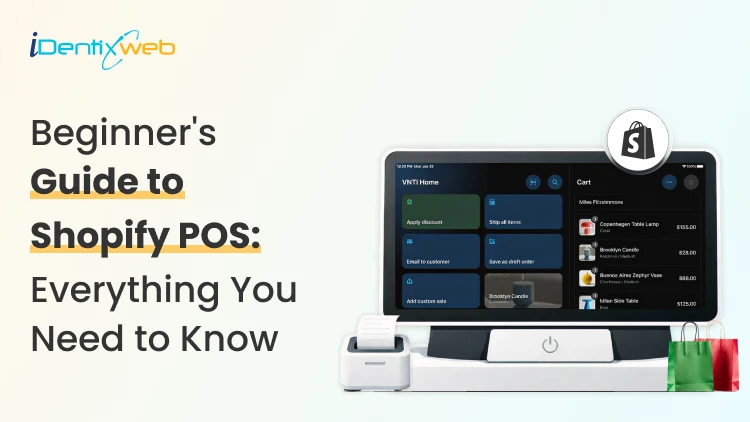
Today's shoppers expect the same smooth experience whether they buy from your website or walk into your store. This is what Shopify POS is built to deliver.
It connects your in-person sales to the Shopify store you already run, so your inventory, customers, payments, and reports all live in one place.
In this guide, I will cover what Shopify POS is, how it works, what it costs, the hardware you need in 2026, how to set it up, and tips to get the most out of it.
What is Shopify POS?
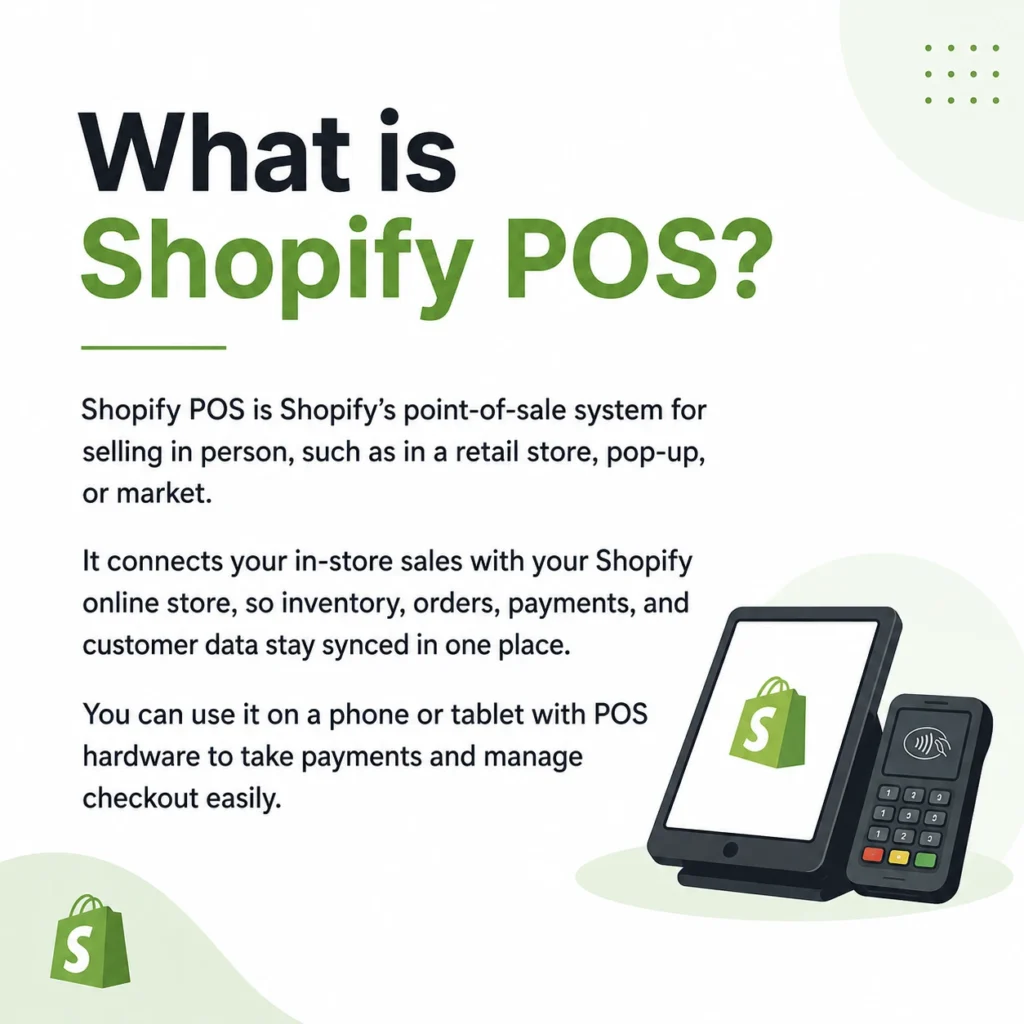
Shopify POS stands for "Point of Sale," and it's like a fancy cash register for the modern age. It is a comprehensive and versatile point of sale system designed for online and brick-and-mortar stores.
It provides a unified platform for managing inventory, processing transactions, and analyzing sales data.
How does Shopify POS work?
Shopify POS is a sales channel that lives inside your existing Shopify admin. Your in-store and online stores share the same product catalog, inventory count, and customer list.
When you sell something at the counter, stock updates everywhere in seconds.
Here's the basic flow:
- You download the Shopify POS app to an iPhone, iPad, or Android device,
- Pair a card reader (or use Tap to Pay to accept contactless payments with no extra hardware), and start ringing up sales.
Payments run through Shopify Payments, so every transaction lands in the same order timeline as your online sales.
Because everything is connected, you can do things like sell an out-of-stock item and ship it from the warehouse, let a customer buy online and pick it up in store, or start a return in store for an order placed on your website.
Shopify POS features
- Multi-Channel sales: Shopify POS allows businesses to sell products in physical stores, and online through a unified platform. This ensures that inventory and sales data are synchronized across all channels.
- Inventory management: Easily manage in-store and online inventory, track stock levels, and receive low-stock alerts. Product details and availability are updated in real time.
- Customizable checkout: Customize your in-store checkout process by adding products, applying discounts, and processing payments quickly and efficiently.
- Payment processing: Accept various payment methods, including credit cards, cash, and digital wallets. It is designed to handle payments securely.
- Hardware compatibility: Shopify supports a range of compatible hardware, including receipt printers, barcode scanners, cash drawers, and card readers.
- Customer profiles: Create and access customer profiles to track purchase history and preferences. Use this data to personalize interactions and build customer loyalty.
- Sales and discounts: Create discounts, apply promotions, and set up automatic discounts based on criteria you define.
- Offline mode: Continue selling even when you lose internet connectivity. Shopify POS can process transactions offline, syncing the data once you're back online.
- Analytics & reporting: Access sales reports and analytics to monitor performance, track trends, and make data-driven decisions. Gain insights into your business's health.
- Gift cards: Sell and redeem gift cards, encouraging repeat business and attracting new customers.
- Staff management: Assign roles and permissions to your staff members, allowing them to access the necessary functions while maintaining security.
- Customizable receipts: Create and customize receipts that match your brand and include your logo and return policy.
- Customer loyalty programs: >Set up loyalty programs to reward repeat customers with discounts and special offers.
- Multi-location management: If you have multiple physical store locations, it lets you manage and monitor inventory, sales, and staff.
- Advanced tax calculations: Automate complex tax calculations and generate accurate tax reports.
- Multi-currency support: Sell to customers worldwide and display prices in their preferred currency.
- Returns and exchanges: Easily process returns and exchanges, with the ability to search for past orders.
- In-store marketing: Use it for in-store marketing by showcasing product images, product details, and promotions.
Shopify POS pricing: POS Lite vs POS Pro
POS comes in two tiers. Choosing the right one is usually the first real decision you'll make.
- POS Lite is included free with every paid Shopify plan. It covers the essentials: accept card and cash payments, sync your product catalog, build basic customer profiles, and use the on-screen "smart grid."
It's a great fit for pop-ups, weekend markets, and single-counter shops where the owner is the one ringing up sales.
- POS Pro is an add-on that costs about $89 USD/month per location. It unlocks unlimited staff accounts with role-based permissions, advanced multi-location inventory, buy-online-pickup-in-store (BOPIS), ship-from-store, cross-location returns, and custom receipts.
A quick way to decide. If you have staff, more than one location, or you want online and offline selling truly connected, POS Pro pays for itself.
If you're testing physical retail or selling occasionally, Lite is enough to start.
One more thing worth knowing if you're scaling: Shopify Plus includes POS Pro for a number of retail locations at no extra charge.
How to set up Shopify POS in your store?
Step 1: Create your Shopify account and pick a plan
POS Lite is included on every paid plan, so any plan gets you selling in person. If you know you'll need staff roles or multi-location tools, plan for POS Pro at your retail locations.
Step 2: Download the Shopify POS app
Install it from the Apple App Store (iPhone/iPad) or Google Play (Android). Sign in with your Shopify credentials, and the app connects to your store automatically.
Step 3: Set up Shopify Payments
This is what lets you accept card payments in person and keeps your fees and payouts consistent.
Step 4: Add and pair your hardware
At a minimum, you need a way to take payment. Either Tap to Pay on a supported iPhone/Android, or a Shopify card reader.
From there, connect any accessories (receipt printer, barcode scanner, cash drawer). For the most reliable connection in 2026, wire accessories through the Shopify POS Hub instead of relying on Bluetooth.
Step 5: Build your smart grid and add staff
Arrange your most-used products, discounts, and actions on the POS home screen for fast checkout. Add your team and set permissions (on POS Pro).
Step 6: Run a test sale and go live
Ring up a test transaction to confirm payments, receipts, and hardware all work, then open for business.
Benefits of Shopify POS for customers & store owners
For store owners:
- Unified inventory and reporting: One stock count and one dashboard across every location and your store.
- Seamless online-and-offline integration: No separate systems to reconcile. A sale in-store updates on your website instantly, and vice versa.
- Payment flexibility: Accept tap, chip, swipe, cash, and digital wallets, all processed through Shopify Payments.
- Customer insights: Every purchase attaches to a customer profile, so you can see history, personalize service, and build loyalty.
- Faster, more accurate checkout: A customizable smart grid and connected hardware keep lines short and reduce manual errors.
- Flexible fulfillment: Offer buy-online-pickup-in-store, ship-from-store, and easy returns. Managing multi-location pickup and inventory becomes far simpler.
For customers:
- A consistent experience whether they shop online or in person.
- More ways to buy and receive: Pick up online orders in store, buy in store and ship home, or return an online order at the counter.
- Faster checkout and accurate stock. Customers are less likely to be told an item is unavailable.
- Recognized and rewarded: Loyalty and purchase history follow them across every visit.
Shopify POS hardware (2026 lineup)
Tap to Pay on iPhone / Android
Accept contactless cards, Apple Pay, and Google Pay using just a supported phone. No extra hardware, which makes it ideal for pop-ups, markets, and customers on a busy floor.
Shopify Tap & Chip Card Reader
Shopify's versatile reader for tap and chip payments at the counter or on the go. It's the lowest-cost way to add a dedicated reader and pair with a phone or tablet running the POS app.
Shopify POS Terminal
A countertop payment terminal with a built-in customer-facing display for tap, chip, and swipe.
It has Shopify Payments built in and is the best fit for a fixed checkout lane in a staffed store. This requires a tablet or phone running the Shopify POS app.
Shopify POS Hub
A wired connectivity hub that replaces flaky Bluetooth pairing for your reader, receipt printer, barcode scanner, and cash drawer.
For a permanent counter, wiring accessories through the Hub is the most reliable setup.
Receipt printers
Compatible USB and network models let you print branded receipts. Many stores skip paper entirely and email or text receipts through the app.
Barcode scanners
Speed up checkout and stock counts. Most HID-compatible scanners work, and your device's built-in camera can also scan barcodes if you want to keep costs down.
Cash drawers
Connect to your receipt printer and open automatically at checkout, with Shopify POS tracking your cash flow.
Tablet stands and mounts
Turn an iPad into a tidy, secure countertop register.
Shopify POS staff management
Staff management is another part that has become one of the most useful parts of Shopify POS.
On POS Pro, you get unlimited staff accounts and role-based permissions. You decide exactly what each person can and can't do. For example, who can apply discounts, process refunds, edit inventory, or see sensitive settings.
Each sale is tied to the staff member who rang it up, which makes it easy to track individual performance and spot your top sellers.
POS Lite keeps it basic. It's built for a single operator or a very small team rather than a store with shifts and multiple permission levels. So if you have employees, this alone is often the reason to move up to POS Pro.
If you also need to give staff access to your Shopify admin (not just the POS), here's my breakdown on how to add another admin to your Shopify store in 2026.
Shopify POS tips to get more out of it
- Assign inventory to the right location. Don't dump everything into one location. Accurate per-location stock is what makes BOPIS, ship-from-store, and correct online availability work.
- Wire your hardware through the POS Hub: Bluetooth dropouts at the counter will frustrate your staff. A wired setup will help them.
- Customize your smart grid: Put your best-sellers, common discounts, and gift-card actions on the home screen so checkout is a couple of taps.
- Use Tap to Pay for line-busting: Staff with a phone can check out customers anywhere on the floor instead of forming one queue at the register.
- Keep online and offline promotions aligned: Mismatched pricing between your site and your store confuses customers fast.
- Turn on offline card payments before you need them. If your internet drops, you can keep selling. But this has to be enabled in your admin ahead of time, with per-transaction limits set.
Sync offline and online sales with POS
As you embark on your journey, remember that continuous learning and adaptation are keys to success.
We hope this guide has equipped you with the knowledge and insights to make the most of Shopify POS and propel your business forward.
FAQs
1. What is Shopify POS in simple terms?
POS is Shopify's point-of-sale app that turns an iPhone, iPad, or Android device into a register for in-person sales. It shares the same products, inventory, customers, and reports as your Shopify online store.
2. How does Shopify POS work?
When a sale is completed, the order, inventory, payment, and customer information sync with Shopify. This helps merchants manage their online and physical sales from one system. Shopify’s standard in-person selling features are included with paid plans. POS Pro adds advanced tools for staff, inventory, reporting, exchanges, and omnichannel selling.
3. Is Shopify POS free?
Yes, it's free. The POS Lite tier is included with every paid Shopify plan at no extra cost. POS Pro, which adds advanced retail features, is an add-on (about $89 USD/month per location, or ~$79 billed annually. Verify current pricing on Shopify's site).
4. How to Set up Shopify POS?
Create a Shopify store, choose a suitable plan, and install the Shopify POS app on a compatible iOS or Android device. Add your retail location with the correct products and inventory. Next, configure staff roles and PINs, taxes, receipts, and accepted payment methods. Connect compatible hardware such as a card reader, barcode scanner, receipt printer, or cash drawer. Shopify Payments and integrated card readers are available in supported countries, so merchants in other regions need to record payments made through a third-party terminal as a custom payment method.
5. How to create a customer profile in Shopify POS?
Open Shopify POS, tap Add customer, and enter the customer’s name, email address, phone number, & other details. Choose whether the customer agrees to receive marketing, decide whether to add the profile to the current cart, and then tap Add customer.
6. How to test a sale on Shopify POS?
Add a product to the POS cart, tap Checkout, and complete the test transaction using Cash. You can also add a test customer, send a receipt, and label the order “Test transaction” for easy identification. Shopify POS card readers cannot process credit-card transactions while Shopify Payments is in test mode, so use a cash payment for POS testing.
7. What is Shopify POS Pro?
Shopify POS Pro is a paid add-on that provides advanced retail features for individual store locations. This includes staff permissions, unlimited POS-only staff, exchanges, automatic discounts, inventory receiving, saved carts, omnichannel fulfilment, and retail analytics. It is best suited to permanent stores, multi-location retailers, and businesses that require more control than the standard in-person selling features included with paid Shopify plans.
8. What phones or tablets work with Shopify POS?
Shopify POS works on an iPhone 7 or newer running iOS 15.1 or later, and supports iPads running iPadOS 15.1 or later. It also works on Android phones or tablets running official Android 10 or later with Google Play Services and Google Mobile Services enabled. It does not work on desktop computers, laptops, Amazon Fire tablets, beta operating systems, or jailbroken and rooted devices, and some features such as Tap to Pay may require newer hardware.
9. How to use a barcode scanner with Shopify POS?
Connect a Shopify-supported barcode scanner through Bluetooth, USB, or the Shopify POS Hub. Open the POS connectivity panel and follow the hardware setup instructions. HID scanners must also have Allow HID mode enabled under Settings. Once each product variant has a unique barcode, scanning it can quickly find the product and add it to the cart, while the device’s built-in camera can also scan 1D and 2D barcodes without a separate scanner.


About the author
Sajini Annie John
Meet Sajini, a seasoned technical content writer with a passion for e-commerce and expertise in Shopify. She is committed to helping online businesses to thrive through the power of well-crafted content.