






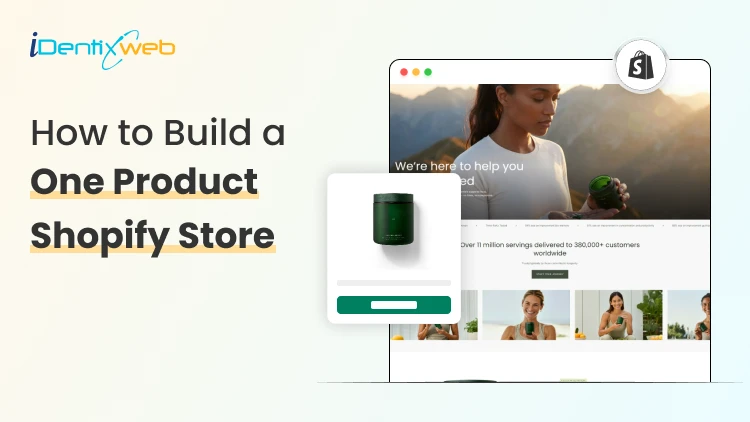
You don't need 100 products to build a profitable Shopify store. Some of the most successful ecommerce brands online right now sell exactly one thing, and they're doing it better, faster, and more profitably than most multi-product stores will ever manage.
A one product Shopify store works precisely because it's focused. One customer problem. One clear solution. One brand story that your ideal buyer sees themselves in and clicks "Add to Cart" because it feels like it was made specifically for them. This guide will help you to build a one product shopify store.
What Is a One Product Shopify Store (And Why It Works)
A one product Shopify store is exactly what it sounds like: a Shopify store built entirely around a single hero product. Every page, every word of copy, every ad, every email, all of it serves one purpose: selling that one product to the right customer.
One Product Store vs. General Store
| Factor | One Product Store | General Store |
| Branding | Strong, focused brand identity | Diluted, hard to differentiate |
| Conversion Rate | Typically higher (3–5%) | Lower (1–2% average) |
| SEO Power | Deep topical authority possible | Spread thin, harder to rank |
| Ad Targeting | Laser-focused audiences | Broad, expensive to test |
| Inventory Risk | Concentrated | Spread across many SKUs |
The verdict? If you've found a product that solves a real problem for a specific audience, a Shopify one product store will almost always outperform a general store. If you're still testing and haven't validated a winner, a general store gives you more room to experiment.
Explore these one product Shopify store examples show exactly what's possible when you commit to a single product done right.
What Makes a Great One-Product Store Product?
Solves a specific, painful problem - The sharper the pain, the faster the sale. People spend money when something bothers them enough.
Has a clear "wow factor" or visual appeal - Something people want to share, show off, or talk about. This drives organic word-of-mouth and UGC.
Targets a passionate or underserved niche - Pet owners, new moms, fitness enthusiasts, gamers. Niche buyers convert faster and complain less.
Has demonstrable results - Anything with a before/after, a measurable outcome, or a visible transformation sells in video ads like nothing else.
Allows strong margins - Aim for at least 3x COGS (cost of goods sold) to give yourself room for ads, shipping, and refunds without bleeding out.
Isn't easily replicated by Amazon - If Amazon already dominates the keyword with cheap alternatives, you're in a price war you can't win. Differentiate.
Has repeat purchase or upsell potential - A consumable (like supplements, skincare, or coffee) lets you build LTV. Even a non-consumable can have accessories
Where to Find Product Ideas
Stop guessing. Use these proven research channels to find what's already gaining momentum:
- TikTok and Instagram Reels
Search for "#tiktokmademebuyit" or "#amazonfinds." Products going viral here are often months ahead of what shows up on conventional research tools. If people are gasping at a product video, they're one click from buying.
- Amazon Movers & Shakers
Amazon publishes their fastest-rising products by category in real time. This is a live feed of what consumers are suddenly obsessed with. Your job: find it before it's saturated, then build a focused brand around it on Shopify.
- Reddit + Niche Communities
Subreddits like r/BuyItForLife, r/lifehacks, and niche hobby communities are goldmines. Read the "what would you recommend for X problem" posts. The answers reveal products people trust and love.
- Google Trends + Keyword Research
A product is only worth building a store around if people are actively searching for it. Use Google Trends to validate the demand curve. Is it rising, stable, or seasonal? Each requires a different strategy.
- Competitor Ad Libraries
The Facebook Ad Library and TikTok Creative Center show you exactly what ads are running and for how long. A store running the same ad for 3-6 months? They're profitable. Study their angle, then build something better.
How to Build Your One Product Shopify Store: Step-by-step
So, you have found your product and let’s see the steps to build the store:
Step 1: Choose the Right Shopify Theme
For a one product Shopify store, your theme needs to support a product-first experience. The best single product theme is the one you'll actually launch with. There are many free Shopify themes you can get started with. Don't spend three weeks tweaking colors. Ship, sell, iterate. You can always redesign once you have revenue.
Step 2: Nail Your Brand Identity
For a Shopify one product store, branding is not optional it's the entire game. Answer these questions before you design anything:
What does my brand stand for?
What is the transformation my customer experiences?
What's the one word I want my brand to own in my customer's mind?
What's my brand's tone of voice?
Step 3: Build a High-Converting Product Page
In a one product Shopify store, your product page is your homepage, your sales team, and your brand story all in one. Most merchants under-invest here. Don't. Your product page needs to cover all of these:
- Hook headline
- Lifestyle imagery
- Video content
- Benefit-driven copy
- Social proof above the fold
- Strong, singular CTA
Step 4: Structure Your Store Pages
Less is more. For a one product Shopify store, you don't need 20 pages. You need the right pages:
- Home Page
This is the hero. Lead with your strongest hook, a headline, a punchy video, and your primary CTA above the fold. The homepage should feel like a landing page that builds trust as you scroll: social proof, benefits, how it works, more testimonials, final CTA.
- Product Page
In many one product stores, the homepage and product page are almost the same experience. That's by design. Drive all traffic to whichever page converts best typically the product page for paid ads, and the homepage for brand awareness.
- About Page
This is where trust is built or broken. Tell the real story of why you built this product. Customers don't connect with companies they connect with people and missions. Make this human, specific, and genuine.
Step 5: Set Up Essential Shopify Apps
Don't install many apps, and slow your store down. These are the only ones most one product Shopify stores need to start:
Upsell / Cross-sell - iCart, ReConvert, UpCart
Reviews - Judge.me or Loox
Email Marketing - Klaviyo or Omnisend
Conclusion
A one product Shopify store works because of its focus and clarity. Instead of managing multiple products, you concentrate on one strong offer, one audience, and one clear solution, leading to higher conversions and a stronger brand.
Success comes down to choosing the right product, building a compelling brand, and creating a high-converting store experience. With continuous testing and optimization, this model can generate consistent and scalable sales.
Frequently Asked Questions
1. What is a one product Shopify store?
A one product store focuses on selling a single product (or a tightly related variation), allowing for highly targeted branding, messaging, and marketing.
2. Can I do dropshipping with a one product store?
Yes, and many successful one product Shopify stores start with dropshipping to validate demand before investing in inventory. The key is to add branding, custom packaging, and a superior customer experience so you're not competing on price with every other dropshipper selling the same product.
3. Do I need a separate domain for a one product store?
Yes. A custom domain (e.g., yourproductname.com) is non-negotiable for brand credibility. Never send paid traffic to a myshopify.com subdomain.
4. How do I choose the right product?
Look for products that solve a clear problem, have strong demand, offer good margins, and can be differentiated through branding or positioning.

![How to Create a Discount Code on Shopify [Easy New Tutorial]](https://www.identixweb.com/wp-content/uploads/2026/03/26-03-Thu-Blog-How-to-Easily-Create-a-Discount-Code-on-Shopify_-2.webp "How to Create a Discount Code on Shopify [Easy New Tutorial]")
About the author
Sajini Annie John
Meet Sajini, a seasoned technical content writer with a passion for e-commerce and expertise in Shopify. She is committed to helping online businesses to thrive through the power of well-crafted content.