





Black Friday 2026 falls on Friday, November 27, followed by Cyber Monday on November 30. For Shopify merchants, however, BFCM is no longer a four-day promotion that can be prepared at the last minute. Shoppers start comparing products, joining email lists, watching offers, and buying well before Black Friday itself. Shopify recommends locking offers by November 1, while its broader 2026 guidance treats September and October as important preparation months.
There is plenty at stake. As per the previous year’s Shopify BFCM 2025 report, Shopify merchants generated a record $14.6 billion in global sales, up 27% year over year. More than 81 million customers bought from Shopify-powered brands, more than 94,900 merchants had their highest-selling day ever, and the average cart price reached $114.70.
That means the goal for BFCM 2026 should not simply be getting more traffic. Merchants need to make sure that traffic can find the right products, understand the offer, add more value to the cart, checkout without friction, and receive a smooth post-purchase experience.
This Shopify Black Friday checklist covers each of those areas.
Black Friday and Cyber Monday 2026 Dates
| Event | Date |
| Thanksgiving | Thursday, November 26, 2026 |
| Black Friday | Friday, November 27, 2026 |
| Small Business Saturday | Saturday, November 28, 2026 |
| Cyber Monday | Monday, November 30, 2026 |
Before BFCM Traffic Arrives, Fix What Happens After “Add to Cart”
Getting shoppers to a Shopify store is expensive during Black Friday. The bigger problem begins when they add one product to the cart but see no reason to buy anything else.
A customer may be only $12 away from free shipping but never realize it. Someone buying a skincare cleanser may never see the matching moisturizer. Another shopper may happily buy three units if there is a visible volume discount, but the offer never appears at the moment they are deciding.
That is where the cart can do more work.
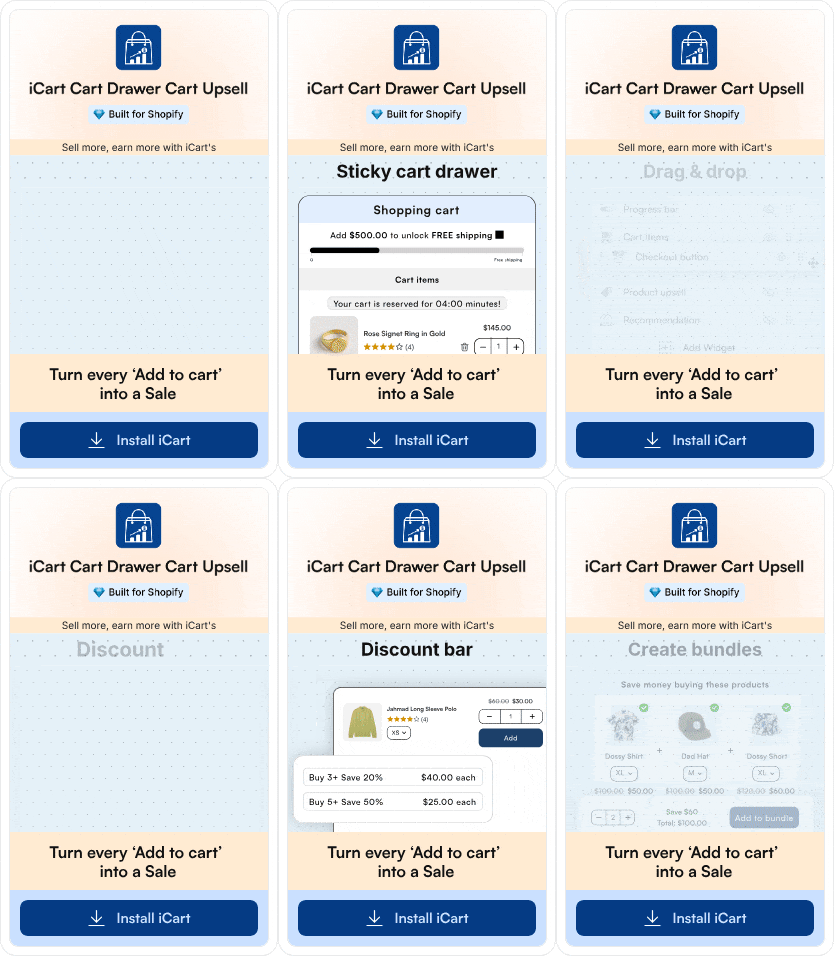
iCart Cart Drawer Cart Upsell lets Shopify merchants add cart upsells, product recommendations, bundles, volume discounts and multi-tier progress bars inside the cart without forcing shoppers to leave their buying flow.
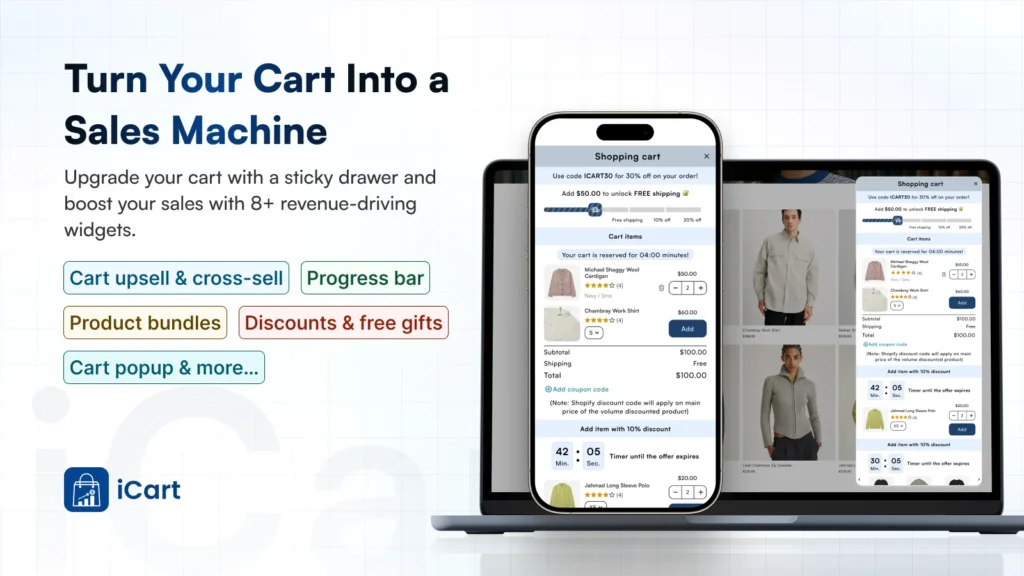
During BFCM 2025, stores using iCart recorded a 6.32% increase in AOV, with the app supporting more than 1,000 stores and 950,000 orders over the weekend. Across 2025, the progress bar generated 17.5% of iCart's widget-driven upsell revenue, while the cart drawer accounted for 78.8% of upsell revenue.
Get 50% OFF iCart for 3 months and prepare your Shopify cart before Black Friday traffic arrives.
Complete Shopify Black Friday Checklist for 2026
Instead of treating this as another list of Black Friday ideas, merchants can work through the checklist in the order below.
| Timing | What needs to be completed |
| 8 - 10 weeks before | Review previous performance, set targets and forecast inventory |
| 6 - 8 weeks before | Finalize offers, discounts, bundles and margin limits |
| 4 - 6 weeks before | Audit mobile experience, speed, apps and Shopify setup |
| 3 - 4 weeks before | Build landing pages and prepare email, SMS and paid campaigns |
| 2 - 3 weeks before | Optimize product pages, cart, upsells and free-shipping thresholds |
| 1 - 2 weeks before | Test checkout, payments, shipping, returns and support |
| Final week | Run complete purchase tests and freeze unnecessary store changes |
| During BFCM | Monitor revenue, AOV, inventory, conversion and store issues |
| After BFCM | Retain new customers and analyze what worked |
1. Review Last Year's BFCM Performance Before Planning New Offers
Before deciding whether to run 20%, 30% or 50% discounts, Shopify merchants should first understand what happened during the previous holiday season.
Compare BFCM performance with a normal sales period and record revenue, orders, conversion rate, average order value, best-selling SKUs, traffic sources, abandoned carts, returns and profit margin. Also check which products sold out too early and which discounted products were still sitting in inventory after Cyber Monday.
This prevents a common BFCM mistake: repeating last year's campaigns because revenue looked good while ignoring whether the campaigns were actually profitable.
For example, a store may discover that its 40% sitewide discount generated more revenue but reduced margin substantially. A bundle offering 15% savings might have produced a higher AOV with healthier profit.
Use those findings to define the BFCM 2026 targets before changing the storefront.
2. Set Revenue, Conversion and AOV Targets
A Black Friday checklist works better when every promotion has a measurable target.
Instead of simply deciding to “increase sales,” a Shopify merchant might aim to increase BFCM revenue by 20%, move AOV from $70 to $85, reduce cart abandonment, clear 60% of a seasonal collection, or acquire 2,000 new email subscribers.
If increasing AOV is one of the targets, the promotion strategy should be built around encouraging larger orders rather than simply increasing discount depth.
3. Build a BFCM Offer That Protects Margin
Shoppers expect value during Shopify Black Friday, but that does not mean every product needs the same discount.
A stronger promotion might combine a smaller product discount with incentives that increase order value. For example, a fashion merchant could offer 15% off selected products, free shipping above $80, a free accessory above $120, and an additional saving when customers buy three items.
A beauty merchant might combine a cleanser, serum and moisturizer into a BFCM routine bundle instead of discounting every SKU individually.
This gives shoppers a clear reason to spend more while allowing the merchant to maintain better control over margins.
If bundles are part of the strategy, Identixweb's guide to product bundling examples covers approaches such as frequently bought together, complete-the-look, BOGO, build-your-own and gift bundles.
4. Forecast Inventory Before Advertising Your Best Sellers
BFCM advertising can work too well.
If the hero product sells out on Friday morning, the merchant loses the rest of the weekend's demand and wastes campaign spend driving shoppers to unavailable inventory.
Start with previous BFCM sales, recent sales velocity, promotional lift, current inventory and supplier lead times. Give the highest priority to products that already have strong demand rather than guessing which items might suddenly become popular.
Also create a plan for low-stock products before they run out. That could mean removing them from paid campaigns, replacing them in promotional collections, suggesting an alternative, or creating bundles that distribute demand across available inventory.
Inventory specialists such as Prediko also recommend stress-testing forecasts under different demand scenarios instead of planning around one expected outcome, particularly because BFCM buying patterns differ from normal weeks.
5. Create a Dedicated Black Friday Landing Experience
Do not make customers hunt through the homepage to understand the sale.
A BFCM landing page should immediately answer five questions: what the offer is, when it ends, which products are included, why the shopper should act now, and where to start shopping.
Keep the hero simple. Then organize deals by collection, price, recipient or product category depending on how customers normally shop.
For example:
Black Friday: Up to 30% OFF + Free Gift Above $100
Follow this with “Shop Best Sellers,” “Gifts Under $50,” “Bundles,” and “Last Chance” sections instead of displaying one huge product grid.
For inspiration, see these Black Friday landing page examples from Identixweb.
6. Audit Mobile Experience and Shopify Store Speed
BFCM shoppers will not patiently work around a slow or confusing store.
Test the homepage, BFCM landing page, collection pages, product pages, cart and checkout on real mobile devices. Buttons should be easy to tap, menus should not cover content, pop-ups should be dismissible, product images should load correctly, and the cart should remain easy to use on smaller screens.
If the mobile experience needs work, use this guide to make a Shopify store mobile-friendly.
Speed deserves a separate check. Review Shopify's Web Performance reports and pay particular attention to LCP, INP and CLS. Identixweb's current Shopify app and speed audit guide explains how apps, third-party scripts, media and theme changes can affect performance.
Do not spend the week before Black Friday adding five new storefront apps without testing them. Every customer-facing widget should justify the space and resources it uses.
7. Check Two Important Shopify Changes Before BFCM 2026
This is one area where merchants relying on last year's Shopify setup can run into trouble.
Shopify Scripts Have Ended
Shopify Scripts stopped executing entirely on June 30, 2026. Merchants who previously relied on Scripts for custom discounts, shipping or payment logic need to make sure those functions have been migrated to Shopify Functions or an appropriate app before BFCM.
A legacy promotion that worked during Black Friday 2025 should therefore not be assumed to work during Black Friday 2026.
Check the Thank You and Order Status Pages
For non-Plus stores, August 26, 2026 was Shopify's deadline to upgrade legacy Thank You and Order Status pages. Stores that previously relied on incompatible scripts, pixels or legacy app customizations should review these pages before the BFCM rush.
Run at least one test order and make sure analytics, pixels, conversion tracking and post-purchase functionality still behave as expected.
8. Prepare Your Shopify Store for AI Shopping in 2026
Google is no longer the only place a shopper may discover a product.
Shopify's Agentic Storefronts can make eligible products discoverable through AI channels including ChatGPT, Google AI Mode and Gemini, Microsoft Copilot and Meta. Shopify says Agentic Storefronts are active by default for eligible stores and provide reporting for AI-driven search and sales activity.
Before BFCM, review product titles, descriptions, categories, variants, prices, images, availability, shipping information and policies. AI systems depend much more heavily on structured and accurate product information than on a dramatic Black Friday banner.
Shopify also says AI searches powered by its Catalog convert at 2x the rate of searches using scraped product data, which makes clean product information particularly relevant in 2026.
This is a worthwhile addition to a Shopify BFCM checklist because shopping discovery is no longer limited to traditional search, email and social channels.
9. Start Black Friday Email and SMS Before the Weekend
Customers will receive an extraordinary amount of promotional communication during BFCM. Sending the first email on Black Friday means competing at the noisiest possible moment.
Use the weeks before BFCM to build anticipation.
An effective sequence could move from teaser to early access, sale launch, bestseller reminder, low-stock reminder and final-hours message. Existing customers can receive different messaging from first-time subscribers, while customers who bought a particular category can receive offers relevant to that category.
The aim is not to send more emails for the sake of volume. The aim is to make each message useful at the point the shopper receives it.
For campaign examples, subject lines and timing ideas, see Identixweb's guide to Black Friday email campaigns.
10. Optimize the Cart for BFCM Revenue, Not Just Checkout
Many merchants spend weeks improving ads, email and product pages but leave the default Shopify cart untouched.
That is a missed opportunity because the cart is where shoppers have already shown purchase intent.
iCart helps you show a cart drawer, cart popup, and full cart, along with upsells, bundles, recommendations, discount options, and progress-bar rewards.
11. Test the Full Checkout Journey
Do not test only whether the “Buy Now” button works.
Run an actual purchase journey from ad or landing page through product selection, discount, cart, checkout, payment, confirmation and order-status page.
Pay particular attention to whether discount combinations behave correctly, shipping rates are accurate, Shop Pay and other intended payment options appear, inventory reduces correctly, confirmation emails arrive, tracking events fire and mobile checkout works without layout issues.
Also test every major BFCM coupon before promotion begins. A discount advertised in thousands of emails but rejected at checkout can turn a successful campaign into a customer-support problem within minutes.
12. Make Shipping Costs and Delivery Expectations Obvious
Unexpected costs remain one of the strongest reasons shoppers abandon ecommerce purchases.
During BFCM, communicate free-shipping thresholds before checkout rather than surprising customers after they have already decided to buy.
If the store has holiday shipping cutoffs, delayed dispatch times or specific delivery restrictions, place them prominently on product pages, the cart, FAQ pages and order confirmation messages.
The same applies to stores offering local pickup. Customers buying gifts often care as much about when they will receive the order as how much they save.
For additional planning around peak retail dates, see Identixweb's guide to the busiest shopping days of the year.
13. Make Returns Easy to Understand Before Customers Purchase
BFCM discounts can attract first-time customers who know less about the brand and therefore have more questions about sizing, quality, shipping and returns.
Make the return window, eligibility conditions, refund process and any exclusions easy to find before checkout.
Avoid introducing a highly restrictive BFCM-only policy without making that difference clear. Confusion may reduce trust before the first purchase and generate support tickets afterward.
If the policy itself needs work, follow this guide to creating a clear Shopify return policy.
14. Prepare Customer Support for Repetitive BFCM Questions
The support team should not spend Black Friday repeatedly investigating the same basic questions.
Create prepared answers for discount eligibility, discount stacking, delivery estimates, order changes, cancellations, returns, gift cards, international shipping and out-of-stock products.
Update the FAQ page before the campaign begins and make important answers visible within the buying journey.
If chat support is available, make sure the team can quickly access current BFCM terms. A customer asking “Can I combine this code with the bundle discount?” should not receive three different answers depending on which support agent responds.
15. Freeze Unnecessary Changes Before Black Friday
The final days before BFCM are not the ideal time for a theme redesign.
Once the major landing pages, offers, apps and tracking setup have passed testing, freeze non-essential storefront changes. Urgent fixes should still be made, but avoid introducing new code simply because someone had a last-minute design idea.
The objective during BFCM week is stability.
A store that is slightly less visually ambitious but works correctly is more valuable than a redesigned store with an unexpected checkout, tracking or mobile issue.
16. Run a Final BFCM Test Order
Before the campaign launches, assign someone who was not involved in building the promotion to shop like a customer.
Give that person a specific task such as: find a gift under $75, unlock free shipping, apply the BFCM offer, complete checkout from a phone and locate the return policy.
Watch where they hesitate.
Internal teams often know the store too well. A fresh tester can quickly expose unclear category labels, confusing offers, hidden thresholds or cart friction that everyone else stopped noticing.
17. Monitor BFCM Performance in Real Time
Once BFCM starts, avoid making decisions from revenue alone.
Track traffic, conversion rate, AOV, orders, top products, inventory, cart performance, discount usage, payment failures and marketing channel performance.
For example, if traffic increases sharply while conversion rate falls, the issue may be landing-page relevance, site performance or the offer itself.
If conversion remains healthy but AOV drops, adjust the prominence of bundles, thresholds and relevant upsells rather than immediately offering a deeper storewide discount.
If a bestseller starts running low, shift advertising and homepage space toward another product before it sells out completely.
18. Plan the Post-BFCM Campaign Before Black Friday Starts
BFCM often introduces a store to thousands of first-time customers.
The campaign should therefore continue after Cyber Monday.
Separate first-time BFCM buyers from existing customers and create a follow-up experience for each. New shoppers could receive helpful product education, complementary product suggestions, loyalty incentives or a reason to make their second purchase.
Existing customers may respond better to VIP rewards or early access to the next promotion.
The objective is to avoid buying expensive BFCM traffic only to lose the customer after one discounted order.
Shopify BFCM Checklist FAQ
1. When is Black Friday 2026?
Black Friday 2026 falls on Friday, November 27. Thanksgiving is November 26, Small Business Saturday is November 28, and Cyber Monday follows on November 30.
2. What does BFCM mean?
BFCM stands for Black Friday Cyber Monday. Ecommerce brands commonly use the term to describe the major promotional period running around Thanksgiving, Black Friday weekend and Cyber Monday.
3. When should Shopify merchants start preparing for BFCM 2026?
September is an appropriate time to start the main preparation work, particularly inventory, offer planning, store audits and campaign setup. Shopify's current 2026 Black Friday guidance organizes preparation across September, October and November rather than treating BFCM as a last-minute weekend campaign.
4. How can a Shopify store increase AOV during Black Friday?
Merchants can increase AOV with product bundles, complementary upsells, volume discounts, free-shipping thresholds and free-gift milestones. These incentives work best when customers can clearly see them while making the purchase rather than discovering them after checkout.
5. How much did Shopify merchants sell during BFCM 2025?
Shopify reported $14.6 billion in global merchant sales during BFCM 2025, a 27% increase from the prior year. More than 81 million customers purchased from Shopify-powered brands during the period.
6. Is Black Friday or Cyber Monday more important for Shopify stores?
Both are important because many merchants now treat BFCM as a connected promotional period rather than two isolated sales days. The right approach is to plan inventory, offers and marketing across the wider period and adapt promotions based on live performance rather than depending on a single day.
7. What should Shopify merchants check immediately before BFCM?
Complete an end-to-end mobile purchase, verify discounts, payment methods, shipping rates, cart offers, tracking, confirmation emails and order-status functionality. Merchants should also check inventory levels and avoid unnecessary storefront changes once the tested campaign is ready.
About the author
Sajini Annie John
Meet Sajini, a seasoned technical content writer with a passion for e-commerce and expertise in Shopify. She is committed to helping online businesses to thrive through the power of well-crafted content.