





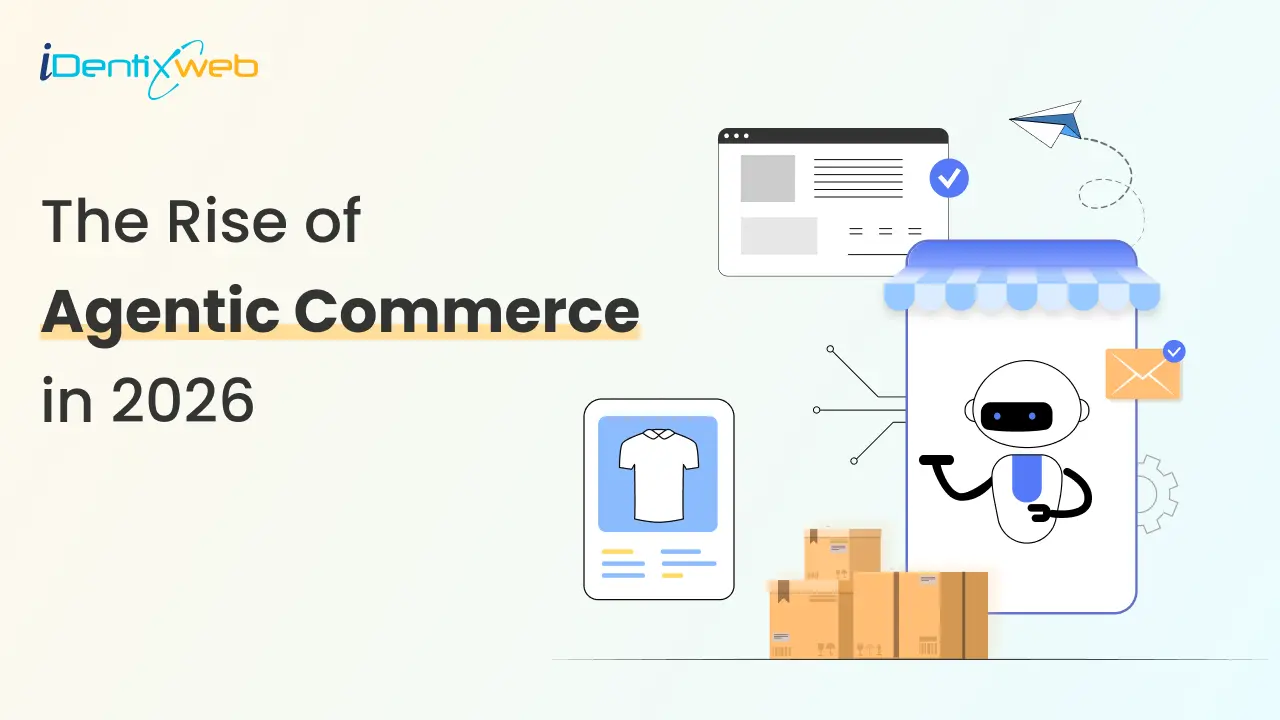
We have all been there:
- 15 tabs open.
- Comparing prices across five different sites.
- Scrolling through endless reviews to figure out what’s real and what’s a bot.
- Checking delivery dates. It’s exhausting! Right?
But what if you could hand all of that over to an assistant who actually understands your preferences, your budget and your taste? That’s exactly why agentic commerce is gearing up to be the retail trend of 2026.
If you’ve been keeping even half an eye on what’s happening in retail tech, you’ve probably seen the phrase “agentic commerce or agentic AI” popping up everywhere. And if you haven’t… well, you’re about to hear it a lot more in this blog.
What is Agentic Commerce?
Agentic commerce is a new retail model among the ecommerce trends 2025 in which different types of AI agents handle the entire shopping process on behalf of consumers. These AI agents manage everything from finding out products to comparing prices and even completing the buying process.
Instead of browsing, scrolling & deciding, artificial intelligence (AI) does your job. You just need to approve the outcome. Many retailers are now exploring custom AI agent solutions, so they can build agents tailored to their unique workflows, audience behavior and product needs.
As the adoption of agentic commerce grows, we’re also seeing the rapid rise of AI agent marketplaces platforms where businesses can access, deploy, and customize different AI agents according to their needs.
Let’s see a real-world example of buying running shoes with agentic AI

What Will Agentic Commerce Look Like?
Agentic commerce will completely change the way of online shopping. Instead of browsing, comparing & making decisions manually, shoppers will simply tell their needs & preferences, based on which AI agents will work for them and make the shopping process effortless for them. All shoppers need to do is approve for checkout to let the bots complete the buying process.

For Shoppers:
- No more endless browsing - Simply state your needs and preferences
- AI agents work for you - They research, compare, and filter options
- One-click approval - Review recommendations and approve checkout
- Stress-free experience - No information overload or decision fatigue
For Retailers:
- Smarter personalization - AI understands individual customer preferences
- Dynamic pricing - Real-time optimization based on demand and competition
- Automated customer support - AI handles common queries 24/7
- Higher conversions - Reduced friction in the buying journey
- Lower return rates - Better product matching means happier customers

Types of AI Agents
1. Learning Agents
These agents keep on learning at every stage. The more customers browse, compare, and shop, the better these agents become at predicting to suggest what they will want next.
2. Utility-Based Agents
Utility-based agents always target the “best overall value”. These agentic AI consider factors like price, delivery speed and brand value to suggest the best choice for customers.
3. Simple Reflex Agents
These agents operate on instant, rule-based decisions. They don’t think further; they just react. For example, when a price drops, they instantly notify customers about it.
4. Hierarchical Agents
These agents work in layers that separate the shopping process into multiple steps, from finding items to add to the cart. For eg, one layer understands the task, another plans & the other executes it.
5. Multi-Agent Systems (MAS)
These agents work in a team. Each agent is specialized in one or the other - some may check the price while understanding the customer preferences & combine their results.
6. Customer Service Agents
These AI agents provide instant support to customers with common questions and problems. They can check order status, handle returns, fix issues, and give instant answers anytime.
7. Marketing Agents
These types of agentic AI bots find out what individual customers want and recommend them the right products or offers at the right time. It helps brands to make their marketing more personal.
8. Reactive Agents
As the name itself says, these types of AI agents respond on the spot with real changes. They make quick decisions based only on what’s happening right now.
9. Agentic AI
AI that can take action on your behalf, not just recommend but actually plan, decide, and execute tasks.
10. Autonomous Purchasing Agents
These agents can complete the entire buying process from research to checkout, automatically (with your approval settings).
11. Collaborative Agents
These agents are designed to work with humans, not to replace them. They assist, recommend and help in decision making.
12. Conversational AI
Agents that communicate through natural language, like chat or voice. They think like humans, solve issues, help with shopping and feel like talking with a friend.

The Gaps in E-Commerce That Agentic Commerce Is Designed to Solve
Current Challenge #1: Too Many Choices
Problem: Customers face thousands of options and can't decide.
Agentic Solution: AI agents filter everything and present only the best-fit options instantly.
Current Challenge #2: High Cart Abandonment
Problem: 70% of carts are abandoned due to friction in the checkout process.
Agentic Solution: Agents can complete the entire purchase flow on behalf of the customer with one approval.
Current Challenge #3: High Return Rates
Problem: 30% of online purchases are returned due to poor product matching.
Agentic Solution: Agents learn customer preferences and recommend items that actually match their needs.
Current Challenge #4: Poor Product Discovery
Problem: Customers can't find what they really want amid noise.
Agentic Solution: Agents scan everything like prices, reviews, stock and highlight the best choices.
Current Challenge #5: Impersonal Shopping Experience
Problem: Generic recommendations feel robotic and irrelevant.
Agentic Solution: Agents add a personal touch by remembering preferences and offering tailored guidance.
Current Challenge #6: Information Overload for Retailers
Problem: Retailers struggle to process customer data into actionable insights.
Agentic Solution: Agents process data in real time and automate decisions that boost conversions.
Future of Agentic Commerce
The future of agentic commerce is heading towards a world where shopping feels almost effortless. Instead of browsing through dozens of pages, comparing prices, reading reviews, and guessing what’s best, shoppers will simply express a need, and AI will handle the rest. These agents will research products, evaluate quality, monitor prices, check availability, and even complete purchases automatically for routine items.
What's Coming:
- Proactive purchasing: AI anticipates needs before you realize them
- Voice-activated shopping: "Hey AI, restock my essentials"
- Cross-platform integration: Agents work across all your devices seamlessly
- Autonomous subscriptions: AI manages all recurring purchases at optimal prices
- Predictive recommendations: AI suggests products based on life events and seasons
The Numbers Don't Lie
As more consumers get comfortable with AI assistants and retailers invest in automation, shopping will become faster, more personalized, and far less manual. On the customer service front, Gartner forecasts that by 2029, agentic AI will autonomously resolve 80% of common service issues, leading to a 30% cut in operational costs.
Conclusion
In the coming years, we’ll see AI embedded in everyday tools, phones, browsers, and smart homes, making proactive, needs-based purchasing the new norm. Essentially, people will spend less time shopping and more time just enjoying what they buy.
And as agentic commerce grows, retailers that start early will have a major advantage. If you’re exploring how AI agents can fit into your business whether through experimentation, prototype development, or launching custom solutions our ai agent development service can help you build and scale AI agents designed for real retail performance.
Frequently Asked Questions
1. What is Agentic Commerce?
Agentic commerce is a new retail model where AI agents manage the entire shopping process on behalf of consumers, from searching and comparing products to completing purchases automatically with approval.
2. What are the different types of AI Agents?
Common types of AI agents include learning agents, utility-based agents, multi-agent systems, customer service agents, conversational AI, and autonomous purchasing agents.
3. What is an AI Agent Marketplace?
An AI agent marketplace is a platform where businesses and individuals can access, deploy, and integrate different AI agents for tasks like pricing optimization, product recommendations, marketing automation, logistics management, and autonomous purchasing.
4. Is agentic commerce safe and secure?
Yes, purchases are only made with user approval settings, and all actions are traceable. Security and transparency remain core requirements as adoption grows.
5. How will agentic commerce impact retailers?
Retailers can expect reduced cart abandonment, improved personalization, fewer returns, faster decision-making, automated support, and better conversions through intelligent shopping automation.
6. Will agentic commerce replace human shopping entirely?
No. Agentic commerce is designed to assist and enhance the shopping experience, not replace human judgment. Consumers remain in control and can intervene at any point in the process.




About the author
Sajini Annie John
Meet Sajini, a seasoned technical content writer with a passion for e-commerce and expertise in Shopify. She is committed to helping online businesses to thrive through the power of well-crafted content.